
 Neng Nana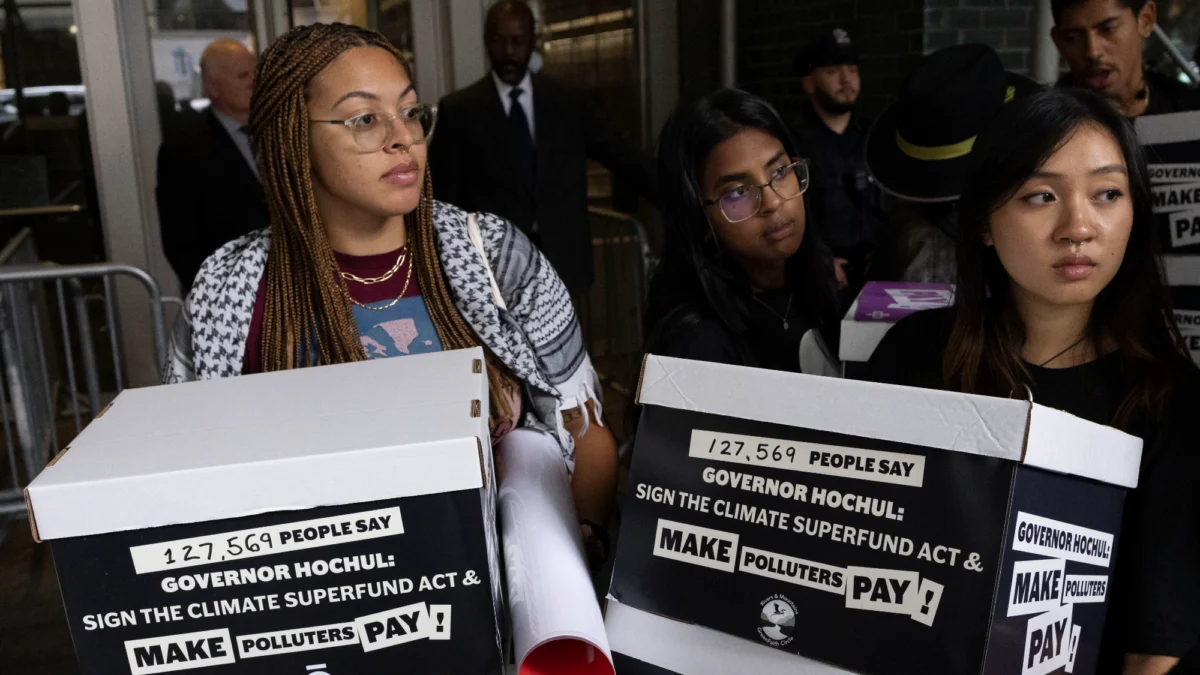
In a major legal victory for the fossil fuel industry and the Trump administration’s “energy dominance” agenda, a federal judge has struck down New York’s Climate Change Superfund Act. The ruling, delivered on Monday by Chief Judge Brenda Sannes of the U.S. District Court for the Northern District of New York, effectively halts a landmark piece of legislation that aimed to hold major oil and gas companies financially accountable for the massive infrastructure costs associated with climate change.
The decision has sent shockwaves through environmental policy circles, casting a shadow over similar “polluter pays” legislation in other states and intensifying the ongoing legal battle between state-level climate action and federal preemption.
The Core of the Conflict: What was the Climate Superfund Act?
Passed in 2024, New York’s Climate Change Superfund Act was designed to be a transformative fiscal mechanism. It sought to extract $75 billion from major fossil fuel producers over the course of 25 years. The logic was simple but ambitious: those who profited from the sale of products that historically contributed to greenhouse gas emissions should be required to help foot the bill for the physical damage those emissions cause.
The funds were earmarked for critical climate-adaptive infrastructure. Under the law, the state would have utilized the $75 billion to modernize aging sewage treatment plants, fortify stormwater drainage systems against increased flooding, upgrade electrical grids to withstand extreme heat, and reinforce transit systems against rising sea levels.
For proponents, the law was a matter of basic fairness. As climate disasters become more frequent and costly, the financial burden has largely fallen on taxpayers and local municipal budgets. The Superfund Act aimed to shift that weight toward the entities that researchers and activists argue have known for decades about the link between their products and global heating.
Legal Chronology: From Legislative Triumph to Judicial Halt
The road to this week’s ruling was paved with intense litigation and political maneuvering.
- May 2024: Vermont passes the nation’s first Climate Superfund Act, setting a precedent that other states, including New York, quickly moved to emulate.
- Late 2024: New York follows suit, passing its own version of the bill amid a wave of public pressure and advocacy from environmental coalitions.
- December 2024: The U.S. Chamber of Commerce and the American Petroleum Institute (API) launch a coordinated legal assault against Vermont, arguing that state laws targeting global emissions are unconstitutional.
- July 2026: During a pivotal hearing in the New York case, Judge Sannes exhibits clear skepticism regarding the constitutionality of the state’s law, questioning whether federal precedents—specifically a 2021 ruling regarding climate damages—effectively stripped the state of its jurisdiction.
- August 31, 2026: Judge Sannes issues her 63-page opinion, officially declaring the New York act preempted by the federal Clean Air Act.
- September 2026: The Department of Justice, now operating under a distinctively deregulatory mandate, publicly applauds the decision, marking a significant alignment between the federal government and industry interests.
The Judicial Rationale: Why Did the Court Rule Against New York?
In her comprehensive 63-page opinion, Judge Sannes centered her argument on the principle of federal preemption. She characterized the Climate Change Superfund Act as a “sprawling” and “unusual” statute that attempted to legislate in an area—international climate policy—that remains the exclusive purview of the federal government.
“The Climate Act is an unusual and sweeping statute, designed to address the effects of climate change—a ‘uniquely international problem of national concern,’” Sannes wrote. “Thus, the Court finds the Climate Act is ‘simply beyond the limits of state law.’”
The ruling relied heavily on the interpretation of the Clean Air Act. The court held that by attempting to levy damages based on cumulative greenhouse gas emissions, New York was effectively attempting to regulate air quality on a global scale, an authority the court argued was never granted to individual states. Furthermore, the decision leaned on the 2021 Second Circuit ruling in a case where New York City had sued fossil fuel companies for climate damages—a case that the city ultimately lost.
However, legal scholars are divided on the weight of that precedent. Patrick Parenteau, a law professor and Climate Policy Fellow at Vermont Law School, noted that the 2021 decision is not binding in the current context. “It has been severely criticized by other federal and state courts,” Parenteau observed. “Judge Sannes should not feel bound by it.”
Official Responses: A Sharp Political Divide
The reaction to the ruling has been as swift as it has been polarized.
The Federal Stance: "Protecting Energy Dominance"
The Department of Justice, led by the newly rebranded Energy and Natural Resources Division, positioned the ruling as a victory for national economic interests. Principal Deputy Assistant Attorney General Adam Gustafson hailed the decision as a fulfillment of President Trump’s executive orders.
“The Department of Justice is delivering on President Trump’s order to protect American energy from state overreach,” Gustafson said in a statement. He argued that the New York law amounted to an “expropriation” of $75 billion that would have hindered energy companies during an “energy emergency.” He further asserted that the state’s efforts were in “direct defiance of American foreign policy.”
The Advocacy Stance: "The Costs Will Not Disappear"
Environmental groups, who have mobilized thousands of activists to push for these laws, expressed profound disappointment. For these organizations, the legal setback does not alter the physical reality of the climate crisis.
“The floods will still come, roads will still wash out, and communities will still need billions to protect themselves,” said Cassidy DiPaola, Communications Director for the coalition Make Polluters Pay. “Those costs don’t disappear just because fossil fuel companies don’t want to pay them.”
Implications for Future Climate Policy
The implications of this ruling extend far beyond New York’s borders. Currently, 13 other states are evaluating similar legislation. The ruling has provided a roadmap for industry lobbyists to challenge these bills before they even reach the governor’s desk.
In New Jersey, for instance, Senator Michael Testa has already leveraged the ruling to push back against pending legislation, warning his colleagues that the state “should pay close attention” to the New York outcome. “Our state’s similar bill should go no further,” Testa said. “It’s a waste of time and resources.”
However, the legal landscape remains unsettled. With the Vermont case still pending and the potential for an appeal by New York Attorney General Letitia James, the final word on state-level climate accountability has not yet been spoken.
The Path Forward
The conflict highlights a fundamental tension in American governance: who pays for the transition to a climate-resilient future? As federal courts continue to favor an interpretation of the law that shields industry from state-level liability, the pressure is shifting back to the legislative branches.
If states are to succeed in holding fossil fuel companies accountable, they may need to refine their legal strategies, focusing more narrowly on specific, localized damages rather than the broader, systemic issue of cumulative global emissions. Until then, the “polluter pays” movement faces a significant uphill battle in a federal judiciary that appears increasingly wary of state-led environmental intervention.
For now, the decision stands as a formidable barrier, reinforcing the dominance of federal oversight and leaving states like New York to navigate a future of climate-related infrastructure costs with a significantly depleted toolkit.


 Raul Delapena Setiawan
 Laily UPN
 Reynand Wu
 Sagoh
Sagoh

 Azzam Bilal Chamdy
 Ali Ikhwan