
 Reynand Wu
For years, many marketing departments—Semrush included—approached data studies with a "when we have time" mentality. Research was often treated as an intermittent vanity project, sparked by a sudden flash of inspiration or a quiet lull in the production calendar. The result was predictable: one or two heavy, 80-page PDFs published annually, which would briefly spike in interest before fading into the digital archives.
However, in an era where AI-generated content threatens to commoditize information, the value of proprietary, original research has never been higher. Transitioning from sporadic data drops to an "always-on" engine of thought leadership is no longer a luxury—it is a competitive necessity. This article explores the blueprint for transforming data studies into a repeatable, scalable growth channel.
The Strategic Imperative: Why Data Studies Demand Your Budget
In a landscape saturated with recycled opinions and AI-repurposed blog posts, original data serves as a distinct competitive advantage. It is a rare asset that creates something entirely new. When you publish a study, you aren’t just summarizing existing knowledge; you are expanding the industry’s collective understanding.
The Business Case
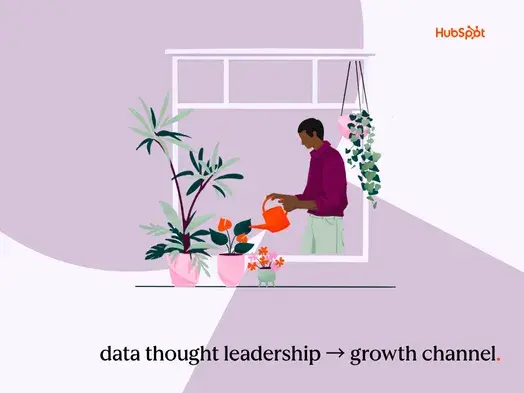
Beyond the pursuit of brand awareness, data-driven thought leadership functions as a top-of-funnel powerhouse. When executed correctly, a robust data program yields:
- Authority and Trust: Data provides empirical support for your brand’s perspective, positioning you as an industry expert rather than a vendor.
- Backlink Acquisition: High-quality research is the "gold standard" for earning organic citations from credible journalists and industry influencers.
- Lead Generation: Beyond visibility, these reports serve as lead magnets that drive qualified traffic and, ultimately, new business acquisitions.
Since Semrush formalized its data-driven thought leadership, the program has moved beyond simple vanity metrics. It now consistently attracts thousands of unique visitors without the need for paid promotion, drives hundreds of webinar or whitepaper registrations, and contributes directly to new customer acquisition.
Chronology of Transformation: Building the Engine
The shift from sporadic output to a systematic program did not happen overnight. It required a fundamental pivot in organizational philosophy.
Phase 1: Securing Official Priority
Before a single data point is collected, the program must have executive buy-in. It requires cross-functional coordination, specifically between the marketing team and data science. At Semrush, this meant establishing a Directly Responsible Individual (DRI) within the marketing team and ensuring that the data science department had dedicated capacity to support these initiatives.
Phase 2: The Research Content Plan
A data strategy without a roadmap is just noise. Every quarter, the research plan is audited against three pillars:

- Industry Trends: What is happening in the market that our data can clarify?
- Product Roadmap: How can our proprietary data showcase the efficacy or necessity of our tools?
- Customer Pain Points: By interviewing users, we identify the questions they are asking that no one else is answering.
Phase 3: The "So What?" Filter
The most critical error teams make is publishing data for the sake of data. If the findings do not offer practical utility, they are destined to be ignored. We implemented a mandatory "So What?" filter for every project. If the data cannot lead to a specific takeaway, a playbook, or a strategic shift in how a user operates, it is scrapped. We prioritize the "why, what, and how" to ensure the data is actionable.
Supporting Data: Operational Frameworks
To maintain velocity, the production process must be categorized. Not all studies require the same resource intensity. Semrush categorizes its research into four distinct buckets:
- Category 1: Internal Data Science Studies. These are heavy-lift projects requiring deep engineering resources and defined, rigorous briefs.
- Category 2: Expert Collaborations. Partnering with industry analysts allows for an outside perspective and significantly increases reach within niche communities.
- Category 3: Lightweight Marketer-Led Analyses. Surveys and agile analyses that bypass the engineering queue, allowing the team to react to breaking industry trends in real-time.
- Category 4: Co-Branded Research. While time-intensive, this is the most rewarding in terms of ROI. By combining datasets with partners—such as the recent Semrush-LinkedIn collaboration—we can uncover insights that neither company could have generated in isolation.
The LinkedIn partnership, which analyzed how AI tools surface content, became the most viral research piece in company history. It was cited by major media outlets, amplified by influencers, and repurposed into dozens of smaller content assets, proving that data-sharing is a multiplier for distribution.
Official Responses and Tactical Execution
The success of a study is often determined after the "Publish" button is pressed. An effective distribution engine is not an afterthought; it is planned during the brief.
The Distribution Playbook
To ensure each study has a long life cycle, we utilize a multi-channel approach:
- Newsjacking: Identifying current industry conversations and inserting our data as the definitive source of truth.
- Influencer Outreach: Providing early access to data to key voices in the industry.
- Newsletter and Community Engagement: Distributing bite-sized insights to existing subscribers.
- Repurposing: Breaking a 40-page report into 10+ social media threads, infographics, and short-form video scripts.
Measurement: Finding the Balance
Measurement is often the final hurdle. The trap is either measuring nothing or obsessing over granular data that misses the bigger picture. We focus on:
- Earned Media: The number of unique domains linking to the report.
- Direct Traffic: How many users visit the report as a result of referral or social signals.
- Downstream Impact: While we track new MRR where possible, we view data studies primarily as a brand-building and trust-earning exercise. The impact is cumulative; it builds over years, not weeks.
Implications: The Future of Thought Leadership
As AI-driven content becomes the baseline for the internet, the human-centric nature of original research will only become more valuable. However, the window of opportunity is closing. As competitors realize the value of data-backed storytelling, the market will become more crowded.
The implication is clear: differentiation is the new currency.
It is no longer enough to be the only company with data; you must be the company that best interprets that data for your audience. Organizations that treat their data as a core product—investing in the infrastructure, the talent, and the editorial rigor required to turn numbers into narratives—will dominate the conversation in the coming decade.
Final Takeaways for Your Team
You do not need an entire department to start. Begin with one experiment. Validate the model by showing how a single study can influence a prospect’s perception or drive a spike in organic traffic. Once you have a "win," build the system around it.
The goal of a data program is not just to count things; it is to tell a story that your competitors cannot. By aligning your data with your brand strategy and your customers’ deepest needs, you transform your marketing from a cost center into an authoritative, indispensable industry resource.



 Iffa Jayyana
 Raul Delapena Setiawan

 Sagoh
Sagoh

 Azzam Bilal Chamdy
 Ali Ikhwan