
 Azzam Bilal Chamdy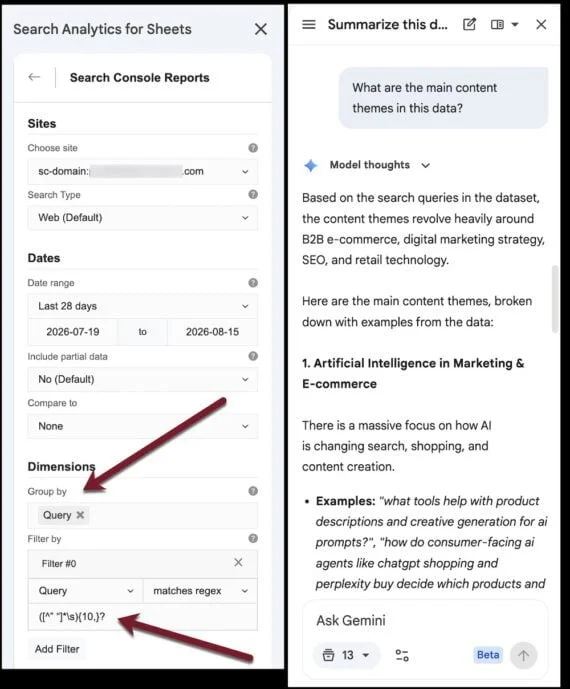
For nearly four years, the digital marketing industry has operated in a state of data-starved uncertainty. Since the meteoric rise of ChatGPT in late 2022, followed by competitors like Claude and Gemini, SEO professionals have been forced to play a guessing game. We have tracked the evolution of search behavior, yet we have lacked a granular view into the "black box" of generative AI interactions. How are consumers actually prompting these models? What follow-up questions are they asking? And, most importantly, how are these interactions impacting the visibility of our content?
For years, the industry relied on traditional search query data to infer genAI trends, a practice that was akin to reading tea leaves. While Bing offered a sliver of transparency through its "Grounding Queries" reporting, Google remained notoriously tight-lipped. However, a recent confirmation from within the SEO community has fundamentally shifted our understanding: Google Search Console (GSC) is indeed capturing AI Mode interactions, including both initial and follow-up prompts, as search queries.
This revelation provides a critical new lever for SEO practitioners to pull. By learning to filter and interpret this data, marketers can finally gain a glimpse into the conversational intent driving traffic—or lack thereof—in the age of AI.
The Chronology of the "AI Mode" Discovery
The path to this discovery was paved by the investigative spirit of the SEO community. The confusion began when SEO managers started noticing anomalous, conversational "queries" appearing in their Google Search Console performance reports. These were not the typical keyword strings associated with commercial or informational intent; instead, they looked like snippets of a chatbot conversation.
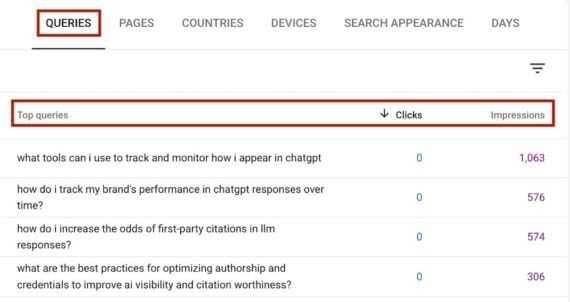
Terms such as "yes," "yes, pricing," or long-form, multi-sentence questions were appearing in GSC reports, often characterized by high impressions but zero click-throughs.
Anastasia Kourou, an SEO Manager at the Greece-based Relevance Digital Agency, took the initiative to seek clarity. In a direct inquiry on LinkedIn, she tagged Google’s Search Advocate, John Mueller. She presented the evidence: GSC was listing highly specific, conversational, and AI-like prompts as standard search queries.
In a move that confirmed what many had suspected, Mueller replied to the inquiry, explicitly stating that these were indeed follow-up prompts from users engaging with Google’s "AI Mode." This confirmation was the missing piece of the puzzle. It validated that the "noise" in our Search Console data was, in fact, a signal—a direct window into how users interact with Google’s generative AI features.
The Mechanics of AI Search Data
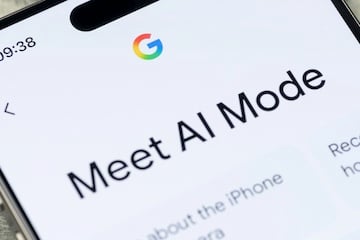
To understand why this is happening, one must understand how Google integrates its Search Generative Experience (SGE) or "AI Mode." When a user engages with AI-powered search, the interaction is not a singular event. It is a dialogue.
- The Initial Prompt: The user enters a complex question or a request for a comparison.
- The Response: The AI generates a summary or a list.
- The Follow-up: The user asks a clarifying question, such as "Can you refine that?" or "What about the pricing for the premium version?"
Google’s infrastructure treats these inputs as search activity. Because these prompts are recorded as queries, they populate in the Performance report. However, they lack the traditional "click" metric because, in many cases, the user never leaves the search engine results page (SERP). The AI provides the answer directly within the interface, resulting in a high-impression, zero-click event.
How to Isolate and Analyze AI Prompts
Because these queries are buried among millions of traditional keyword searches, finding them requires a targeted approach. Manual filtering is insufficient; the key lies in leveraging Regular Expressions (regex) to identify the specific patterns inherent in conversational AI prompts.
1. Utilizing Regex in Search Console
The built-in filtering tools within Google Search Console are surprisingly powerful if you know how to configure them. To begin, navigate to the "Performance" tab and select "Add filter" > "Query" > "Custom (regex)."
To identify long, conversational queries, use the following regex string:
([^" "]*s)10,?
This filter isolates queries that contain at least 10 words. Since standard search queries are typically concise (usually 2–4 words), long strings are often a primary indicator of a generative AI prompt.
2. Identifying Follow-Up Prompts
As noted by SEO strategist Jean-Christophe Chouinard of Tripadvisor, simple length-based filtering isn’t enough. Many AI prompts are short, conversational follow-ups. Expanding your regex to include phrases like "tell me more," "is there a cheaper version," or "yes, please" is essential for capturing the full scope of user engagement.
3. Leveraging External Tools for Deeper Analysis
While GSC’s front-end interface is useful for spot-checking, it is limited. The Search Console API offers significantly more depth, and third-party tools can act as an interface to extract and process this data at scale.
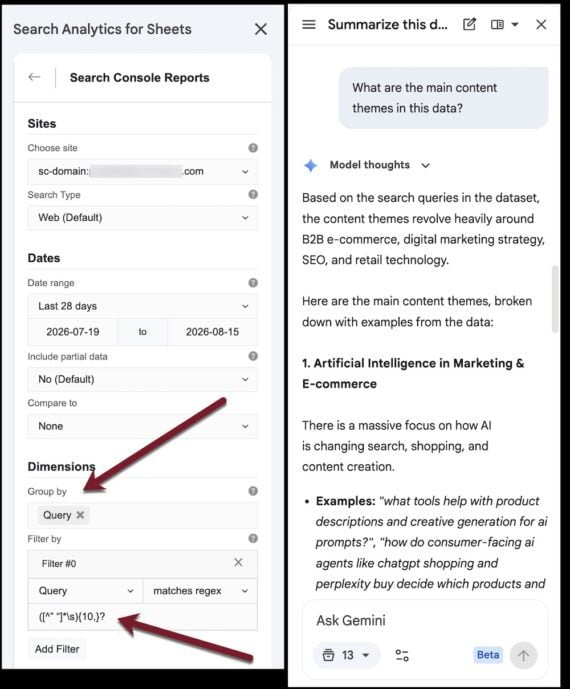
"Search Analytics for Sheets" is a widely utilized tool that allows users to export up to 25,000 queries directly into a spreadsheet. By pulling this volume of data, you can use built-in AI models (like Gemini) to cluster the queries into thematic groups. This allows you to identify not just individual prompts, but the topics that users are asking AI about in relation to your brand.
Official Responses and Industry Implications
The implications of this data discovery are profound. For years, the "zero-click" trend has been a point of contention for publishers. Now, we have evidence that the search ecosystem is evolving from a navigational tool into a conversational one.
When Google’s John Mueller confirmed the nature of these queries, he implicitly underscored the importance of transparency in the AI era. While Google has not yet provided a dedicated "AI Mode" filter within the GSC dashboard, the ability to manually isolate this data allows SEOs to start building their own benchmarks.
We are currently witnessing a shift in the definition of "SEO." It is no longer just about optimizing for keywords; it is about optimizing for answers and dialogue. If your brand is appearing in these conversational queries, it suggests that your content is being used to "ground" the AI’s responses.
Strategic Implications: How to Act on the Data
Once you have identified these AI-driven prompts, what do you do with them? The strategy for "AI-prompt optimization" differs significantly from traditional SEO.
A. Treat Prompts as Content Briefs
If you see users asking specific questions like, "What tools can I use to monitor my AI appearance?" and your site has high impressions for that query, you have identified a content gap. The user is asking the AI a question because they want a direct answer. If the AI is struggling to answer that question comprehensively, your content should be updated to provide that definitive, structured answer.
B. Monitor Competitor Tracking
Some of the long, strange queries you see may not be from human users at all. They may be the result of automated prompt-tracking software used by your competitors. Monitoring these can be incredibly valuable; if a competitor is constantly pinging AI models with questions about your pricing, services, or technical specs, you can gain insight into their strategic focus.
C. Shift to Semantic Optimization
Traditional keyword density is becoming less relevant. AI models are trained on semantic connections. By analyzing the "follow-up" prompts in your data, you can see how users connect ideas. If a user asks about "Product X" and then follows up with "Is it compatible with Y?", ensure your content on "Product X" explicitly addresses compatibility with "Y" in a way that is easily parsable by an LLM.
D. Focus on "Answer-First" Structure
Since AI models often pull from the first few paragraphs of a page to generate their summaries, your content structure should prioritize the "bottom line" upfront. Use clear headers and concise, informative lists. By providing the answer in a format that is easy for a machine to read, you increase the likelihood that your content will be the source of truth for the AI’s response.
The Future of Search Analytics
The revelation that Google Search Console contains data on generative AI interactions is a turning point for the SEO industry. While we are still in the early stages of learning how to interpret this "conversational data," the tools and methods are now available to those willing to look.
We are moving into an era where the boundary between a search engine and an AI assistant is non-existent. As search behavior continues to mirror the way we talk to one another, our metrics must evolve. By embracing regex-based filtering, leveraging external API tools, and treating conversational queries as legitimate content requirements, SEO professionals can regain their footing in an increasingly automated landscape.
The data is there. The "invisible" prompts are no longer hidden—they are simply waiting to be analyzed. The brands that learn to decode these conversations today will be the ones that own the AI-driven search results of tomorrow.


 Reynand Wu
 Iffa Jayyana
 Raul Delapena Setiawan

 Sagoh
Sagoh

 Ali Ikhwan