
 Raul Delapena Setiawan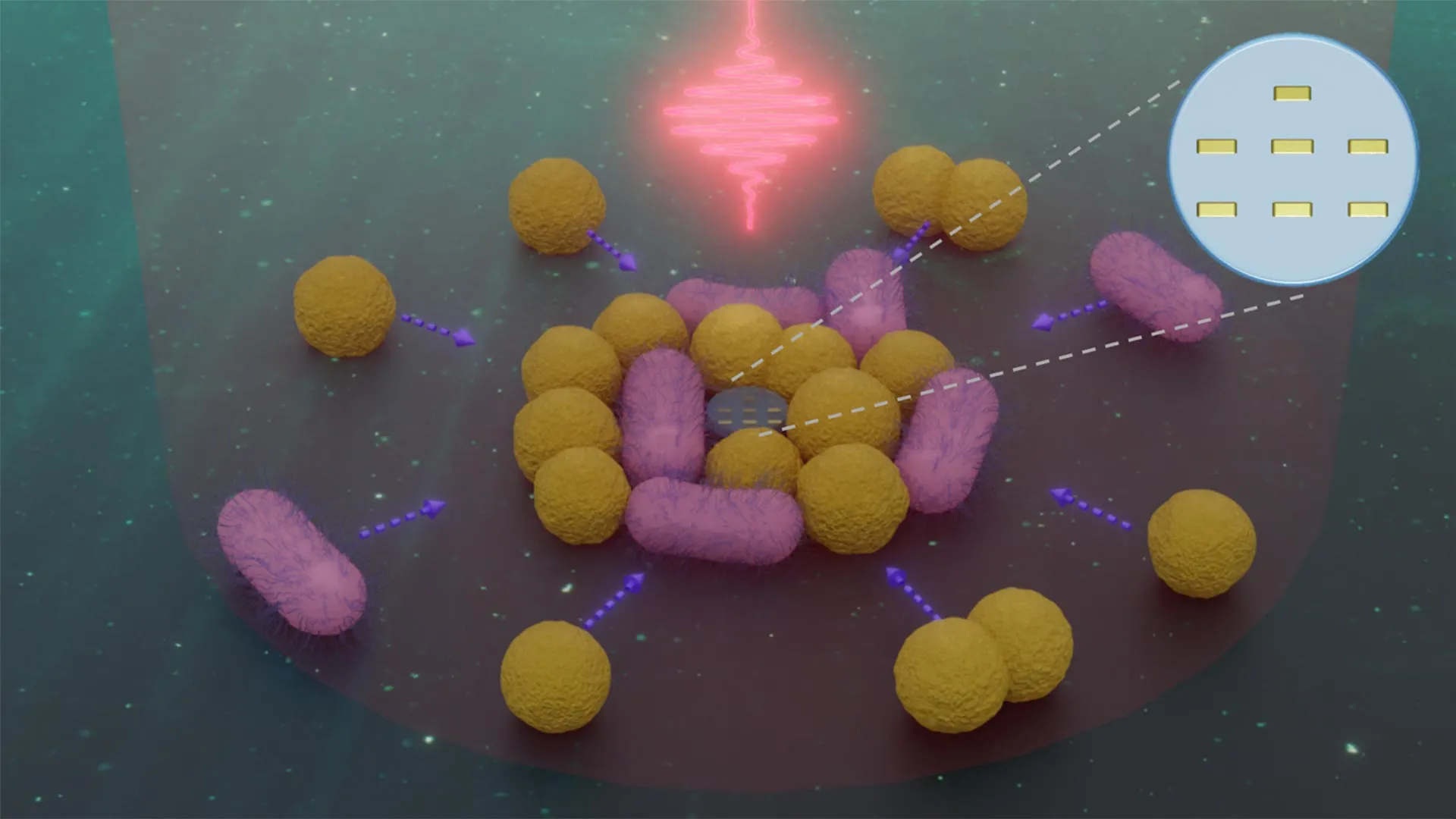
In a breakthrough that bridges the gap between science fiction and tangible engineering, researchers at Julius-Maximilians-Universität Würzburg (JMU) have unveiled a new class of light-propelled nanorobots capable of operating within the microbial realm. Measuring less than one micrometer—approximately 50 times smaller than the diameter of a human hair—these devices represent a monumental shift in our ability to interact with the microscopic world. By harnessing the fundamental physics of photon recoil, scientists have created "microscopic cleaners" that can track, capture, transport, and release individual bacteria, opening unprecedented avenues for biomedical research and precise material manipulation.
Main Facts: Engineering at the Limit of Light
The core innovation behind the JMU team’s success lies in the marriage of plasmonic physics and micro-engineering. For decades, the primary challenge in nanotechnology has been propulsion: how does one power a device that is too small for batteries, motors, or chemical fuels?
The team, led by Professor Bert Hecht, turned to the recoil of photons. When light is absorbed and then re-emitted by plasmonic nanoantennas embedded within the robot, it generates a physical force. Much like the recoil experienced when firing a firearm, the redirection of each photon provides a tiny, measurable thrust. Because these nanorobots possess an incredibly low mass, this infinitesimal force is sufficient to propel them at significant speeds.
The robots are equipped with nanoscale antenna wires that serve dual purposes: they facilitate propulsion and act as a sophisticated steering mechanism. By adjusting the polarization of incoming light, researchers can dictate the orientation of the nanorobot. As the wires align with the light’s polarization, the robot turns, allowing for precise navigation through aqueous environments.
Chronology: A Trajectory Toward the Microscopic
The path to this achievement has been a decade-long endeavor in the field of nano-optics.
The Foundational Years
Initial research into plasmonic antennas began with stationary experiments, where researchers demonstrated that light could manipulate the movement of nanoparticles. However, the transition from moving simple particles to autonomous, functional "drones" required significant advancements in nanofabrication.
The Scaling Phase
Several years ago, the JMU team first successfully demonstrated the concept of photon-recoil propulsion. At that stage, the devices were significantly larger and required complex external setups. The focus then shifted toward miniaturization. The researchers systematically stripped away redundant components, realizing that they could use the robot’s own structural antennas for steering, rather than relying on external, energy-heavy guidance systems.
The Breakthrough
In the most recent iteration of their work, the researchers succeeded in shrinking the robots to under one micrometer. This size threshold is critical; it is the scale at which bacteria and individual cells operate. By reaching this dimension, the robots were finally able to interact with biological entities without the disruptive fluid dynamics that plague larger objects at the microscopic scale.
Supporting Data: Physics and Performance Metrics
The efficiency of these nanorobots is rooted in the precision of their design. Each robot contains up to four plasmonic nanoantennas, which are engineered to respond to specific light frequencies.
- Propulsion Physics: The recoil force generated is proportional to the intensity and directionality of the emitted light. By managing the helicity and polarization of the light source, researchers achieve a propulsion-to-drag ratio that allows for sustained movement in water—a medium that, at the micro-scale, behaves with the high viscosity of thick honey.
- Maneuverability: The robots exhibit high-agility turning capabilities, often executing 90-degree turns within fractions of a second. This maneuverability is essential for "scanning" samples, allowing the robots to cover large areas of a petri dish or slide to identify target bacteria.
- Payload Capacity: While the speed of the nanorobots is reduced when carrying clusters of bacteria due to increased drag, the structural integrity of the motion system remains intact. The robots demonstrate a robust ability to "tether" bacteria, transporting them across microscopic distances to specific coordinates.
Official Responses and Expert Perspectives
The lead experimental scientist on the project, Jin Qin, highlights the functional nature of these devices. "In essence, we have built a light-driven nanorobot that can track down and collect bacteria," Qin states. "By simplifying the design, we reached a size at which these robots can operate directly in the microbial world—almost like microscopic cleaning devices."
Professor Bert Hecht, who has been a driving force behind the project, emphasizes the broader implications of the work. "This is a striking example of how light can be used not only to observe the microscopic world, but also to actively shape it," says Hecht. "The idea of tiny robotic cleaners may sound futuristic, but we are already demonstrating the physical principles that make it possible."
The research team notes that while these robots currently operate in highly controlled laboratory conditions, the consistency of the results suggests that the technology is scalable. The peer-reviewed findings have been met with enthusiasm in the physics and bioengineering communities, as they provide a concrete solution to the long-standing "propulsion problem" in micro-robotics.
Implications: The Future of the Microbial Frontier
The ability to directly manipulate the microbial world holds profound implications for several critical sectors.
Advancements in Biomedical Research
Currently, medical research often relies on bulk sampling or indirect observation through microscopes. With nanorobotic intervention, scientists could eventually perform "micro-surgery" on individual cells. This includes the targeted delivery of medication, the extraction of specific cellular components for biopsy, or the assembly of synthetic biological structures.
Environmental Remediation
The concept of a "microscopic cleaner" could be scaled to address water contamination. If these robots can be deployed in larger swarms, they could theoretically be programmed to identify and isolate harmful pathogens in water supplies, effectively "scrubbing" samples of bacteria without the need for chemical agents that might alter the water’s chemical balance.
Material Science and Nanofabrication
Beyond biology, these robots offer a new tool for "bottom-up" manufacturing. By placing microscopic components in specific configurations, researchers could build complex, tiered materials atom-by-atom or cell-by-cell. This would represent a departure from traditional manufacturing, which often relies on the etching or removal of material.
Challenges Ahead
Despite the excitement, the team remains grounded. Scaling the production of these robots—moving from a handful of devices to thousands—remains a hurdle. Furthermore, transitioning from a laboratory setting (where light can be precisely focused) to a real-world environment (where light might be scattered by complex biological tissues) will require significant advancements in optical technology and, potentially, the development of infrared or fiber-optic guidance systems.
Conclusion: A New Lens on the Invisible
The work conducted at Julius-Maximilians-Universität Würzburg serves as a testament to the power of fundamental research. By focusing on the interplay between light and matter at the smallest possible scales, Professor Hecht and his team have provided a new "hand" for humanity—a tool that allows us to reach into the invisible, manipulate the fundamental building blocks of life, and reshape the microscopic landscape.
As we look toward the future, these light-powered microdrones stand as a bridge between the macroscopic world of human intent and the microscopic world of biological action. The goal of interacting directly with the microbial world is no longer a distant theoretical ambition; it is an active, ongoing reality that promises to redefine the boundaries of what is possible in medicine, technology, and beyond. Whether they act as microscopic cleaners in a lab or the precursors to complex nanobots of the future, these devices represent one of the most significant leaps in engineering in the 21st century.


 Neng Nana
 Evan Lee Salim

 Reynand Wu
 Sagoh
Sagoh

 Azzam Bilal Chamdy
 Ali Ikhwan