
 Iffa Jayyana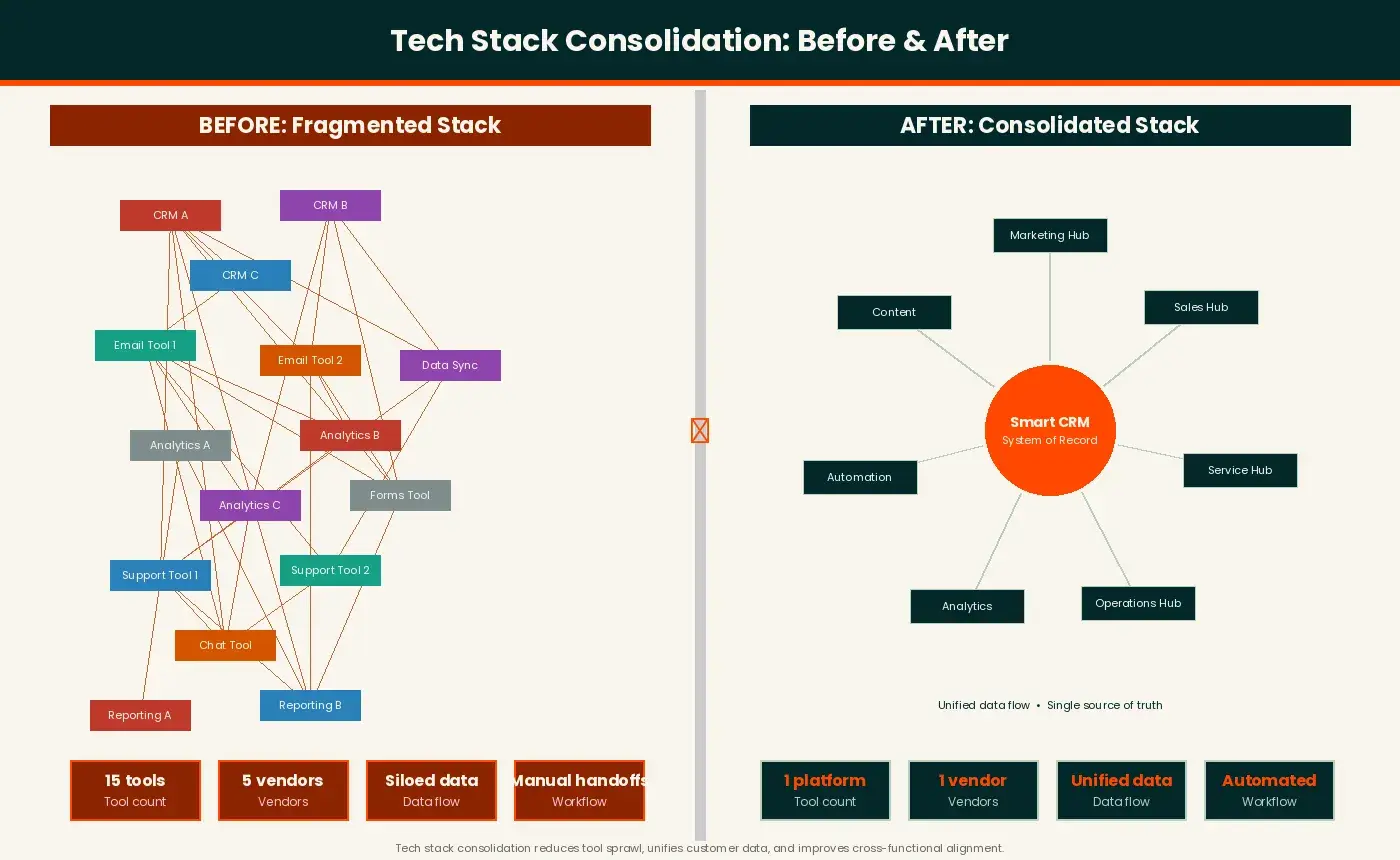
In the modern digital economy, the adage "more is better" has proven to be the undoing of many high-growth organizations. As businesses sprint to adopt the latest SaaS solutions to solve departmental pain points, they frequently find themselves trapped in a labyrinth of "tool sprawl." Tech stack consolidation—the process of retiring redundant software and standardizing operations on a unified, integrated core—has emerged as the definitive strategy for businesses looking to scale efficiently.
This isn’t merely a cost-cutting exercise; it is an architectural overhaul. By collapsing fragmented systems into a single source of truth, organizations are reclaiming lost productivity, eradicating data silos, and providing their teams with a coherent view of the customer lifecycle.
The Anatomy of Tool Sprawl: A Growing Crisis
The modern enterprise tech stack has become bloated. With departments often purchasing software independently—a phenomenon known as "Shadow IT"—organizations frequently find themselves paying for five different tools that perform essentially the same function.
According to recent data from Gartner, software expenditure continues to climb despite economic headwinds, driven by the unchecked proliferation of niche applications. When data lives in disparate silos, the "customer journey" is effectively broken. Marketing teams report on metrics that don’t match Sales’ CRM data, and Service agents are left scrambling to reconstruct a customer’s history. This fragmentation creates friction that ripples across the entire business, leading to disjointed customer experiences and operational paralysis.
The Strategic Foundation: Establishing a System of Record
At the heart of successful consolidation lies the CRM. It serves as the "System of Record," the centralized repository where every customer interaction—from the first website visit to the final contract renewal—is captured, stored, and analyzed.
By designating a core CRM platform, organizations shift from a reactive stance to a proactive one. When the CRM powers workflows across Marketing, Sales, and Service, the benefits are immediate:
- Unified Reporting: No more reconciling conflicting definitions of an "active customer" before board meetings.
- Seamless Automation: Lead scoring, nurturing, and lifecycle transitions occur automatically across departments.
- Enhanced Context: Reps and agents gain a 360-degree view of the customer, eliminating the frustration of asking clients to repeat information.
Chronology of an Effective Consolidation
For organizations ready to reclaim their operational efficiency, a structured, 90-day execution plan is the gold standard.

Phase 1: Audit and Alignment (Days 1–30)
The first step is a comprehensive audit. Leadership must pull a complete inventory of every tool currently in the organization’s portfolio. This includes central procurement software, departmental subscriptions, and shadow IT.
During this phase, teams must document the "Who, What, and Why" of every tool. Who owns the contract? What is the annual cost? When is the renewal date? Most importantly: How does it contribute to the current data flow? By the end of the first month, the organization should possess a "Master Tool Inventory" and a clear set of data standards (naming conventions, deduplication rules, and lifecycle definitions).
Phase 2: Prioritization and Planning (Days 31–60)
With the audit complete, leadership must score tools based on utility and redundancy. This is the stage where "quick wins" are identified—retiring low-utilization tools that provide minimal value.
During this window, integration maps are validated. If a tool is slated to be retired, the team must ensure that the core platform (the CRM) can absorb the essential workflows without creating gaps. Communication is critical here; affected teams must be brought into the process early to mitigate resistance and ensure buy-in for the upcoming transition.
Phase 3: Execution and Governance (Days 61–90)
The final phase focuses on migration, training, and the establishment of long-term governance. Pilot programs for the first round of retirements should be launched, with success measured not just by cost savings, but by adoption rates and workflow stability.
Post-day 90, the organization must implement a formal "Intake Process." Any new software request must now pass through a gatekeeper who verifies that the tool doesn’t replicate existing capabilities. This is how organizations prevent the inevitable return of sprawl.
Supporting Data and Operational Implications
The case for consolidation is supported by the direct correlation between system integration and business velocity.

- For Marketing: Attribution accuracy increases when every touchpoint feeds into a single platform, allowing for precise ROI calculations.
- For Sales: By eliminating tool-toggling, reps gain back hours of manual entry time, directly impacting pipeline velocity and forecasting accuracy.
- For Operations and IT: Vendor consolidation reduces the "attack surface" for security risks and simplifies the complex web of integrations that often break during system updates.
The financial implications are equally significant. Beyond the immediate savings of canceling redundant licenses, the "hidden" ROI comes from the elimination of operational debt. When Ops teams stop spending 40% of their time maintaining custom integrations between disparate tools, they can pivot to high-value strategic initiatives that directly drive revenue.
Addressing Stakeholder Resistance
A major challenge in consolidation is the "emotional attachment" to specific tools. Teams often resist moving away from a tool they are comfortable with, even if that tool is suboptimal for the wider organization.
To mitigate this, leadership must:
- Focus on Outcomes: Emphasize how the new, consolidated workflow saves the team time or provides them with better, more reliable data.
- Provide Training: Resistance is often a symptom of fear of the unknown. Robust enablement sessions are non-negotiable.
- Acknowledge Edge Cases: If a team has a legitimate, unique workflow that a generic tool cannot handle, treat it as a documented, deliberate exception rather than an arbitrary mandate.
Avoiding the "Sprawl" Trap: A Look Toward the Future
The most common mistake organizations make is treating consolidation as a one-time project. In reality, it is a continuous cycle of governance.
Without a living tool inventory, sprawl will return within 12 to 18 months. To prevent this, successful firms establish:
- Category Owners: Individuals tasked with overseeing specific tool classes (e.g., Marketing, Sales, Data) who are responsible for renewals and utilization reviews.
- Quarterly Reviews: Anchored to major contract renewal windows, these reviews ensure that every tool in the stack continues to earn its keep.
- Standardized Procurement: A central intake form that forces a business case assessment for every new tool, effectively stopping "rogue" purchases before they begin.
Conclusion: A Strategic Shift
Tech stack consolidation is more than an IT project; it is a fundamental shift in how an organization handles its most valuable asset: data. In an era where efficiency is the primary lever for competitive advantage, the ability to streamline operations and unify the customer experience is what separates market leaders from those struggling under the weight of their own complexity.
By moving from a fragmented, vendor-heavy model to a consolidated, platform-first approach, businesses can stop fighting their own infrastructure and start focusing on what truly matters: growth, customer satisfaction, and the execution of their core mission. As the digital landscape continues to evolve, the organizations that simplify their stacks today will be the ones that possess the agility to innovate tomorrow.


 Ammar Sabilarrohman
 Sagoh
Sagoh
 Raul Delapena Setiawan
 Reynand Wu


 Azzam Bilal Chamdy
 Ali Ikhwan