
 Pevita Pearce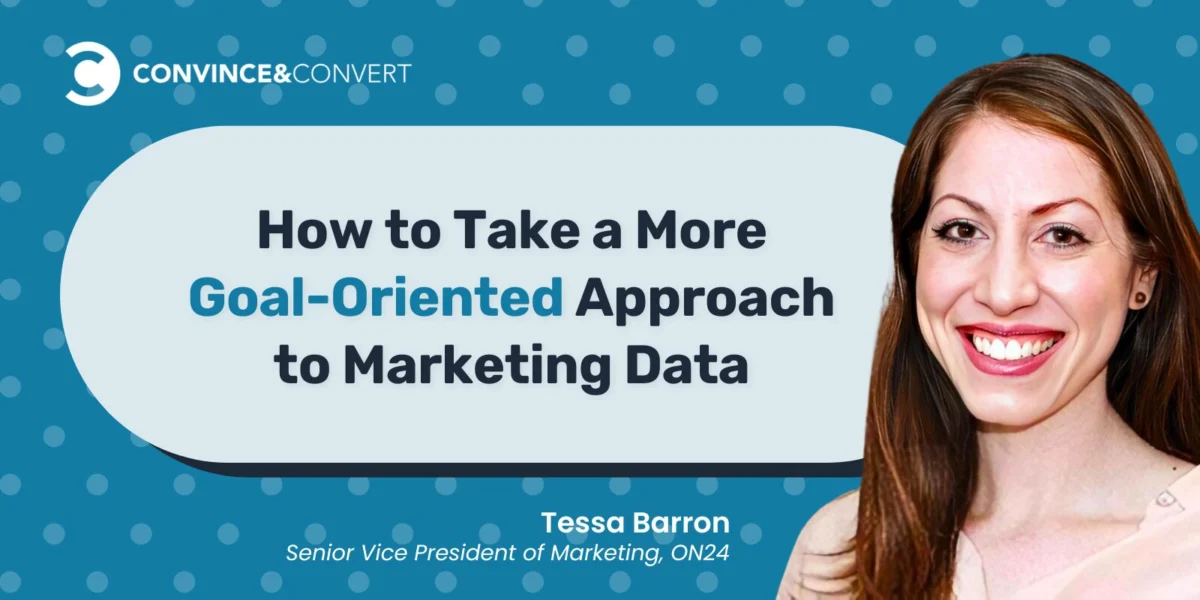
In the current economic climate, the phrase "do more with less" has become the perennial mantra of the C-suite, often leaving marketing teams in a state of professional paralysis. Faced with tightening budgets, diminishing resources, and increasingly aggressive pipeline targets, many marketers find themselves caught in a cycle of diminishing returns. The prevailing industry wisdom suggests that if you simply increase the volume of tactics—more webinars, more whitepapers, more social media posts—you will inevitably see an uptick in results.
However, Tessa Barron, formerly Senior Vice President of Marketing at ON24, argues that this "volume-first" approach is fundamentally flawed. In her appearance on the Data-Driven Decisions podcast, Barron posits that the solution is not to "do more," but to fundamentally re-engineer how marketing organizations view their role in pipeline generation. By shifting from a tactic-oriented mindset to a goal-oriented one, marketers can move away from busywork and toward meaningful, data-backed revenue contribution.
The Mandate for a Mindset Shift
The modern marketing landscape has undergone a seismic shift, particularly in the wake of the global pandemic. Consumer behaviors, buyer expectations, and the digital touchpoints that influence decision-making have evolved rapidly. Yet, many organizations remain anchored in the strategies of 2019 or 2020.
Barron challenges marketers to perform an honest internal audit: "We as marketers have to check in with ourselves and ask: Have we changed? Are we still doing what we were doing three or four years ago? If the answer is yes, that is the first sign that we need to stop expecting that if we execute the same way and do more, we’re going to get more in return."
For seasoned professionals, the temptation to rely on "tried-and-true" tactics is high. Content formats like webinars, whitepapers, and videos are staples of the marketing toolkit. While these assets remain valuable, they are often deployed as default solutions rather than strategic responses. The failure, Barron notes, is in starting with the tactic instead of the objective.
From Tactics to Objectives
To break this cycle, marketers must redefine their planning process. Instead of setting a goal to "produce four webinars in Q1," a goal-oriented marketer asks, "How can we achieve a 10% uplift in pipeline targets or secure X number of new accounts in Q1?"
This framework forces a pivot toward conversion. If the objective is to improve the conversion rate of first meetings by 10%, the marketer must then investigate the specific content types that historically engage prospects at that stage. If the audience seeks deep education, a webinar might be the ideal vehicle. If they require quick validation, a different format may be required. In this model, the tactic is no longer the destination—it is a surgical tool designed to achieve a specific, measurable conversion outcome.
Uncovering Key Signals in a Noisy Environment
We live in an era of data abundance. However, having access to massive datasets often leads to "analysis paralysis," where signal is lost in a sea of noise. Barron advocates for a radical simplification: focus exclusively on the "signals" that indicate a prospect is nearing a conversion point.
Once these signals are identified, marketing teams can design "traps"—strategic touchpoints intended to elicit specific behavioral data. At ON24, this approach is applied to digital engagement with high precision. By embedding polls, surveys, Q&A sessions, and specific calls-to-action (CTAs) within a single webinar, marketers can transform a passive viewing experience into a goldmine of actionable intent data.
Case Studies in Strategic Data Capture
The effectiveness of this approach is best illustrated through real-world applications across diverse industries:
- The Technology Sector: A cloud-based enterprise firm aiming to reclaim market share identified that prospects using a specific, competing cloud provider were ten times more likely to convert. Rather than blanket marketing, they utilized a targeted webinar strategy, explicitly asking, "What cloud provider are you currently using?" during the session. This allowed the marketing team to pass highly qualified, "high-intent" leads directly to sales.
- The Pharmaceutical Industry: A healthcare company sought to reach physicians with patients in critical need of specific therapies. By hosting educational sessions on the latest breakthroughs and asking, "How would you rate the risk of your patient base?" they were able to segment attendees by urgency. Those who identified their patient base as "high risk" signaled an immediate need for the company’s intervention, allowing for tailored follow-up.
Aligning Marketing with the Sales Frontline
One of the most significant barriers to effective pipeline growth is the disconnect between marketing departments and sales teams. Too often, marketing metrics—such as "content engagement scores" or "click-through rates"—are disconnected from the realities of the sales floor.
Barron suggests that marketers should step out of their silos and engage directly with sales representatives. "What questions are they asking to determine if a lead is qualified?" is the most important inquiry a marketer can make. Salespeople are the individuals on the front lines; they understand the specific pain points, hesitations, and expectations that prevent a prospect from becoming a customer.
The Collaborative Pipeline
There is a common misconception that marketing is solely responsible for creating the pipeline. Barron clarifies this distinction: "Marketers are creating signals and developing a net to catch people who might turn into pipeline. But it’s the salespeople, those on the front lines, who create the pipeline."
The marketer’s primary responsibility is to ensure that when a salesperson finally picks up the phone, they have the clearest possible picture of who they are calling. By aligning marketing data with the criteria sales uses to qualify leads, the organization ensures that marketing efforts directly fuel the sales engine rather than just filling a database with "top-of-funnel" noise.
The Framework for Persistent Messaging
To successfully move prospects through the funnel, marketers must utilize a framework that maps data to specific, relevant messaging at every stage of the buyer’s journey. This requires an iterative process of testing and refinement.
- Identify the Friction Points: Where are prospects dropping off? Is it a cumbersome lead form, or is the messaging misaligned with the prospect’s current stage?
- Optimize the Micro-Steps: Small tweaks—such as shortening lead forms, refining landing page copy, or providing more granular interaction points—can yield disproportionate improvements in conversion.
- Develop Targeted Content: Use the insights gathered from sales conversations to address specific objections or needs at each stage of the funnel.
"It’s figuring out what those key steps are in between a lead becoming a pipeline opportunity," Barron explains. "It’s focusing there that you can really start to be able to control and understand how to turn dials, and add more success."
Communicating Impact to Stakeholders
The challenge of "doing more with less" is exacerbated by the need to justify marketing spend to internal stakeholders. When presenting data to leadership, simplicity is paramount. Stakeholders are generally less interested in vanity metrics and more concerned with the bottom line: Is the pipeline growing? How is the budget impacting conversion?
Barron recommends presenting data in the most visually intuitive way possible. By focusing only on the metrics that support the broader strategic goals, marketers can tell a compelling story about their contribution to the company’s growth. When marketing teams can demonstrate that they aren’t just "producing content" but are instead "collecting high-intent signals that drive conversion," they change the narrative from one of cost-center expenditure to one of revenue-generating investment.
Conclusion: The Path Forward
The "do more with less" pressure is unlikely to dissipate in the near future. However, by adopting a mindset shift that prioritizes goal-oriented strategy over tactic-oriented busyness, marketers can find a sustainable path forward.
By leveraging strategic data capture, fostering deep alignment with the sales organization, and focusing on the granular steps of the conversion journey, marketing teams can stop chasing the illusion of volume and start pursuing the reality of value. In the end, the most effective marketing is not about how much you do, but how intentionally you align your actions with the ultimate goal: a robust, high-conversion pipeline that drives the business forward.
For further insights into these strategies and a deeper dive into the methodology of data-driven marketing, tune in to the full episode of the Data-Driven Decisions podcast.


 Ammar Sabilarrohman
 Sagoh
Sagoh
 Raul Delapena Setiawan
 Reynand Wu


 Azzam Bilal Chamdy
 Ali Ikhwan