
 Neng Nana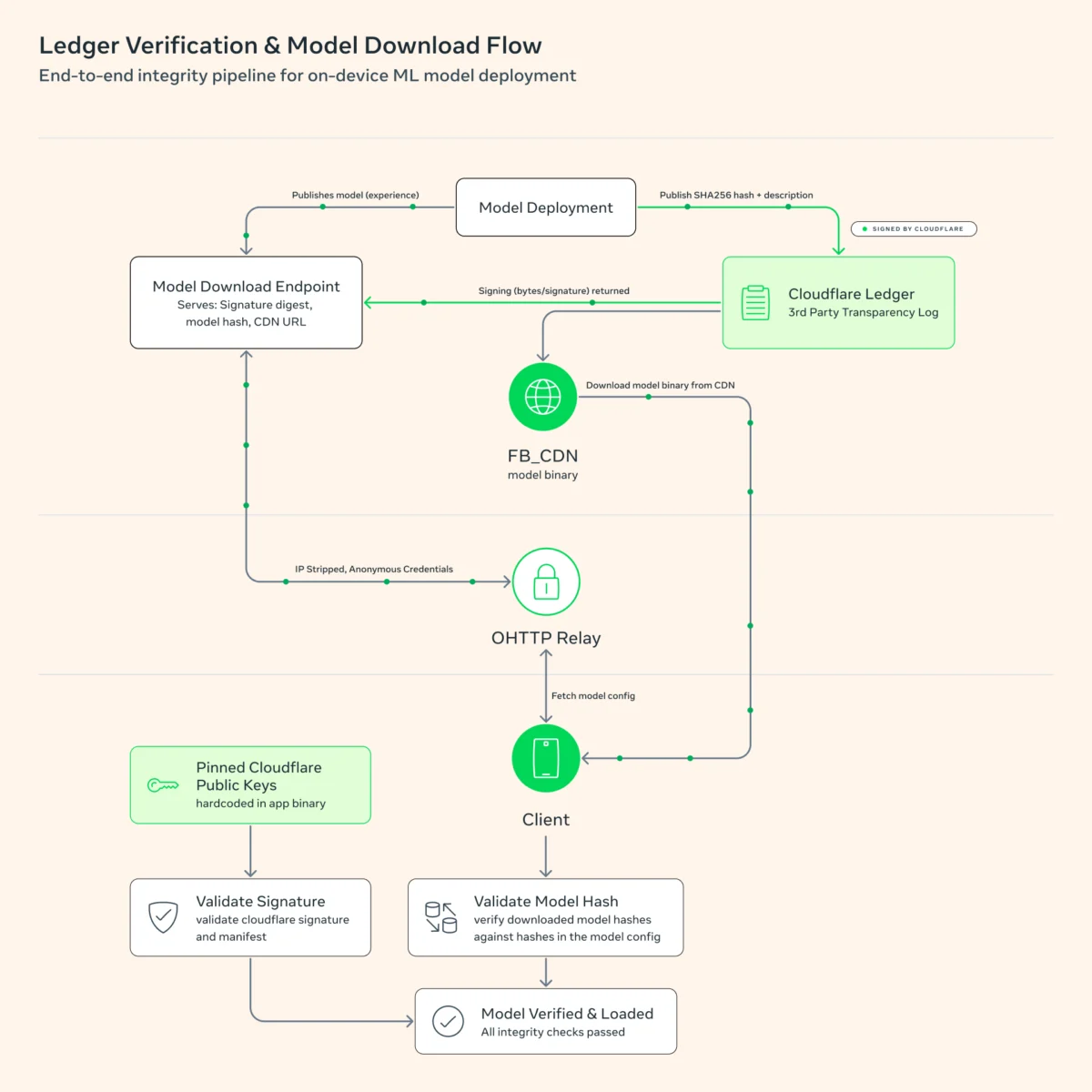
In an era where digital communication has become the backbone of global commerce and personal connection, the sophistication of fraud has reached unprecedented levels. From AI-driven social engineering to elaborate impersonation tactics, bad actors are constantly refining their methods to bypass traditional security measures. Today, WhatsApp has taken a significant step toward neutralizing these threats with the announcement of Scam Alert, a pioneering, on-device machine learning feature designed to protect users without compromising the platform’s foundational commitment to end-to-end encryption.
By keeping all processing local to the user’s device, WhatsApp is setting a new industry standard: proactive security that does not require users to surrender their privacy.
The Core Mandate: Balancing Security and Privacy
At the heart of the new feature is a fundamental design philosophy: the protection of personal messages must not come at the cost of the messages themselves. As scammers evolve, WhatsApp’s security infrastructure must follow suit, yet it must do so within the rigid, ironclad walls of end-to-end encryption.
Scam Alert is an optional feature that utilizes a lightweight machine learning model running directly on the user’s smartphone. Unlike traditional anti-phishing tools that scan content in the cloud, Scam Alert performs all inferences locally. No message content ever leaves the device for classification, nor is it auto-reported to Meta or any third party. This ensures that the privacy of the conversation remains intact, even as the system works to identify potential fraud.
Chronology: From Concept to Beta
The development of Scam Alert is the result of years of research into privacy-preserving artificial intelligence.
- Initial Research Phase: WhatsApp engineers began exploring how to run complex text-classification models on mobile hardware without incurring significant battery or performance penalties.
- Architectural Selection: By early 2025, the team finalized an architecture that favored on-device execution, choosing to avoid server-side components entirely to eliminate the risk of data interception.
- The "PAPAYA" Foundation: The project leveraged the "PAPAYA" Federated Analytics Stack—a peer-reviewed system presented at USENIX NSDI 2025—which allows for the aggregation of insights without identifying individual user data.
- Beta Rollout: As of the current announcement, the feature has entered a limited Beta phase. This period is dedicated to stress-testing the system through an expanded Bug Bounty program, inviting security researchers to probe the model for vulnerabilities before a global launch.
Supporting Data and Technical Architecture
The efficacy of Scam Alert rests on its ability to classify threats based on linguistic patterns and conversational structures observed in historical scam reports.
On-Device Inference
The machine learning model is small enough to reside on modern mobile hardware without impacting device responsiveness. When a message is received from a non-contact, the model analyzes the text in real-time. If the probabilistic classification indicates a high likelihood of a scam, the user is presented with a discreet, private warning.
Crucially, the warning is visible only to the recipient. The sender—potentially the scammer—remains unaware that the message has been flagged. This prevents the attacker from learning how to bypass the system by testing different variants of their lure.
Confidential Federated Analytics
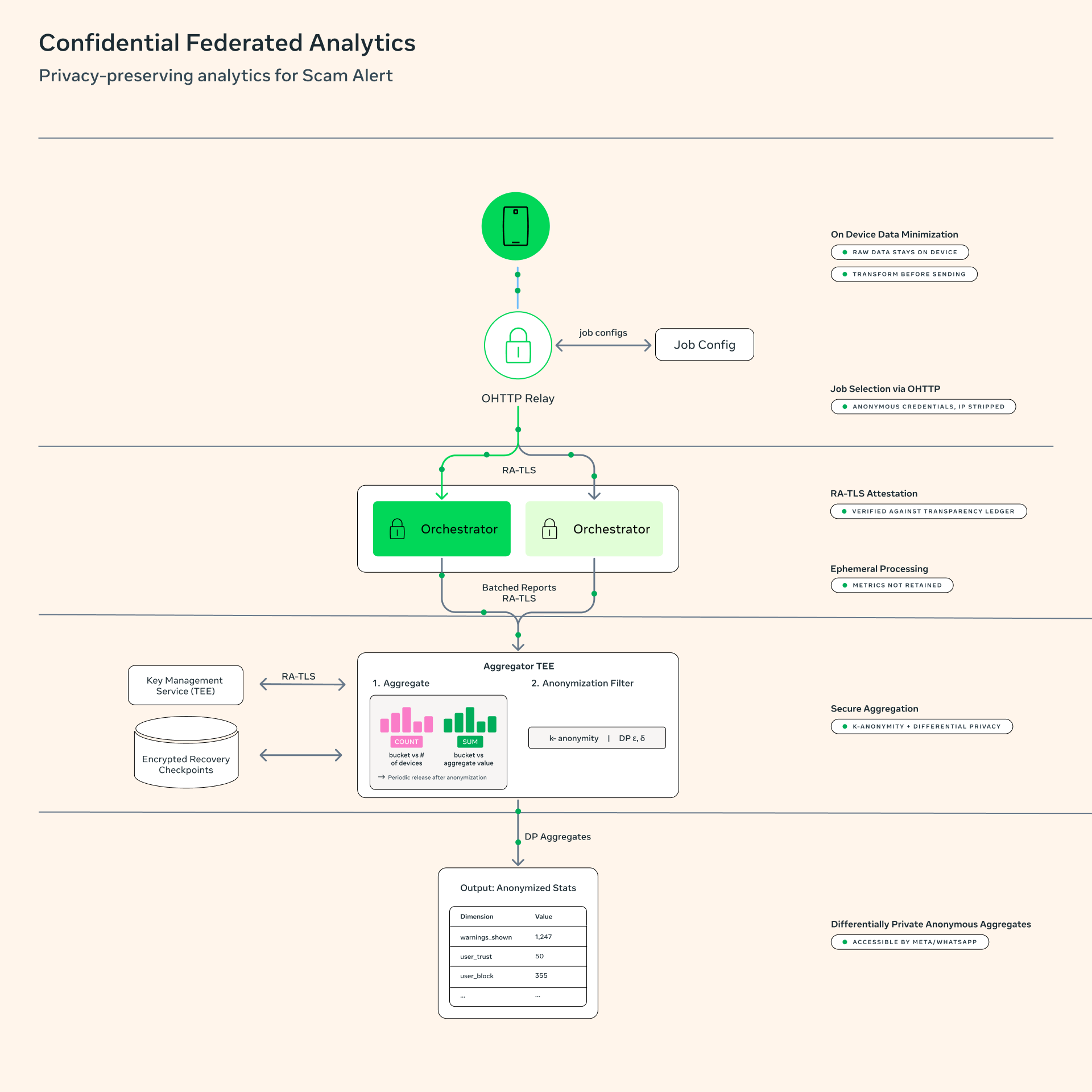
To ensure the feature is actually working, WhatsApp needs performance metrics. To do this while maintaining total anonymity, the company utilizes a Confidential Federated Analytics pipeline.
- TEE Isolation: All analytics processing occurs within a Trusted Execution Environment (TEE).
- Differential Privacy: Noise is added to the aggregated data, providing a mathematical guarantee that no individual user’s behavior can be inferred from the final reports.
- OHTTP Relays: Data in transit is routed through third-party OHTTP relays, stripping IP addresses and ensuring that the data stream cannot be associated with a specific user profile.
Official Stance: The "Defense-in-Depth" Strategy
WhatsApp’s leadership maintains that their threat model must account for the most extreme adversarial scenarios. Their defense-in-depth strategy is built on three pillars:
- Protection Against External Actors: By using OHTTP relays and encrypted data paths, even a compromised network cannot intercept or inspect the data.
- Protection Against Insider Threats: The system is architected so that even Meta engineers cannot access the TEE shell at runtime. All software is built from checked-in, auditable source code, making unauthorized changes virtually impossible to hide.
- Physical and Remote Hardening: The TEE infrastructure employs encrypted DRAM and CVM (Confidential Virtual Machine) hardening to resist even sophisticated hardware-level attacks.
The Role of Transparency Ledgers
One of the most innovative aspects of the Scam Alert rollout is the use of an append-only transparency ledger. Every model update, including its specific SHA-256 hash, is published to this public, tamper-evident log before it reaches any user. This allows independent security researchers to verify that the version of the model on their phone is the same as the version verified by the community.
Implications for the Security Landscape
The implications of this rollout extend far beyond WhatsApp. By proving that high-accuracy scam detection can be achieved via local, privacy-preserving AI, WhatsApp is challenging the industry-wide assumption that user safety and data privacy are mutually exclusive.
Empowering the User
The feature is inherently user-controlled. If the model flags a message incorrectly, the user retains the agency to mark the chat as "trusted." This action removes the warning and provides the user with an option to share the last five messages with WhatsApp to improve the model’s accuracy—a move that effectively turns the user into a partner in their own security, rather than just a passive subject.
The Bug Bounty Expansion
To build lasting trust, WhatsApp is opening the entire Scam Alert ecosystem to the Bug Bounty community. Researchers are encouraged to test the model against a variety of adversarial inputs. This "open-box" approach to security ensures that any deviations in model behavior—or potential evasion tactics—can be identified and patched before they become systemic weaknesses.
A New Standard for AI Ethics
By documenting their entire pipeline and subjecting it to academic and community scrutiny, WhatsApp is effectively moving the goalposts for how tech giants handle "black-box" AI. Future iterations of this system will likely serve as a blueprint for other messaging platforms and enterprise communication tools that handle sensitive data.
Looking Forward: An Ever-Evolving Defense
The battle against digital fraud is a war of attrition. As WhatsApp noted in their technical summary, scammers are relentless, constantly rotating their tactics to stay ahead of automated filters.
WhatsApp’s commitment to the Scam Alert program is not a one-time release but a long-term initiative. By ensuring that the model can be updated remotely—without requiring a full application update—and by keeping that process transparent, the company is ensuring that their defensive posture can remain as fluid and adaptive as the threats they aim to mitigate.
For now, the focus remains on the Beta phase. The engineering team, led by a cross-functional group of experts, continues to refine the model’s accuracy. For users, the promise is simple: a safer messaging environment where the technology works for them, invisibly and securely, in the background.
As the digital world continues to expand, the marriage of privacy and proactive security will be the defining challenge of the next decade. With the introduction of Scam Alert, WhatsApp has clearly signaled its intention to lead that charge.
Acknowledgements
This project was made possible by the collaborative efforts of Ronald Anthony, Shafin Anwarsha, Samyukta Mogily, Lenny Grokop, Riccardo Tortul, Harish Srinivas, Kiran Teja Tummuri, Roman Dashchakivskyi, Chao Zhang, and Jitendra Mohanty. Their work on the intersection of cryptography, machine learning, and privacy-preserving analytics represents a significant milestone in secure communications.


 Jia Lissa
 Nila Kartika Wati
 Raul Delapena Setiawan
 Reynand Wu
 Sagoh
Sagoh

 Azzam Bilal Chamdy
 Ali Ikhwan