
 Lina Irawan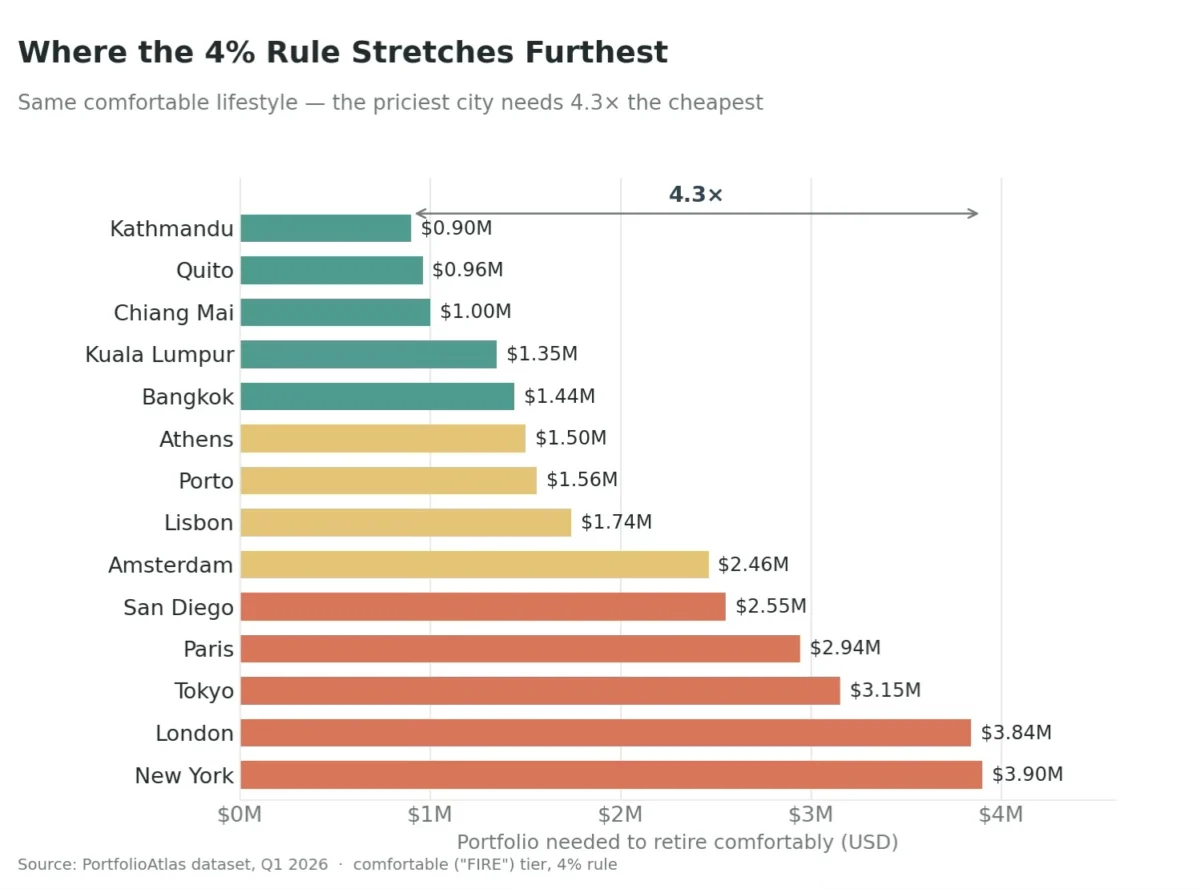
In the high-stakes world of Financial Independence, Retire Early (FIRE), the narrative is often dominated by a singular, rigid mantra: maximize your savings rate. The community has spent decades obsessed with the "math of austerity"—the idea that by pushing a savings rate from 40% to 65%, one can shave years off their corporate grind. While this disciplined approach to accumulation is undeniably effective, it treats one of the most critical variables in the retirement equation as a fixed constant: the cost of living.
According to Chris, the founder of the financial planning tool PortfolioAtlas, the FIRE community is overlooking a seismic opportunity. While most followers of the movement spend their lives agonizing over investment yields and tax-advantaged accounts, they ignore the fact that "annual spending"—the denominator in the 4% rule—is not a static figure. It is a choice dictated by geography. By treating one’s home city as a variable rather than a destination, retirees can unlock a level of financial flexibility that no amount of portfolio optimization can match.
The Mathematics of Location: A Tale of Two Cities
The core of the FIRE movement relies on the "4% rule," which suggests that if you save 25 times your annual expenses, your portfolio should theoretically sustain your lifestyle indefinitely. However, this rule operates on a flawed assumption that the "annual spending" requirement remains tied to a specific geographic locale.
When you hold a "comfortable" lifestyle constant—defined as a well-appointed home, regular dining, high-quality healthcare, and occasional travel—the financial requirements fluctuate wildly depending on the city. Data from PortfolioAtlas highlights a staggering disparity:

- Kathmandu, Nepal: A portfolio of $900,000 sustains a $3,000 monthly spend.
- Chiang Mai, Thailand: $1,000,000 sustains a $3,333 monthly spend.
- Porto, Portugal: $1,560,000 supports a $5,200 monthly spend.
- US Average: $2,080,000 supports a $6,933 monthly spend.
- San Diego, USA: $2,550,000 is required to maintain the same quality of life ($8,500/month).
- New York City, USA: A daunting $3,900,000 is needed to support a $13,000 monthly spend.
The gap is not merely academic. The difference between retiring in New York City and Chiang Mai is roughly $2.9 million—a sum that, in itself, constitutes a full retirement portfolio for many individuals. This reveals that for the vast majority of aspiring retirees, the "FIRE number" is not an immutable objective truth, but rather a reflection of their current zip code.
Geographic Arbitrage: The Ultimate Hedge Against Market Volatility
Beyond the initial savings goal, geographic flexibility serves as a potent, under-utilized risk management tool. The greatest threat to a retiree is not a market downturn in year twenty, but "sequence-of-returns risk" in the first few years of retirement. If a retiree begins their withdrawal phase during a market crash, they are forced to sell assets at a depressed value, significantly impairing the portfolio’s ability to recover.
Standard defensive strategies, such as maintaining a cash cushion, a "bond tent," or pursuing "Barista FIRE" (part-time work), are effective but come with their own costs—namely, lower long-term returns or reduced freedom.
Geographic arbitrage offers a more potent hedge. If a retiree has the ability to relocate, they can effectively lower their cost of living during a market downturn, thereby lowering their withdrawal rate precisely when the market is most fragile.
For instance, a retiree in San Diego drawing $102,000 annually (a 4% rate on a $2.55M portfolio) faces a crisis if the market drops 30%. Their portfolio shrinks to $1.785M, effectively raising their withdrawal rate to a precarious 5.7%. If that same individual relocated to Porto, their annual expenses would drop to roughly $62,400. Suddenly, their withdrawal rate becomes 3.5%, a significantly safer threshold that allows the portfolio to stabilize and eventually recover without the need for drastic asset liquidation.
Chronology of the FIRE Evolution: From Savings to Strategy
The history of the FIRE movement can be categorized into three distinct eras:
- The Accumulation Era (Early 2010s): The movement’s infancy was defined by extreme frugality. The focus was almost entirely on the "savings rate." Books and blogs from this era taught followers how to slash grocery bills, drive older cars, and bike to work to reach a million dollars as fast as possible.
- The Optimization Era (Late 2010s): As the movement matured, the focus shifted to tax efficiency and investment vehicle selection. Roth IRA conversions, tax-loss harvesting, and asset allocation became the new levers for accelerating the path to retirement.
- The Geographic Era (2025–Present): We are currently entering a phase where the "where" is becoming as important as the "how." With the rise of remote work and global mobility, the realization that you can "earn in dollars and spend in pesos" (or Baht, or Euros) has fundamentally altered the retirement timeline for a new generation of nomads and intentional retirees.
Supporting Data: The Timeline Gap
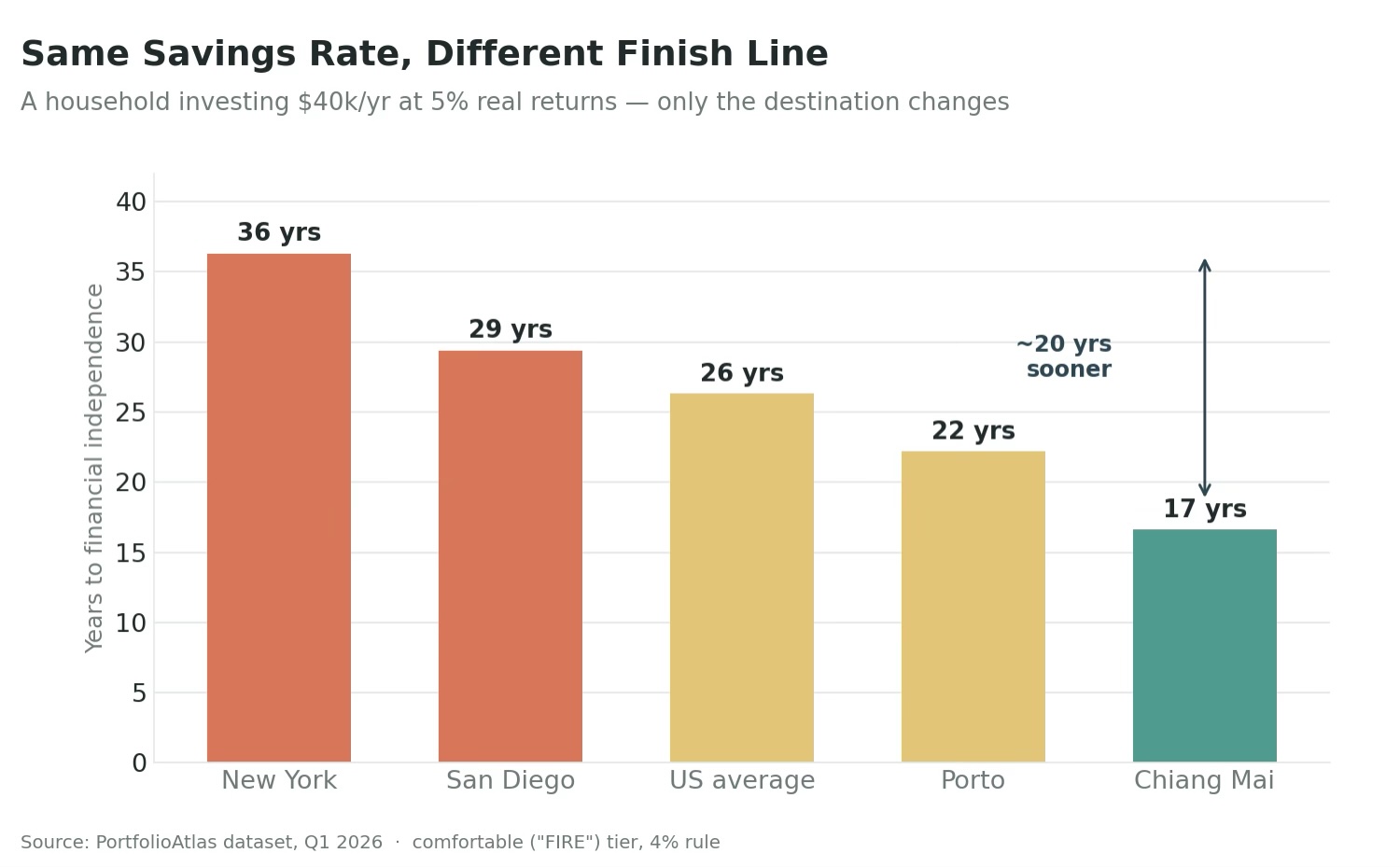
The impact of geography on one’s working years is profound. If a household saves $40,000 annually at a 5% real return, the time required to reach their FIRE number changes dramatically based on their destination:
- New York City: 36.3 years.
- US Average: 26.3 years (10 years saved).
- Porto, Portugal: 22.2 years (14.1 years saved).
- Chiang Mai, Thailand: 16.6 years (19.7 years saved).
The data suggests that for most people, the decision to move is mathematically superior to the decision to sacrifice an additional 5% of their income to increase their savings rate. While increasing one’s savings rate by 5% might shave two years off a 36-year timeline, changing one’s retirement destination can shave off nearly two decades.
Implications for Future Planning
This paradigm shift does not suggest that everyone should uproot their lives and move to a foreign country. Rather, it highlights the existence of an "option value." In financial terms, an option is a right, not an obligation. By maintaining the flexibility to move, a retiree holds a valuable asset that protects them against inflation, market crashes, and rising costs of living in their home country.
However, this transition comes with caveats. Moving internationally introduces complexities:
- Healthcare: Access to quality, affordable medical care is paramount. While many international destinations offer world-class, low-cost healthcare, it requires significant due diligence.
- Social Capital: The psychological toll of leaving behind family and friends is the "hidden cost" of geographic arbitrage.
- Legal and Tax Hurdles: Navigating visa requirements, residency, and the complexities of international tax treaties is a non-trivial undertaking.
Conclusion: Reframing the Dashboard
The retirement planning dashboard has long been stuck on a single dial: the savings rate. By introducing geography as a core component of the planning process, the FIRE community can transition from a "grind-and-wait" mentality to a "design-and-thrive" approach.
As Chris of PortfolioAtlas suggests, the goal is not to force a move, but to realize that your retirement number is a choice. Whether you decide to stay in your current city or leverage the benefits of a lower-cost region, the math is clear: geography is the most powerful, and perhaps the most under-utilized, tool in the pursuit of financial independence. By intentionally selecting where you will spend your life, you are not just managing your finances; you are reclaiming your time.


 Nana Wu
 Sagoh
Sagoh
 Raul Delapena Setiawan
 Reynand Wu


 Azzam Bilal Chamdy
 Ali Ikhwan