
 Nila Kartika Wati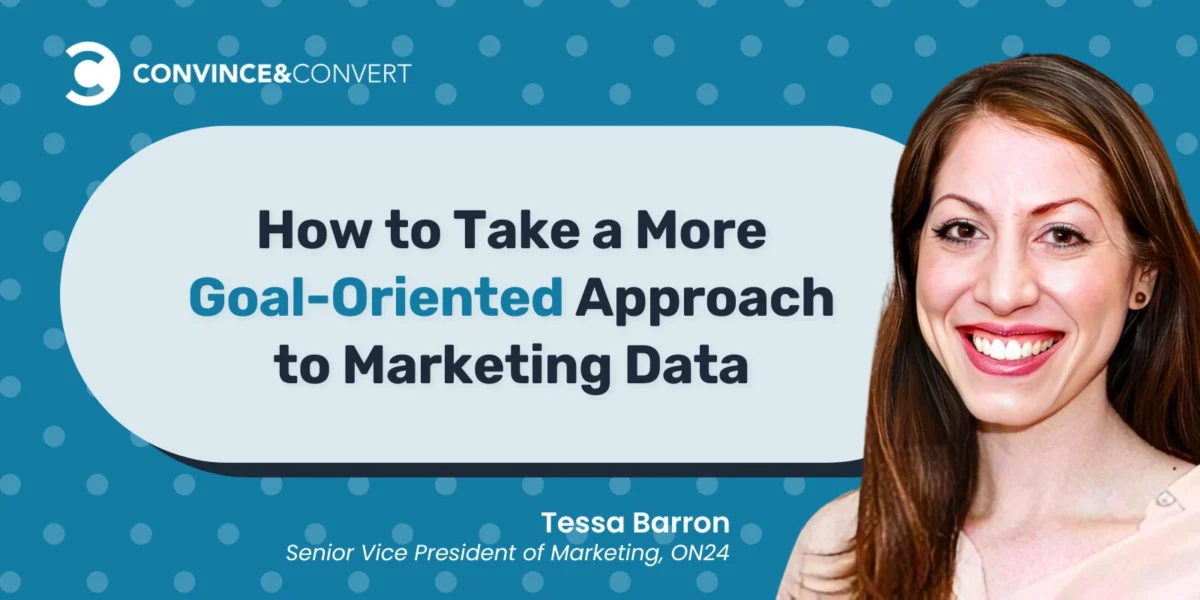
The mantra "do more with less" has become the perennial anthem of the modern marketing department. In an era of tightening budgets, volatile market conditions, and increasingly aggressive pipeline targets, this phrase often feels like an oxymoron. For many, it induces a sense of professional vertigo: how can one expand reach and drive higher-quality leads when resources are being stripped to the bone?
According to Tessa Barron, former Senior Vice President of Marketing at ON24 and a guest on the Data-Driven Decisions podcast, the solution is not to "do more." Instead, it is to fundamentally re-engineer the relationship between data, strategy, and the marketing department’s role in revenue generation. The era of the "tactic-first" marketer is over; the era of the "goal-oriented" strategist has arrived.
The Core Problem: The Tactic-First Trap
For decades, the marketing playbook has remained largely static: produce whitepapers, host webinars, run social media campaigns, and push out video content. While these tools remain essential, the reflexive reliance on them without a clear, data-backed objective is the primary cause of marketing inefficiency.
"We as marketers have to check in with ourselves," Barron argues. "If you are still executing the same way you were three or four years ago, you cannot expect that doing more of the same will yield better results."
The "tactic-first" approach is a trap. It prioritizes volume over value. A team that commits to "running four webinars in Q1" is focusing on output, not outcome. In contrast, a goal-oriented team frames its mandate differently: "In Q1, we need to increase our pipeline by 10% or penetrate X number of new accounts." By starting with the goal, the choice of tactic becomes a deliberate, calculated decision rather than a default action.
Chronology of a Shift: From Noise to Signal
The post-pandemic landscape has fundamentally altered buyer behavior. The digital noise floor has risen, and prospects are more selective than ever about where they invest their attention. To cut through this, marketers must transition from collecting "data" to harvesting "signals."
1. Identifying the Signal
Data is abundant, but most of it is noise. A signal, by definition, is a specific piece of information that indicates a buyer is moving closer to a purchase decision. Marketing teams must identify which behaviors act as leading indicators for conversion.
2. Setting the "Trap"
Once a signal is identified, the strategy shifts to "setting the trap"—creating specific, low-friction interactions that allow prospects to reveal their intent. This is where high-engagement content like webinars shines. By utilizing polls, Q&A, and real-time surveys, marketers turn a passive viewing experience into an active discovery session.
3. The Feedback Loop
This data is then fed back into the sales process, allowing for hyper-personalized follow-ups. If a prospect engages with content related to a specific pain point, the sales team receives a signal that is actionable, relevant, and timely.
Supporting Data: Real-World Applications
Barron points to two distinct case studies that illustrate how this strategic data capture translates into measurable business impact.
The Technology Sector: Identifying Infrastructure
A major technology firm struggling to regain market share identified a critical correlation: prospects using a specific cloud provider were ten times more likely to convert into a viable opportunity. Rather than casting a wide, generic net, they used a simple, targeted question during a webinar: "What cloud provider are you currently using?" By identifying these high-intent leads during the event, they enabled their sales team to prioritize outreach with surgical precision.
The Pharmaceutical Sector: Assessing Patient Risk
In a more complex B2B environment, a pharmaceutical company needed to reach physicians who were actively treating patients with high-risk conditions. By hosting an educational webinar on the latest therapy breakthroughs, they embedded a diagnostic question: "How would you rate the risk profile of your patient base?" This allowed the company to segment their audience immediately, focusing their follow-up efforts on doctors who signaled an urgent need for the therapy, rather than those who were merely browsing.
These examples prove that when marketing is aligned with specific, high-value data requirements, it ceases to be a cost center and becomes a revenue accelerator.
Official Perspective: The Sales-Marketing Nexus
A recurring theme in modern revenue operations is the friction between Sales and Marketing. Barron suggests that this friction is often the result of misaligned goals. Marketing is frequently tasked with "creating" the pipeline, but in reality, Marketing creates the conditions for the pipeline.
"Marketers are developing a net to catch people who might turn into pipeline," Barron explains. "But it’s the salespeople—those on the front lines—who actually create the pipeline."
To bridge this gap, marketing teams must adopt a policy of radical transparency with Sales. Instead of assuming what makes a lead "qualified," marketers should sit in on sales calls. They need to hear the specific objections, the language of the prospect, and the exact questions salespeople use to determine if a lead is ready to move to the next stage.
By mirroring the language of Sales in their marketing messaging, the team creates a seamless transition for the buyer. When the prospect moves from an ebook or webinar to a sales conversation, the experience should feel like a natural progression, not a jarring shift in tone or intent.
Implications: The Framework for Messaging That Sticks
To create messaging that genuinely impacts conversion rates, marketers must move beyond the "one-size-fits-all" approach. This requires a granular understanding of the buyer’s journey. Barron suggests that the most effective marketing teams focus on the "in-between" spaces—the micro-moments where a lead is either captured or lost.
The Optimization Checklist:
- Shorten the Path: Review lead forms and registration processes. Are they creating unnecessary friction?
- Audit the Content: Does the messaging directly address the specific pain points identified by the Sales team?
- Internal Alignment: Ensure that the data being captured is exactly what Sales needs to close the deal.
- Visual Communication: Present the impact of these strategies to stakeholders using simplified, clear metrics that map directly to revenue.
Often, the difference between a stalled lead and a closed deal comes down to these "little steps." It is not about launching a massive, expensive new campaign; it is about auditing the current funnel and tweaking the dials on conversion.
Conclusion: The Path Forward
The "do more with less" crisis is largely a self-inflicted wound born of a legacy mindset. By shifting from a tactic-first orientation to a goal-oriented, signal-driven strategy, marketers can regain control of their outcomes.
The future of marketing is not found in the volume of content produced, but in the quality of the signals captured. It is found in the deep, collaborative partnership with the sales organization. And most importantly, it is found in the courage to stop doing what has "always been done" in favor of what is empirically proven to drive revenue.
As stakeholders demand greater transparency and ROI, the marketers who succeed will be those who can stand before leadership and present not just "vanity metrics" like clicks or downloads, but a clear, data-backed narrative of how their actions are directly feeding the pipeline and closing the gap between interest and revenue. The tools are already in our hands; it is the mindset that must evolve.


 Ammar Sabilarrohman
 Sagoh
Sagoh
 Raul Delapena Setiawan
 Reynand Wu


 Azzam Bilal Chamdy
 Ali Ikhwan