Jia Lissa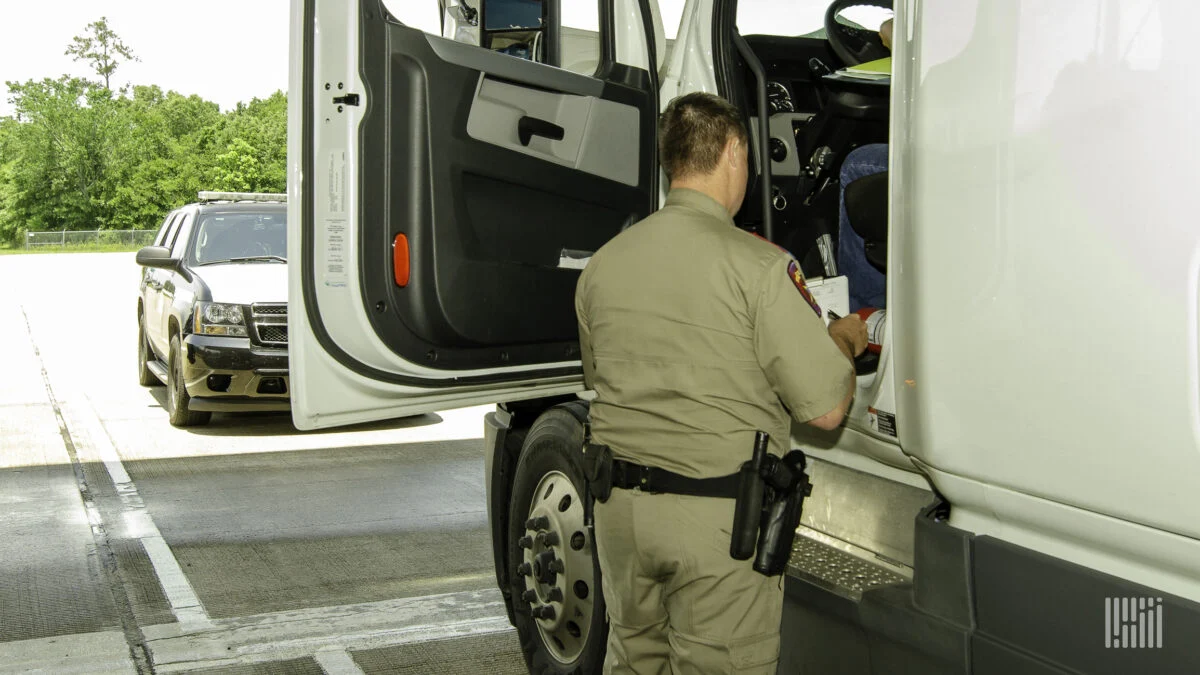
(The views expressed here are solely those of the author and do not necessarily represent the views of FreightWaves or its affiliates.)
For decades, the trucking industry operated under an implicit, informal understanding: a driver’s logbook was the primary—and often only—record of their professional life. Unless an officer physically witnessed a violation or a carrier faced a comprehensive audit, the "Record of Duty Status" (RODS) remained largely a matter of trust. However, a recent incident at an Arizona scale house has served as a wake-up call, signaling that the era of the falsified logbook is rapidly drawing to a close.
A veteran driver, mid-haul, pulled into an Arizona inspection station expecting a routine check. Instead, he found himself facing an officer who possessed a complete, minute-by-minute reconstruction of his multi-state journey—a timeline derived not from the driver’s own paperwork, but from a vast, silent network of roadside cameras and license plate readers (LPRs). As the driver recounted to his peers, the officer didn’t just ask about his logs; he recited them back to him, pointing out exactly where they diverged from the reality of his movement across Louisiana, Texas, New Mexico, and Arizona.
This is not a story of a one-off surveillance fluke. It is a glimpse into a structural transformation of the North American supply chain, where "ground truth" is now generated by infrastructure, rendering the traditional, unverifiable logbook a relic of a bygone era.
The Anatomy of the Encounter: A Digital Paper Trail
The driver’s experience was chilling in its simplicity. When he asked how the officer could possibly know his precise location at specific timestamps throughout the week, the answer wasn’t a tracking device hidden under his chassis or a report filed by a disgruntled shipper. It was the highway itself.
Modern freight corridors are increasingly "lit up" with sensors. From state-line border crossings and major scale houses to strategic intersections and random monitoring points, commercial vehicles are now being captured, identified, and timestamped by high-speed cameras. These systems do not merely photograph a truck; they extract USDOT numbers, motor carrier identifiers, VINs, and plate data.
For the veteran driver, the realization was jarring. He had spent years operating under the assumption that if he managed his own logs, he controlled the narrative of his movements. The Arizona officer’s ability to "stitch together" his journey from disparate camera sightings proved that the narrative no longer belongs to the driver. The infrastructure, owned by public agencies and private data aggregators, now holds the definitive record.
The Technology Behind the Curtain: AI-Driven Freight Intelligence
While license plate recognition technology is not new, the scale and integration of these networks have reached a tipping point. The current state of freight intelligence is defined by companies like GenLogs, a firm that has revolutionized how vehicle movement data is aggregated.
Founded in 2023 by a team with deep roots in the U.S. intelligence community, GenLogs operates a massive network of roadside sensors. Using sophisticated artificial intelligence, the system captures images of trucks in motion and translates them into actionable data. With over 1,000 camera locations and a database containing hundreds of millions of truck sightings, the firm—and others like it—can provide a near-real-time map of commercial logistics across the nation.
How the Tech Works:
- Automated Identification: AI models distinguish between passenger vehicles and commercial trucks, effectively filtering out "noise."
- Privacy-First Protocols: To mitigate legal and ethical concerns, these systems are designed to blur driver faces and windows, focusing strictly on the vehicle’s identifying marks—USDOT numbers, cab logos, and license plates.
- Temporal Reconstruction: The core value lies in the speed of the software, which can cross-reference millions of data points to generate a coherent, chronological "trip history" for any specific vehicle in seconds.
Beyond the Scale House: The Commercial Ecosystem
While the Arizona incident highlights the enforcement potential of this data, it is a mistake to assume that government agencies are the primary drivers of this technology. The most significant users of this "freight intelligence" are actually the private entities that keep the supply chain moving: brokers, shippers, insurance underwriters, and logistics firms.
The Broker and Insurer Perspective
In an era plagued by rampant freight fraud, double-brokering, and the proliferation of "ghost" carriers, brokers are desperate for verification. When a carrier claims to be operating in a specific lane, brokers can now use this sensor data to confirm the claim. If a carrier’s stated lanes do not match their physical sightings, they are flagged as a potential risk.
For the insurance industry, this data is a game-changer. Insurers are increasingly using movement history to sharpen their risk underwriting. A carrier that can prove their operational history through verified, independent data is a more attractive client than one who cannot. Consequently, the "independent record" is evolving from a mere compliance tool into a form of commercial currency.
The Enforcement Climate: A Coordinated Crackdown
The rise of ubiquitous tracking is coinciding with one of the most aggressive enforcement climates in Federal Motor Carrier Safety Administration (FMCSA) history. Following the removal of thousands of non-compliant carriers and a renewed focus on "bad actors," the federal government has signaled that the days of lax oversight are over.
The Supreme Court’s recent focus on "negligent selection" liability has forced freight brokers to act as gatekeepers, further increasing the pressure on carriers to maintain impeccable records. When a carrier is vetted by a broker or an insurer, the data they encounter must align with reality. If a paper log contradicts the sensor-based "ground truth," the consequences extend far beyond a roadside fine; they reach into the carrier’s ability to secure loads, obtain insurance, and ultimately, remain in business.
Implications for Owner-Operators and Small Fleets
The transition to a transparent, sensor-monitored landscape is not necessarily a signal for panic, but it is an urgent mandate for professionalization. The "old guard" of trucking—those who view the logbook as a creative writing exercise—must adjust to the reality that they are now driving in a glass house.
Practical Steps for Survival:
- Embrace ELD Compliance: The Electronic Logging Device (ELD) mandate was only the beginning. Ensure that your ELD setup is not just functional, but perfectly synchronized with your operational reality.
- Document Everything: If you fall under one of the narrow exemptions for paper logs, keep your documentation airtight. Assume that any "gray area" will eventually be tested against the objective data captured by roadside sensors.
- Manage Your Digital Footprint: Understand that your equipment is being "seen" constantly. Your operating behavior, your lanes, and your frequency of movement are all being cataloged.
- Prioritize Transparency: For small fleets, this technology can actually be an advantage. By maintaining consistent, honest reporting, you build a "verifiable track record" that makes you a preferred partner for brokers and insurers who value reliability over the cheapest rate.
Conclusion: The New Paradigm of Compliance
The experience of the driver in Arizona is a microcosm of a broader, irreversible trend. We have entered a stage where compliance is no longer a matter of human trust or manual documentation; it is a matter of digital record.
For decades, the trucking industry enjoyed a degree of anonymity that allowed for a certain level of operational flexibility. That anonymity has been stripped away by the deployment of AI-integrated infrastructure. The record of where a truck has been is now being written by the cameras on the highway, and that record is accessible, searchable, and increasingly, the primary tool for those who regulate and reward the industry.
The era of the "unverifiable claim" is over. Whether at a scale house in the desert or in an insurance underwriter’s office in Chicago, the data is there, it is growing, and it is being used to define the future of the American freight economy. For the professional driver, the mandate is clear: the only way to operate in the modern age is to ensure that your records never lie, because the road itself is keeping score.

 Sagoh
Sagoh
 Ali Ikhwan
 Raul Delapena Setiawan
 Reynand Wu


 Azzam Bilal Chamdy