
 Dwi Wanna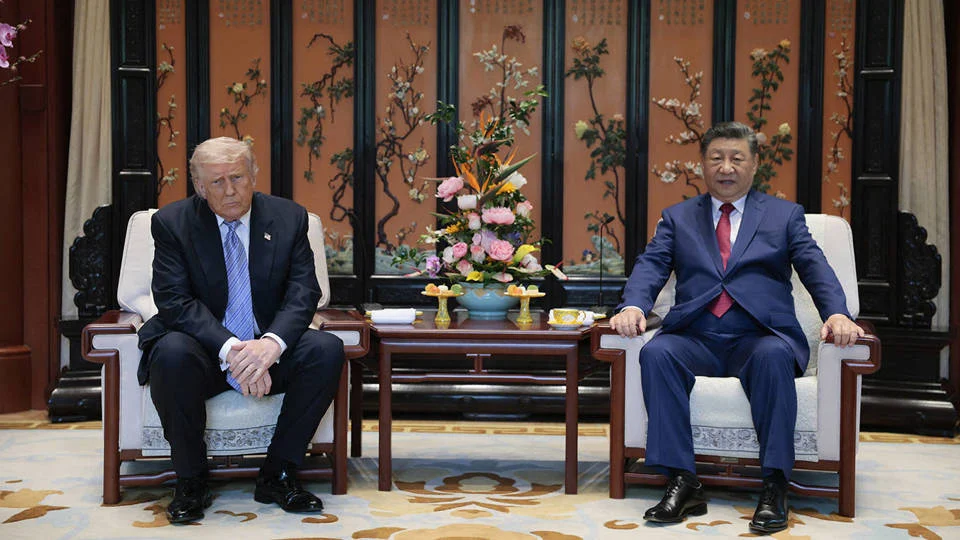
By Shang-Jin Wei
May 15, 2026
In an era defined by geopolitical fragmentation and economic volatility, the recent summit between United States President Donald Trump and Chinese President Xi Jinping in Beijing stands as a watershed moment. If the diplomatic maneuvers of this week successfully yield a sustained Sino-American trade truce and a pragmatic framework for reopening the Strait of Hormuz, the global economy may finally witness the reduction in "tail risks" that has eluded policymakers for the past eighteen months. Following a year marred by supply chain shocks, inflationary pressures, and persistent conflict, the prospect of a stabilized Pacific axis is a welcome, albeit fragile, development.
The Optics of Parity: A New Era of Diplomacy
The summit was, above all, a masterclass in choreographed statesmanship. Staged to project a sense of absolute parity between the world’s two largest economies, the event marked the first visit to mainland China by a sitting U.S. president in nearly a decade.
The visual narrative was reinforced by the presence of a high-powered American business delegation. Accompanying President Trump were the titans of the U.S. technology and manufacturing sectors: Tesla’s Elon Musk, Apple’s Tim Cook, Boeing’s Kelly Ortberg, and Nvidia’s Jensen Huang. For these leaders, the trip was not merely diplomatic; it was an existential necessity. Their businesses rely heavily on the integrity of Sino-American trade channels, and their participation in the grand welcome at the Great Hall of the People served as a stark reminder of the deep, often uncomfortable, entanglement between American capital and Chinese market access.
Chronology: A Path to the Great Hall
To understand the significance of this week, one must look at the trajectory of the past eighteen months.
- Q4 2024 – Q1 2025: The "Great Decoupling" rhetoric intensified. New tariffs on semiconductors and critical minerals created a deadlock, pushing the global economy toward a recessionary dip.
- Summer 2025: The escalation of tensions in the Middle East led to the effective closure of the Strait of Hormuz, sending energy prices soaring and disrupting maritime trade routes essential to both the U.S. and Chinese energy security.
- January 2026: Back-channel negotiations began in neutral territories, focusing on a "grand bargain" that would link trade de-escalation with regional security guarantees.
- April 2026: Formal confirmation of the Beijing summit. Markets responded with cautious optimism, evidenced by a modest rally in both the S&P 500 and the Shanghai Composite.
- May 15, 2026: The summit concludes with a joint communique pledging "a period of strategic restraint."
Supporting Data: The Cost of Conflict
The economic imperative for this meeting is rooted in cold, hard data. Over the last year, the World Bank reported that global GDP growth slowed by 1.2 percentage points, largely attributed to trade friction and the energy premiums resulting from the Strait of Hormuz crisis.
Key Economic Indicators (Year-to-Date 2026)
- Inflationary Pressures: Global energy costs surged by 22% following the blockage of regional shipping lanes.
- Tech Sector Exposure: With companies like Nvidia and Apple deriving nearly 20-30% of their revenue from the Chinese market, the "trade war" environment had wiped out an estimated $400 billion in potential market capitalization across the tech sector.
- Supply Chain Resilience: The cost of container shipping between Shanghai and Los Angeles increased by 140% compared to 2023 averages, directly contributing to the persistent "sticky inflation" noted by the Federal Reserve.
The economic reality is clear: the U.S. needs the manufacturing capacity and market depth of China, while China requires the intellectual property and consumption power of the United States to navigate its current domestic debt restructuring.
Official Responses and Diplomatic Rhetoric
The public statements emanating from Beijing have been carefully curated to project strength without inciting domestic backlash in either nation.
The U.S. Perspective
President Trump’s team emphasized "fairness and reciprocity." In a briefing following the plenary session, the White House Press Secretary noted that the President secured commitments regarding the protection of U.S. intellectual property and a phased reduction in tariffs on American agricultural exports. "We are moving from a relationship of confrontation to one of managed competition," the statement read.
The Chinese Perspective
President Xi Jinping’s rhetoric focused on "mutual respect" and "the necessity of a multipolar stability." The Chinese Ministry of Foreign Affairs emphasized that the summit was a validation of China’s role as a global stabilizer. By facilitating a conversation on the Strait of Hormuz, Beijing is signaling that it is willing to play the role of a regional broker, provided the United States respects China’s core security interests in the Indo-Pacific.
Implications: A Fragile Truce or a Structural Shift?
The critical question for global markets is whether this summit represents a structural realignment or merely a temporary tactical pause.
Implications for Global Markets
If the trade truce holds, we are likely to see a significant "de-risking" of global equity portfolios. Emerging markets, which have suffered from the "flight to quality" caused by geopolitical instability, may see a renewed inflow of capital. Furthermore, if the Strait of Hormuz remains open under a joint U.S.-China monitoring agreement, global energy prices could see a stabilization, providing central banks with the breathing room to pivot away from aggressive interest rate policies.
The Technological Tightrope
Despite the optimism, the "Tech War" remains a latent threat. Even with CEOs like Tim Cook and Jensen Huang in the room, the fundamental divide over AI sovereignty and quantum computing remains unresolved. The summit has likely pushed these issues into a "managed silence" rather than a resolution. Businesses should not expect a return to the unfettered globalism of the 2010s; rather, they should prepare for a "bifurcated" technology ecosystem where interoperability is limited.
Geopolitical Stability
The inclusion of the Strait of Hormuz on the agenda is perhaps the most surprising element of the summit. By bringing China into the security architecture of the Middle East, the U.S. is essentially acknowledging that it can no longer police the world’s maritime chokepoints alone. This marks a paradigm shift in American foreign policy—a transition from hegemony to collaborative security.
Conclusion: The Road Ahead
As the American delegation departs Beijing, the world watches with bated breath. The optics of the summit were undeniably positive, but the history of Sino-American relations is littered with grand meetings that failed to alter the underlying trajectory of rivalry.
The success of this week will be measured not by the handshakes in the Great Hall, but by the tangible outcomes in the months to come: the reduction of tariffs, the smooth passage of tankers through the Strait of Hormuz, and the ability of tech giants to navigate the new, highly regulated landscape. For a world exhausted by eighteen months of volatility, this Beijing summit offers a glimpse of a more predictable, if not entirely harmonious, future. It is a welcome prospect, but as both leaders know, in the game of great power politics, trust is a commodity that is rarely traded and never given for free.


 Nana Wu
 Reynand Wu
 Raul Delapena Setiawan

 Sagoh
Sagoh

 Azzam Bilal Chamdy
 Ali Ikhwan