
 Reynand Wu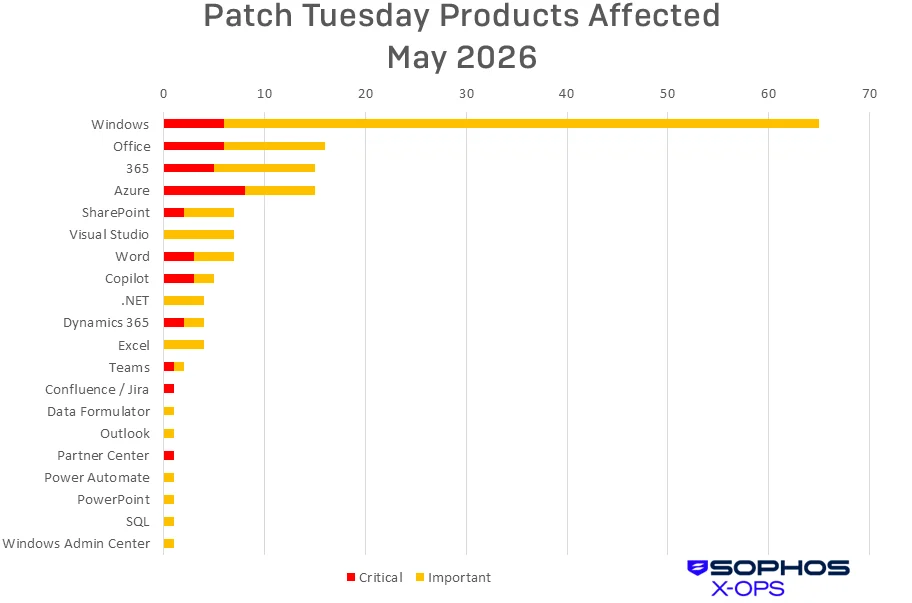
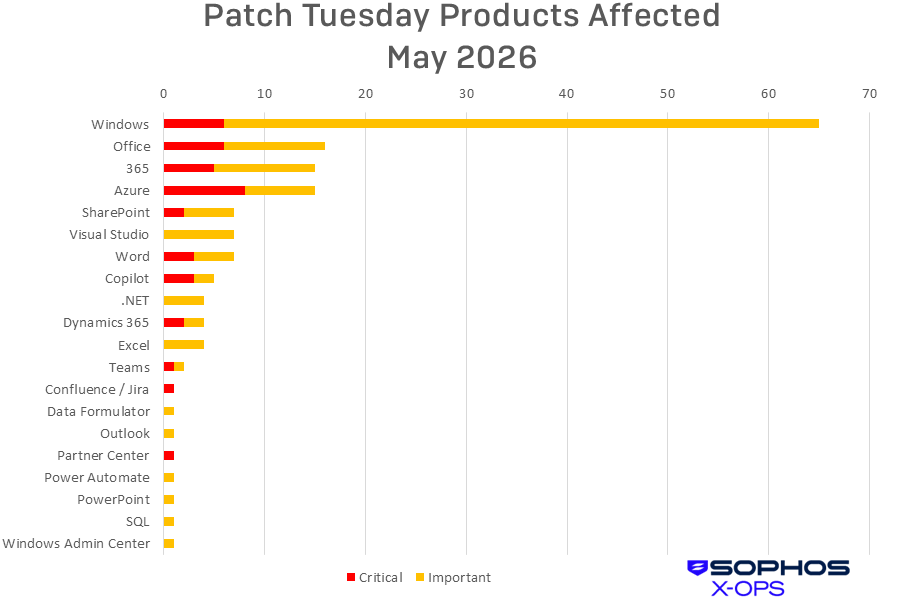
In what has become a definitive trend for the 2026 cybersecurity landscape, Microsoft’s May Patch Tuesday update has arrived with significant force. Addressing 132 unique vulnerabilities across 20 distinct product families, this month’s release highlights the persistent challenge of securing an increasingly interconnected digital infrastructure.
Among the 132 vulnerabilities addressed, 29 have been classified as "Critical," demanding immediate attention from IT administrators and security teams. Perhaps most concerning is the identification of 13 specific issues that, according to Microsoft’s telemetry and threat intelligence, are highly likely to be exploited in the wild within the next 30 days. Furthermore, 43 of the patched vulnerabilities carry a CVSS base score of 8.0 or higher, with one vulnerability achieving the ominous "perfect" score of 10.0.
The Landscape of the May Release
The scale of the May update is vast, mirroring the complexity of the environments it aims to protect. In addition to the primary Microsoft patches, the release includes a staggering 145 advisories. A significant portion of these pertain to the Microsoft Edge browser—largely stemming from upstream Chromium projects—alongside critical updates for Adobe Commerce and a notable, previously addressed, vulnerability in AMD hardware.
Interestingly, 14 of the CVEs (Common Vulnerabilities and Exposures) were patched by Microsoft prior to the official Patch Tuesday date. Crucially, none of these pre-patch items were publicly disclosed, nor is there currently any evidence of their active exploitation in the wild, suggesting a proactive security posture by the vendor’s internal research and response teams.
Notable Vulnerabilities and Strategic Risks
While the sheer volume of patches is daunting, several specific CVEs demand priority status due to their potential for severe impact.
CVE-2026-41103: The SSO Authentication Bypass
Perhaps the most critical item on the docket is CVE-2026-41103, which affects the Microsoft SSO (Single Sign-On) plug-ins for Jira and Confluence. Carrying a high CVSS score, this elevation of privilege vulnerability stems from an incorrect implementation of an authentication algorithm (CWE-303). By exploiting this flaw, an attacker could effectively bypass standard authentication protocols, gaining the ability to sign in as a legitimate user. Given the ubiquity of Jira and Confluence in enterprise workflows, this represents a significant risk to organizational integrity.
Remote Code Execution (RCE) in Core Infrastructure
Two vulnerabilities, CVE-2026-41089 (Windows Netlogon) and CVE-2026-41096 (Windows DNS Client), both carry a CVSS base score of 9.8. These RCE flaws are particularly dangerous because they allow for exploitation by unauthorized, remote attackers. The ability to execute arbitrary code at this level can lead to complete system compromise, making these two entries the "must-patch" items for any Windows server environment.
The Persistence of Legacy Risks
In a testament to the fact that security remains an ongoing struggle rather than a solved problem, CVE-2026-35432 highlights an information disclosure vulnerability in the Windows 11 Telnet client. The presence of such a legacy protocol in a modern OS environment serves as a stark reminder of the "technical debt" that continues to provide attack surfaces for adversaries.
Chronology of the Patch Deployment
The timeline for these updates is categorized by severity and exploitability. Microsoft’s guidance emphasizes that the 13 identified "high-risk" vulnerabilities should be prioritized for deployment within the next 30 days.
For security teams relying on external monitoring, Sophos has already released specific detections for several of these CVEs across their Intercept X and XGS Firewall platforms. Organizations are advised to compare their internal asset lists against the provided appendices to determine their specific exposure.
Data-Driven Insights: Elevation of Privilege Remains King
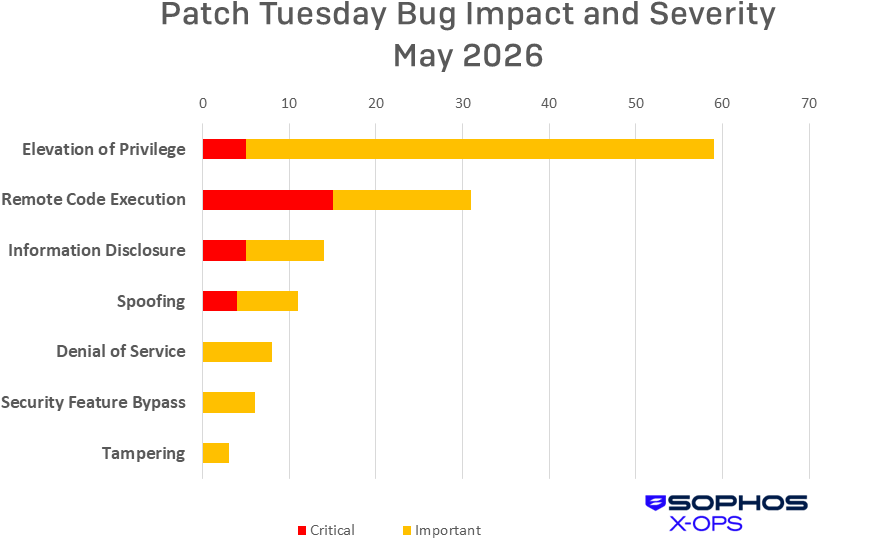
Analyzing the distribution of vulnerabilities by type, Elevation of Privilege (EoP) continues to account for the majority of the month’s CVEs. This trend suggests that threat actors are consistently focusing on moving laterally through networks once an initial foothold is established. While RCE vulnerabilities are often viewed as the most "spectacular," the high volume of EoP bugs indicates that attackers are banking on stealthy, persistent movement within compromised systems.
The cumulative data for 2026 shows a shifting focus among threat actors, with Spoofing and Security Feature Bypass vulnerabilities frequently trading places in the top tier of exploit vectors. Compared to the same period in 2025, where Microsoft had addressed 470 CVEs by this point, the current year is pacing slightly behind in raw numbers but remains heavy on complex, high-severity bugs.
Official Guidance and Remediation
For administrators managing enterprise environments, the recommendation remains the same: move beyond manual updates where possible and leverage automated patching cycles. However, for those requiring immediate mitigation, updates can be accessed via the Windows Update Catalog.
It is vital to utilize the winver.exe tool to verify build numbers before attempting manual installation, as the modern modular nature of Windows updates requires precise matching of cumulative packages to system architecture and build versions.
The Role of CWE Analysis
This month’s release includes deep analysis of the Common Weakness Enumeration (CWE) patterns associated with the patches. The data reveals that "Use After Free" (CWE-416) remains the most prevalent weakness, representing over 18% of the month’s vulnerabilities.
This metric is not merely academic; it informs security teams about the types of flaws they are most likely to encounter in the future. The recurrence of memory management issues—like Heap-based Buffer Overflows (CWE-122) and Improper Access Control (CWE-284)—underscores the ongoing need for secure-by-design coding practices at the vendor level.
Strategic Implications for IT Security Teams
The implications of the May 2026 Patch Tuesday are twofold:
- Complexity is the New Baseline: The fact that 20 product families are affected simultaneously confirms that modern IT environments are deeply entangled. A patch for a Windows Server component might be just as relevant to a developer working on an Azure AI Foundry project as it is to a systems administrator managing local Active Directory controllers.
- The Shift Toward Identity-Based Attacks: With vulnerabilities like the SSO plug-in for Jira/Confluence taking center stage, the focus of the attacker is clearly on the identity layer. When authentication mechanisms can be bypassed, perimeter defenses become secondary. Organizations must adopt a Zero Trust architecture, where the verification of the user and the integrity of the authentication process are paramount.
Looking Ahead
As we navigate the remainder of 2026, the volume of patches will likely continue to reflect the vast scope of the Microsoft ecosystem. Security teams should treat these monthly updates not as a simple administrative task, but as a critical component of their threat hunting and risk management strategy.
The inclusion of detailed appendices in this report—covering everything from product-specific impact to server-version exposure—is designed to help security leads prioritize resources effectively. Whether dealing with massive server deployments or individual desktop workstations, the goal remains the same: to minimize the window of opportunity for adversaries who are constantly probing for the next available exploit.
The "banner month" of May serves as a reminder: in the era of AI and hyper-connectivity, the speed of defense must consistently outpace the speed of discovery. Patching is the foundation of that defense, but it is only the first step. Continuous monitoring, configuration hardening, and a rigorous identity-centric security posture are the necessary components for surviving the modern threat landscape.


 Basiran
 Iffa Jayyana
 Raul Delapena Setiawan

 Sagoh
Sagoh

 Azzam Bilal Chamdy
 Ali Ikhwan