
 Muslim
In the complex ecosystem of cloud security, the relationship between independent researchers and major vendors is governed by a fragile "gentleman’s agreement" known as responsible disclosure. However, a recent standoff between security researcher Justin O’Leary and Microsoft regarding a critical vulnerability in Azure Backup for Azure Kubernetes Service (AKS) has cast a spotlight on the breakdown of this process.
The dispute centers on a "Confused Deputy" vulnerability that allegedly allowed unauthorized users to escalate their privileges to cluster-admin within an AKS environment. While Microsoft has flatly denied the existence of a security flaw, the researcher has documented that the attack vector—which functioned flawlessly in March—has been rendered ineffective following a series of quiet, undocumented changes to the platform.
The Anatomy of the Flaw: A Confused Deputy Scenario
At the heart of the issue is the integration between Azure’s management plane and Kubernetes’ authorization logic. Azure Backup for AKS utilizes a feature known as "Trusted Access" to permit backup extensions to operate with high-level privileges inside a customer’s cluster.
According to O’Leary, this architecture contained a critical logic gap. An attacker possessing only the low-privileged "Backup Contributor" role on a backup vault could force the system to establish a Trusted Access relationship without requiring any pre-existing Kubernetes permissions. By enabling a backup on a targeted AKS cluster, the attacker could trigger an automated configuration process that granted the backup service cluster-admin rights. Once this relationship was established, the attacker could manipulate the environment, restore malicious workloads, or exfiltrate sensitive secrets stored within the cluster.
O’Leary classified this as a classic "Confused Deputy" (CWE-441) attack, where the system’s trust in a lower-privileged entity leads to an unauthorized privilege escalation. In essence, the cloud provider’s automated management tools were being tricked into acting as an agent for an unauthorized user, effectively bypassing the security boundaries that should have existed between Azure RBAC and Kubernetes RBAC.
A Chronology of Conflict
The timeline of this disclosure highlights the deepening friction between independent security analysts and the world’s largest software vendors.
- March 17, 2026: Justin O’Leary identifies the vulnerability and submits a comprehensive report to the Microsoft Security Response Center (MSRC).
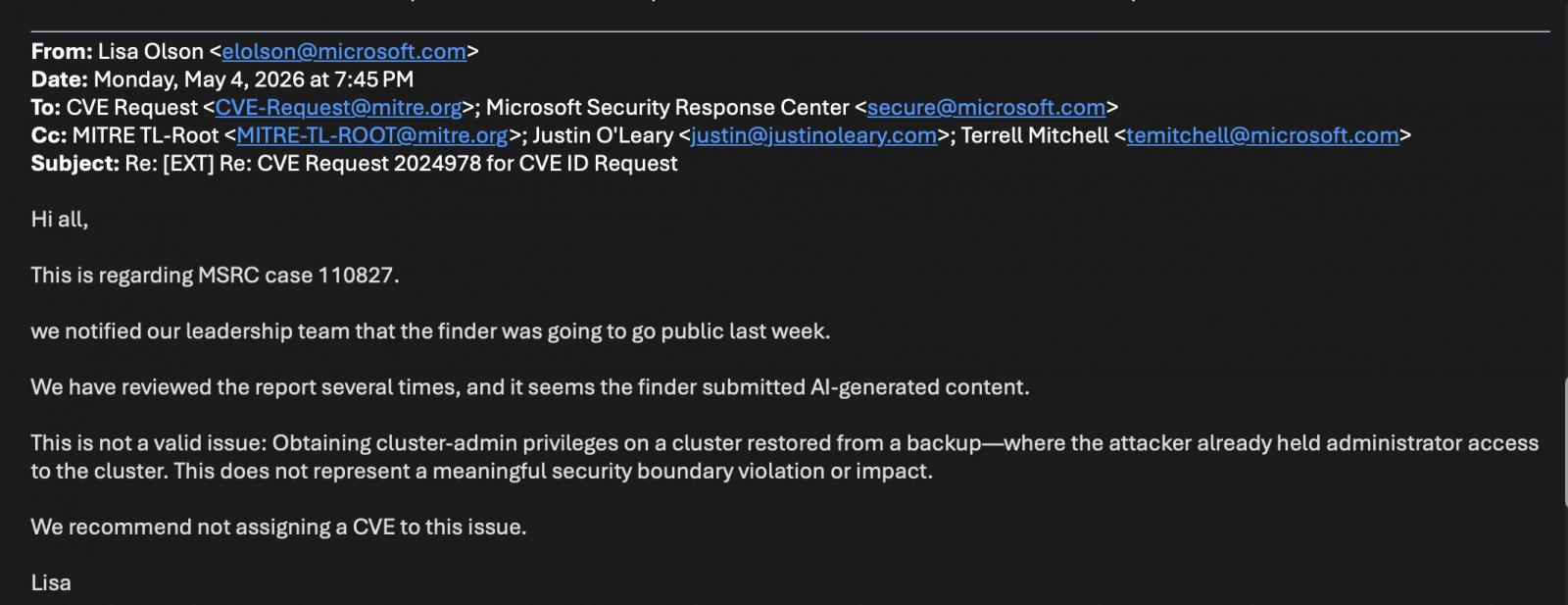
- April 13, 2026: MSRC rejects the report. Microsoft officials argue that the attack requires the user to already hold administrative privileges, a claim O’Leary vehemently denies, maintaining that the exploit allows a user with zero initial Kubernetes permissions to gain full control.
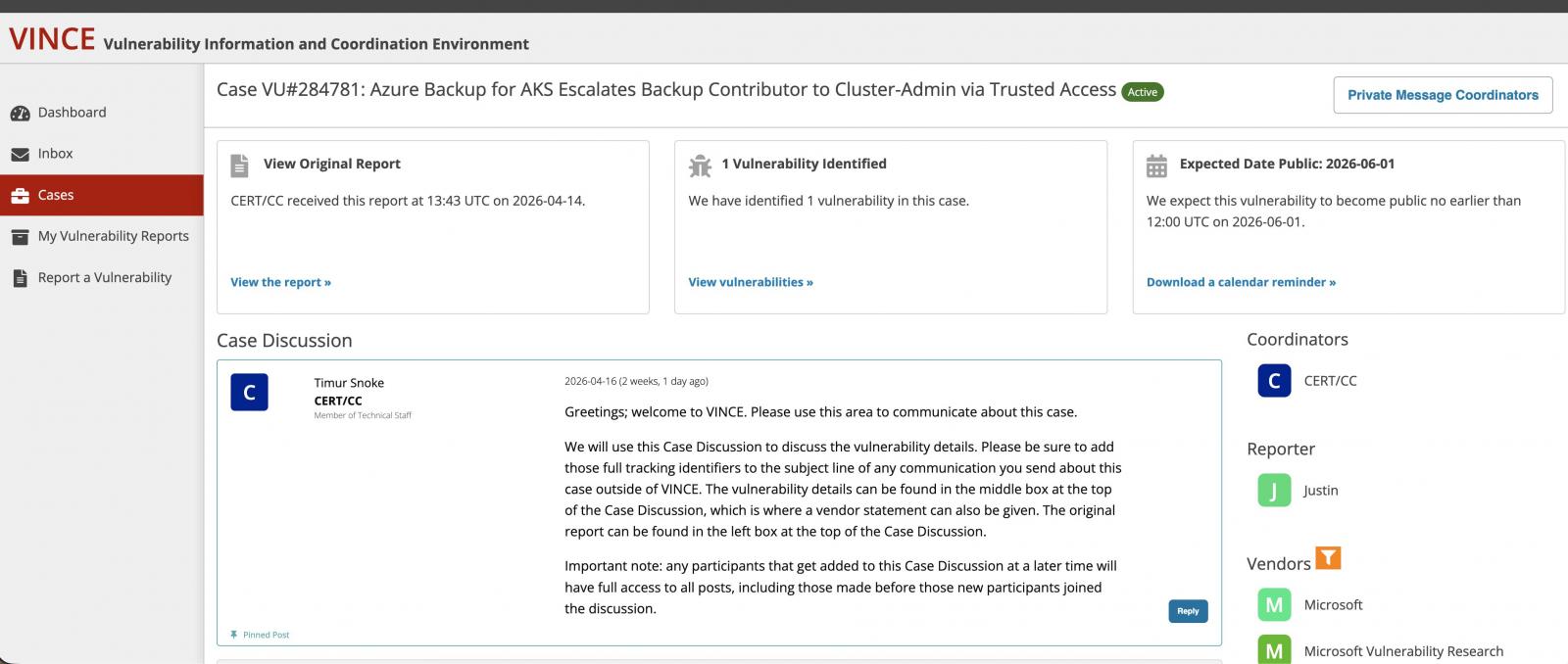
- April 16, 2026: Having exhausted his options with Microsoft, O’Leary escalates the report to the CERT Coordination Center (CERT/CC). CERT/CC independently validates the vulnerability and assigns it a tracking identifier: VU#284781.
- May 4, 2026: Microsoft contacts MITRE, the organization responsible for managing the CVE (Common Vulnerabilities and Exposures) system. Microsoft explicitly recommends against issuing a CVE, reiterating their stance that the behavior is intended and not a security flaw.
- May 2026: CERT/CC, bound by the hierarchical rules of the CVE Numbering Authority (CNA), is forced to close the case. Because Microsoft acts as its own CNA, they hold the final authority over whether a vulnerability in their product is documented for the public.
The "Silent Patch" Phenomenon
The most contentious aspect of this case is not just the rejection of the report, but the subsequent behavior of the Azure platform. Following the disclosure of his findings, O’Leary attempted to replicate the exploit to verify his initial research. He was met with new error messages that had not existed when he first reported the issue in March.
The error, UserErrorTrustedAccessGatewayReturnedForbidden, indicates that the system is now checking for a Trusted Access role binding that was previously handled automatically. Furthermore, O’Leary observed that the service’s Managed Service Identity (MSI) now requires explicit Reader and Contributor permissions on various resources—permissions that were not previously mandatory.
These changes effectively close the attack path O’Leary described. However, because Microsoft maintains that "no product changes were made," no security advisory has been published, and no customers have been alerted to the fact that their environments were potentially exposed to this privilege escalation vector for an indeterminate amount of time.
Institutional Disconnects: Official Responses
When questioned by BleepingComputer, a Microsoft spokesperson remained steadfast in the company’s assessment. The official statement provided to the media reads:
"Our assessment concluded that this is not a security vulnerability, but rather expected behavior that requires pre-existing administrative privileges within the customer’s environment. Therefore, no product changes were made to address this report and no CVE or CVSS score were issued."
This categorical denial stands in stark contrast to the technical documentation provided by O’Leary. Industry analysts suggest that this disconnect stems from a growing trend where vendors, faced with an overwhelming volume of vulnerability reports, attempt to reclassify or downplay findings to avoid the public scrutiny associated with CVE issuance.
The mention of "AI-generated content" by Microsoft representatives during the initial review process has also raised eyebrows. If vendors are dismissing reports based on the format of the submission rather than the technical merits of the exploit, it suggests a systemic failure in the triage pipeline—a sentiment shared by many in the security research community who argue that legitimate, high-impact bugs are increasingly being lost in the noise.
Implications: The "Visibility Gap" for Defenders
The absence of a CVE creates a significant "visibility gap" for security operations centers (SOCs) and cloud administrators. A CVE serves as more than just a label; it is a signal for defenders to investigate their logs, rotate credentials, and assess whether they have been compromised.
By failing to issue an advisory, Microsoft has effectively denied customers the ability to audit their own environments for potential indicators of compromise (IoCs) related to this specific vulnerability. As O’Leary points out, "Organizations that granted ‘Backup Contributor’ between an unknown start date and May 2026 were exposed to privilege escalation. Without a CVE, security teams cannot track this exposure. Silent patching protects vendors, not customers."
This incident underscores the structural weaknesses in the current vulnerability disclosure landscape. As security research becomes more complex, the power imbalance between corporations—who act as both the "judge and jury" for their own vulnerabilities—and the researchers who discover them is becoming unsustainable.
Conclusion: Realigning Incentives
The Azure Backup for AKS controversy is a microcosm of a larger problem. In recent months, high-profile maintainers of open-source projects and independent researchers have voiced similar frustrations. When a vendor can unilaterally decide that a critical flaw is merely "expected behavior," they effectively immunize themselves from the consequences of their software’s security failings.
The industry now faces a reckoning. If the goal of responsible disclosure is to protect the end-user, the current system is failing. Without a framework that enforces transparency—perhaps through an independent third-party arbitration body for CVE disputes or stricter mandates for public disclosure of security-relevant code changes—the industry risks a future where "silent patching" becomes the standard, leaving the very organizations that pay for these services in the dark.
For now, Azure administrators are left to wonder: if a critical flaw can be patched and denied in total silence, what other security gaps remain hidden within the cloud? The "validation gap" identified in this case serves as a stark reminder that in the cloud-first era, trust in a vendor’s infrastructure must be balanced with a rigorous, independent verification of the security controls beneath the surface.

 Basiran
 Iffa Jayyana
 Raul Delapena Setiawan
 Reynand Wu
 Sagoh
Sagoh

 Azzam Bilal Chamdy
 Ali Ikhwan