
 Asro
Asro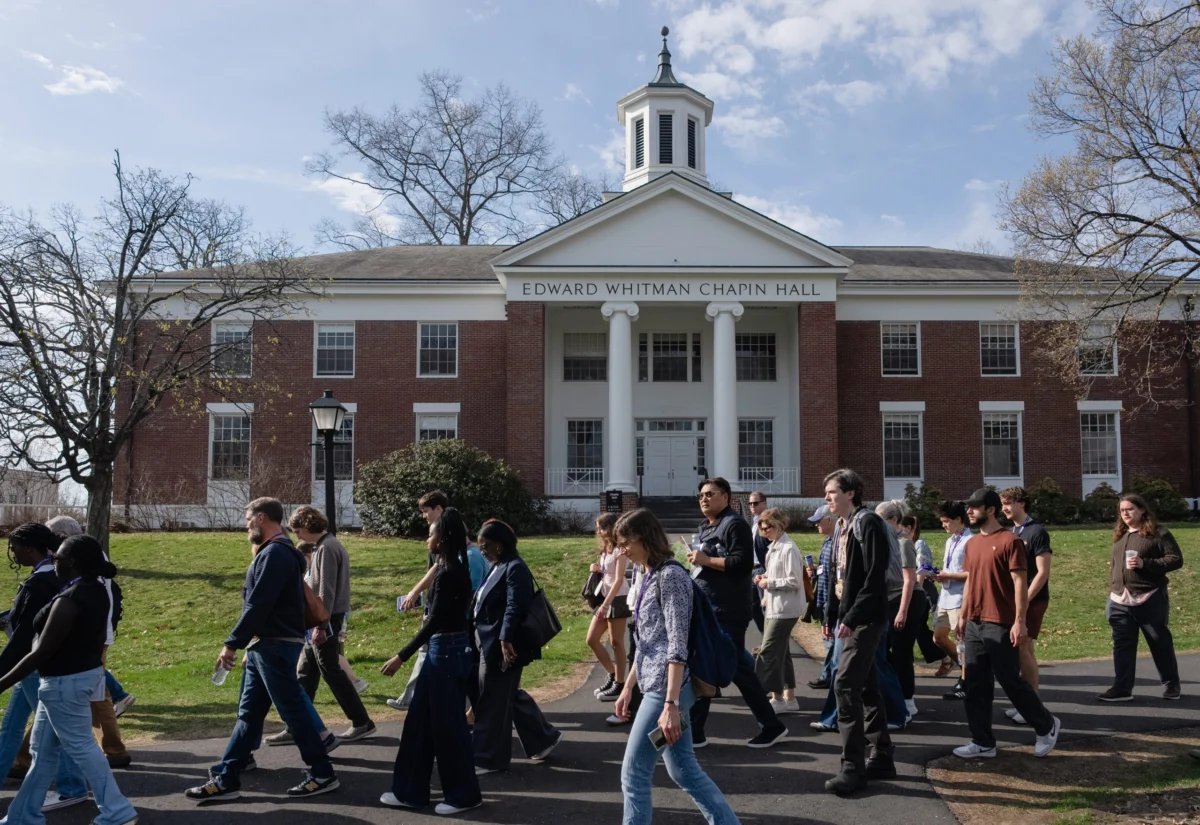
AMHERST, Mass. — Under the flicker of a fire pit outside the Amherst College campus center, a group of high school seniors gathered, their faces illuminated by the orange glow of burning logs. They weren’t there to party; they were there to prove their mettle.
“This is our test of how rural you are—is how good you are at making a fire,” Nathan Grove, the college’s assistant dean of admissions, joked as he worked to ignite a stack of kindling. The laughter that followed was tempered by the gravity of the occasion: a two-day immersion program designed to convince high-achieving rural students—a demographic historically overlooked by the nation’s most prestigious institutions—that they belong on an elite campus.
For these students, the path to an Ivy-plus university is often blocked by more than just high admissions standards. It is obstructed by a lack of access, deep-seated cultural skepticism, and the daunting financial and social barriers that define the rural American experience. Now, a $170 million initiative is working to change that, shifting the focus from simply getting rural students to apply to ensuring they actually enroll and graduate.

The Birth of the STARS Network
The movement began in earnest three years ago with the formation of the Small Town and Rural Students (STARS) College Network. The initiative was catalyzed by a $20 million donation from Byron Trott, a wealthy Missouri-born alumnus and University of Chicago trustee. Trott, who grew up in a rural environment, was alarmed to discover a glaring disparity: while rural residents make up nearly a quarter of the U.S. population, they represented a mere 3 percent of the student body at his alma mater.
The STARS initiative has since expanded into a robust coalition of 32 institutions, including powerhouses such as Brown, the California Institute of Technology, Columbia, Dartmouth, MIT, Stanford, UC Berkeley, and Yale. The Trott foundation has recently injected an additional $150 million into the network to solidify its longevity.
The core mission is simple yet radical: to send admissions officers to rural high schools that are rarely, if ever, visited by elite recruiters. A 2019 study confirmed that admissions officers were far more likely to target high-income, suburban, or private urban schools, effectively ignoring the untapped potential in the American heartland.

A Growing Momentum
The outreach is yielding results. Last year, more than 90,000 rural students applied to STARS member institutions, a 15 percent increase over the previous year.
Jack Hancock, a high school senior from rural Milford, Pennsylvania, admits he was shocked when the letters of interest began arriving. “I was frankly sort of shocked that they cared about rural students,” said Hancock, who overcame the grueling one-in-13 odds of admission to Amherst. Standing by the fire pit with his parents, he reflected on the cultural weight of his decision. In his hometown, the idea of heading off to a private, elite institution is often viewed with skepticism, if not outright suspicion.
“A lot of people don’t think it’s worth it,” Hancock noted. When his older brother enrolled in a private college last year, his mother, Jodi, famously ordered the smallest possible car window decal, fearing that a larger one would be seen as "putting on airs."

“That’s a rural cultural idea, that you don’t want to put yourself better than anybody,” she explained. “We certainly didn’t want to put on airs.”
The Anatomy of the Rural Enrollment Gap
Despite high school graduation rates in rural areas that often exceed those of cities and suburbs—90 percent compared to national averages—rural students are significantly less likely to matriculate to college. According to the National Student Clearinghouse Research Center, just over half of rural high school graduates head straight to college, a number that has been in steady decline since 2016. By comparison, nearly 60 percent of urban and 63 percent of suburban graduates continue their education.
The barriers are multifaceted:

- Economic Disparity: The median income in rural households is 12 percent lower than the national average. Even with generous financial aid packages offered by elite colleges, the sticker shock and the hidden costs of travel and supplies remain prohibitive.
- The "Mystique" Barrier: For many, elite colleges are viewed as foreign, inaccessible entities. Olivia Meier, a senior from Chugiak, Alaska, admitted that she doubted her own capabilities until she learned a peer from her school had been accepted to the University of Chicago. “It’s really easy to doubt yourself when applying to schools like this,” she said.
- Social Isolation: Once on campus, rural students often find themselves in a “rarefied environment,” as described by Mara Tieken, a professor at Bates College and author of Educated Out. “No one hunts. No one shops at Walmart. No one listens to country music. Some of the things that would have seemed so familiar to my students would be totally foreign,” she said.
"Through College," Not Just "To College"
As the STARS Network evolves, the focus has shifted from recruitment to retention. “This process is moving into not just the ‘to college’ part but the ‘through college’ part,” said Marjorie Betley, deputy director of admissions at the University of Chicago and executive director of STARS.
To facilitate this transition, member schools are funding campus visits for prospective students. Last year, over 1,000 students participated in these visits, staying in dorms and attending classes. This hands-on experience is critical for dismantling the intimidation factor.
Catherine Colberg, an admitted student from St. Joseph, Minnesota, toured Amherst’s state-of-the-art science facilities and was struck by the sheer scale of the resources. “My school has, like, one test tube that we all share,” she joked, highlighting the resource disparity that Nathan Grove, Amherst’s coordinator of rural outreach, sees regularly. “Rural students have a lot less access to the things that would typically prepare them for the rigors of an elite campus,” Grove acknowledged.

The Role of Networking and Professional Mentorship
Once on campus, the divide often manifests in the lack of professional social capital. Ryan Peipher, a neuroscience major at Amherst who grew up in Lancaster, Pennsylvania, helped start a rural student support group to address these hidden challenges.
“A good portion of Amherst students come from private Northeastern schools, who have been in upper-level chemistry and had experiences that rural students haven’t,” Peipher said. He points out that students from urban private schools often have family connections to industries like finance or law. “For a student from rural America who doesn’t have those connections, how can they network? How can they get that first leg up?”
Institutional Perspectives: Why Diversity Matters
University leadership argues that the push for rural enrollment is not merely an act of charity, but a strategic necessity. In an era of deep political and cultural polarization, the presence of students from diverse geographic backgrounds is vital to the educational experience.

“Students growing up in rural areas bring perspectives and experiences that students from urban environments don’t have,” said Amherst College President Michael Elliott. “They’ve grown up in different regions where the politics and the culture feel different, and we are interested in the prospect of bringing students together to learn from one another.”
The numbers bear this out. Since joining the STARS network, Amherst’s rural student population has grown from 6 percent to 11 percent. This year, the college accepted 119 rural applicants, utilizing its $3.9 billion endowment to ensure that financial barriers are minimized.
Implications for the Future
The long-term goal of the STARS initiative is to stabilize the future of rural communities. Recent Gallup surveys indicate that fewer than half of young people in rural areas are hopeful about finding good jobs in their home regions. By providing these students with elite educations, colleges are not necessarily looking to pull them away from their roots forever.

Many students, like Peipher, are looking to return. “Once you do get away, you experience how special it was to grow up in that small town, and also the impact you can have,” he said. He plans to attend medical school and return to a rural community to serve as a physician.
Kara Lewis, an Amherst junior from Mardela Springs, Maryland, shares this sentiment. “There’s a romantic sense that lots of students have coming from rural areas where it’s, like, ‘I wish I could get out of here,’” she said. “But I realized how unique it was. And I love it, like I never did when I was actually living there.”
As admissions officers continue to traverse the country, visiting schools in towns that have been off the map for decades, the promise of the STARS network remains clear: by showing up, by building trust, and by demystifying the college experience, elite institutions can finally become accessible to the entirety of the American student body. The distrust that has permeated rural perceptions of higher education is not innate; it is a consequence of absence. By being present, universities are beginning to bridge a divide that has lasted for generations.

 Layla Zulfa
 Ali Ikhwan
 Ammar Sabilarrohman
 Asep Darmawan


 Nila Kartika Wati
 Muslim