
 Lina Irawan
Disclaimer: The opinions expressed by Trellis expert contributors are their own, not those of Trellis.
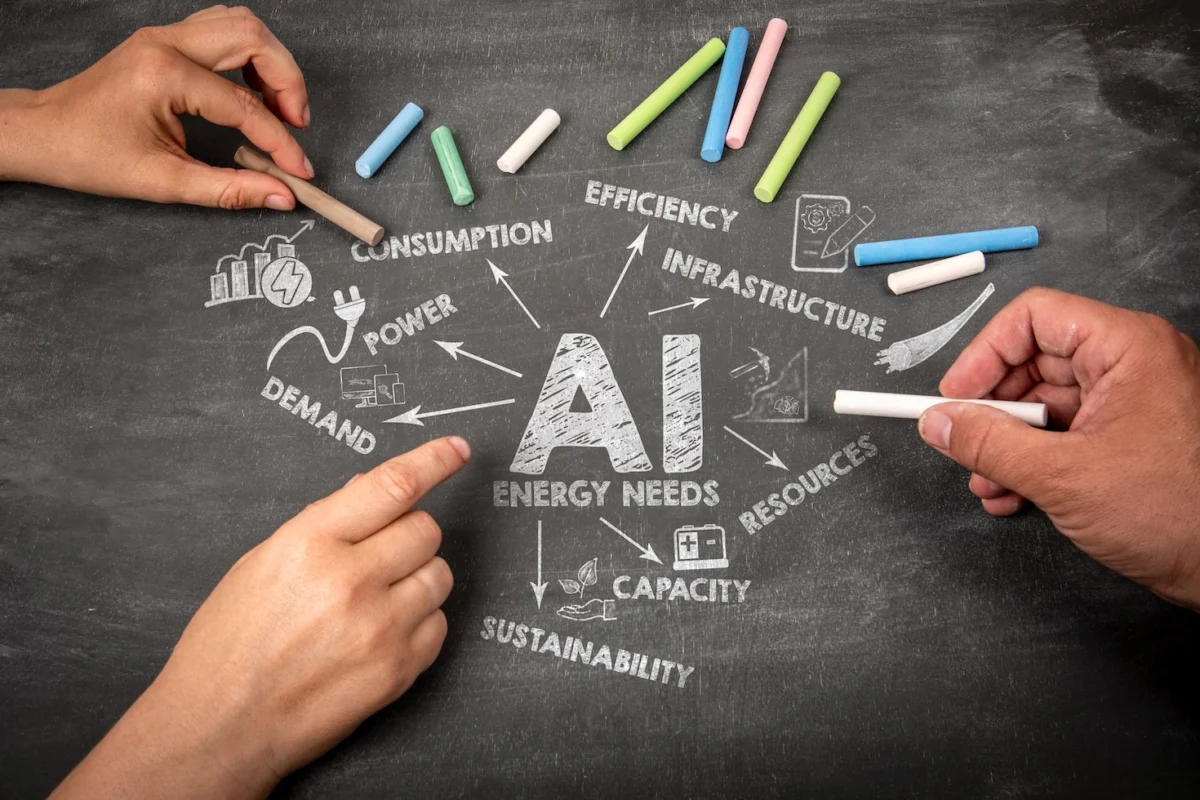
For sustainability practitioners, the rise of artificial intelligence has introduced a complex, multifaceted judgment call: Do the massive carbon emissions and resource consumption inherent in large-scale AI training and deployment outweigh the transformative potential these tools offer for climate mitigation?
The calculus remains frustratingly opaque. Quantifying the net environmental impact of AI is a daunting task, complicated by the fact that many lifecycle assessments omit critical data points—such as the massive electricity consumption of data center cooling systems or the carbon footprint of the hardware supply chain. Yet, despite this uncertainty, a growing body of evidence suggests that the "sustainability dividend" provided by AI may well justify the investment. From optimizing grocery logistics to modeling complex natural resource risks, AI is proving to be an indispensable lever in the transition to a low-carbon economy.
The Core Conflict: Weighing the Costs of Intelligence
At the heart of the debate lies the "energy-intensity" of machine learning. Training a state-of-the-art Large Language Model (LLM) requires thousands of specialized GPUs running for weeks, often drawing power from grids that may not yet be fully decarbonized. However, viewing AI solely through the lens of its power consumption ignores the efficiency gains it unlocks across global industrial systems.
Sustainability leaders are increasingly moving past the binary debate of "AI is bad vs. AI is good" toward a nuanced framework of "net-positive deployment." By applying AI to high-waste, high-carbon sectors, the technology is functioning as an efficiency engine that can identify marginal gains previously invisible to human operators.
Chronology of Innovation: AI in Action
The application of AI to industrial sustainability has accelerated rapidly over the last five years. While early pilots focused on simple pattern recognition, current implementations are integrated into the core operational infrastructure of global enterprises.
Phase 1: Operational Optimization (2020–2022)
Early successes were found in retail and manufacturing, where AI was tasked with "low-hanging fruit": reducing inventory waste and optimizing fuel combustion. These pilots demonstrated that AI could operate effectively within legacy systems, providing an immediate return on investment while simultaneously shrinking the carbon footprint.
Phase 2: Systemic Integration (2023–Present)
We are currently in the era of "Digital Twins" and enterprise-wide integration. Companies are no longer using AI for isolated tasks but are creating virtual mirrors of entire factories to monitor thermal energy, process flow, and waste in real-time. This phase marks the transition from reactive problem-solving to proactive, predictive resource management.
Phase 3: Strategic Risk Modeling (The Horizon)
The next frontier, currently in pilot stages, is the use of AI to quantify "Nature-Adjusted Economic Valuation" (NAEV). This involves mapping corporate reliance on ecosystem services against the risk of environmental collapse, allowing companies to price natural capital into their financial statements.
Supporting Data: Proof of Concept
Retail Logistics: The Cub and Afresh Case Study
Midwest grocery chain Cub faced a perennial challenge: managing the thin margins of produce while minimizing food waste. By partnering with the software firm Afresh, Cub implemented an AI-driven forecasting system that analyzed historical sales data, local demand trends, and seasonal variability.
- Pilot Phase (3 Months): Sales increased by 2%, and inventory holdings dropped by 7%.
- Full Rollout: Produce shrink fell by 18%.
- Environmental Impact: Cub is now on track to avoid 1,200 metric tons of greenhouse gas emissions, 43 million gallons of water, and 2 million pounds of food waste annually.
Industrial Manufacturing: Heidelberg Materials
In the cement industry, where combustion accounts for nearly a third of a plant’s emissions, efficiency is synonymous with sustainability. Heidelberg Materials deployed the Gigaton AI platform at its Mokra plant in the Czech Republic to refine kiln operations.
- Operational Parameters: The AI manages fuel mix, kiln speed, and oxygen levels in real-time.
- Efficiency Gains: Within the first month of continuous operation, the plant achieved a 4% reduction in fuel costs and a 2% drop in fuel-derived emissions.
- Decarbonization Potential: The system enables the shift from heavy fuel oil to less carbon-intensive fuel sources by optimizing heat consumption.
Digital Twins: The Virtual Path to Physical Efficiency
Perhaps the most exciting development in industrial sustainability is the emergence of AI-enabled "digital twins." By creating a virtual replica of a physical system—fed by real-time data from the shop floor—companies can simulate changes before implementing them, effectively eliminating trial-and-error waste.
The Unilever and Accenture Partnership
In June, a major collaboration between Unilever and Accenture was announced, aiming to scale digital twins across the manufacturing of soap, detergent, deodorant, and food. The initiative plans to construct 40 live-data twins.
- The Raeford, North Carolina Case: A digital twin of the deodorant production line (for brands like Dove and Degree) is already predicting 95% of process flow restrictions, resulting in a 20% reduction in physical waste.
- The Haldia, India Case: A twin focused on thermal management has optimized fan speeds and temperature settings, significantly reducing thermal energy consumption over a two-year period.
Official Perspectives: The NAEV Methodology
As corporate sustainability reporting evolves to include nature-related risks (as required by emerging frameworks like the TNFD), AI has become a critical analytical tool. The Nature Adjusted Economic Valuation (NAEV) approach represents a paradigm shift in how companies account for their impact on the planet.
"Before the widespread use of AI, such analyses—compiling vast volumes of field data and ecological models—would be prohibitively time-consuming and expensive to undertake," says the research team behind NAEV.
By using AI to process ecological data, companies can:
- Assess Reliance: Determine how much of their value chain depends on specific ecosystem services (e.g., water filtration, timber growth).
- Project Exhaustion: Model how quickly an ecosystem is approaching a "tipping point" or total degradation.
- Calculate Financial Risk: Translate the loss of ecosystem services into concrete financial metrics, such as revenue loss, business disruption costs, and weighted average cost-of-capital.
Implications: The Path Forward
The implications for the future of sustainability are profound. We are moving toward a reality where "data-driven sustainability" is not a marketing term, but an operational mandate.
1. The Necessity of Transparency
For AI to be a credible sustainability tool, developers must prioritize "Green AI." This means optimizing algorithms to be computationally efficient and ensuring that data centers are powered by renewable energy. Transparency regarding the "cost of compute" must become as standard as carbon disclosure.
2. A Shift in Capital Allocation
The NAEV studies indicate that financial institutions will soon be able to penalize or reward companies based on their natural capital risks. Companies that utilize AI to protect their supply chain ecosystems will likely see lower costs of capital, while those that continue to ignore environmental degradation will face increased risk premiums.
3. Redefining "Waste"
The success of companies like Cub and Unilever proves that "waste" is often just a data problem. AI transforms waste from an inevitable byproduct of industry into a failure of information. When we can see the exact cause of a process bottleneck or a food spoilage event, we can eliminate it.
4. A Net-Positive Outlook
While the skepticism regarding AI’s energy consumption is valid, the current trajectory suggests that the technology is maturing into a force multiplier for the planet. The potential to save millions of gallons of water, prevent thousands of tons of emissions, and protect vital ecosystems offers a compelling argument that the benefits of AI are not just incremental—they are systemic.
In conclusion, the sustainability practitioner’s mandate is clear: use AI to solve the world’s most difficult resource problems, but do so with a rigorous, data-backed eye toward the energy footprint of the tools themselves. The goal is to build an AI-powered economy that generates more value than it consumes, turning the tide on environmental degradation through the power of precision.


 Raul Delapena Setiawan
 Rifan Muazin

 Nana

 Layla Zulfa

 Ammar Sabilarrohman
