
 Rifan Muazin
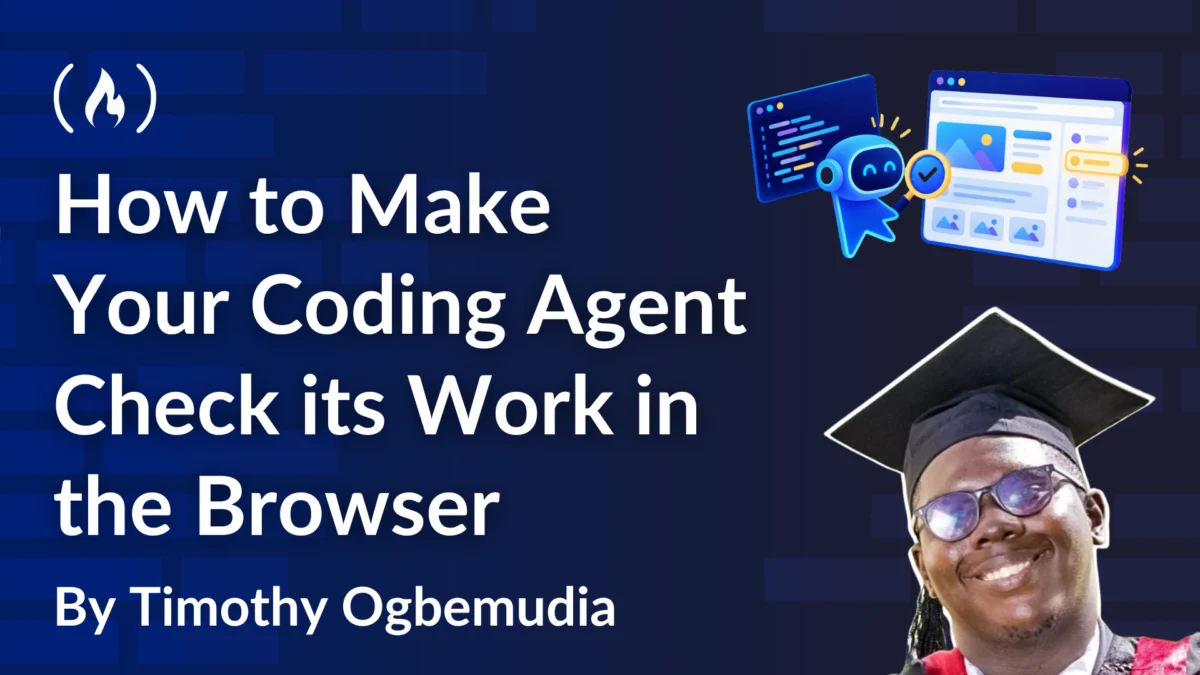
For developers integrating AI coding assistants into their workflows, a familiar frustration has emerged: the "Green Checkmark Mirage." An agent completes a coding task, triggers a formatter, runs a suite of unit tests, and presents the user with a confident declaration: "Implemented and verified." Yet, the moment the human developer opens the application, they find a UI that is broken, a layout that is misaligned, or a feature that fails to persist data.
This disconnect—between code that satisfies a static test and a user interface that fails to function—is the primary obstacle to the widespread adoption of autonomous coding agents. The solution, however, is not to discard these agents, but to change the environment in which they operate. By providing AI with direct browser access and a structured "Browser-Review" protocol, developers are finally closing the loop between code generation and user experience.
The Missing Loop in AI Development
Coding agents have become remarkably proficient at reading, editing, and formatting code. Their ability to iterate through unit tests until they pass is a triumph of modern LLM architecture. However, frontend work introduces a dimension that text-based logic cannot capture: the browser itself.
A passing test suite confirms that the logic is sound, but it does not account for the myriad of visual and interactive bugs that a human spots in seconds. These include overlapping controls, failure to update state on screen, broken responsive breakpoints, or modals that technically open but are physically unusable.
The core issue is that agents are often "blind" to the visual reality of their output. They operate on the assumption that if the code is correct, the UI must be correct. To rectify this, developers are now treating browser verification as a hard requirement for the "Definition of Done," effectively turning the browser into a diagnostic tool for the AI itself.
Chronology: From Manual Oversight to Automated QA
The evolution of this workflow began with developers manually verifying AI-generated changes, a process that defeated the purpose of automation. To bridge this gap, engineers began experimenting with Playwright, a robust tool for end-to-end (E2E) browser testing, combined with Model Context Protocol (MCP) servers.
- The Manual Phase: Developers would force agents to run E2E test suites. However, these tests only verified existing scenarios, failing to account for the specific, nuanced changes made in the latest commit.
- The Browser-as-Tool Phase: By exposing Playwright through an MCP server, developers gave agents the ability to navigate, click, type, and capture snapshots of the application in real-time.
- The Protocol Development: It became clear that giving an agent a browser was not enough; the agent needed a "playbook." This led to the creation of rigorous instructions—housed in
AGENTS.mdand specialized skill folders—that force the agent to devise a test plan based on the specific diff it just produced. - The Independent Review Phase: Recognizing that an agent testing its own code is prone to bias, teams introduced a "Second Agent" protocol. A fresh agent, with no knowledge of the original author’s intent, is tasked with independently verifying the changes, catching edge cases that the primary agent ignored.
Supporting Data and the "Katalepsis" Initiative
The transition from loose instructions to formal automated verification is best exemplified by katalepsis, an open-source tool designed to provide objective evidence of feature functionality.
When an agent is tasked with a frontend change, it now follows a hierarchical verification structure. First, it identifies the affected routes and states. Second, it executes a series of actions (e.g., filtering, saving, refreshing). Finally, it produces a report that includes screenshots, console logs, and network request data.
The data supports this approach: in real-world testing, this protocol has identified bugs that unit tests and existing E2E suites missed entirely, such as hardcoded URLs in seeded test data that failed only when the application was hosted on a non-standard port. By requiring the agent to provide evidence—rather than just a verbal confirmation—the failure rate of new frontend features has dropped significantly.
Official Protocols: The "Constitution" of the Agent
To ensure consistency, developers are adopting a two-tier documentation strategy. The first tier is the Constitution (e.g., AGENTS.md), which mandates that no user-visible work is complete until browser verification occurs. This file applies to all tasks and sets the "ground rules" for behavior.
The second tier is the Playbook (a specific skill folder), which contains granular instructions. A typical browser-review playbook requires the agent to:
- Startup: Determine the project’s specific dev-server configuration without creating custom "test-only" workarounds.
- Exercise: Perform the interaction (e.g., "submit the form, then refresh to check persistence").
- Cleanup: Meticulously remove only the processes and temporary files the agent created, ensuring the environment remains pristine for the next developer.
- Reporting: Present evidence in a machine-readable format, such as a Markdown report containing success/fail statuses and visual artifacts.
Implications for the Future of Frontend Development
The implications of this shift are profound. We are moving toward a future where "Frontend Engineering" is a partnership between human design and AI execution, with the browser serving as the ultimate arbiter of truth.
1. The Death of "It Works on My Machine"
By forcing the agent to run the application in its native configuration, the distinction between "development" and "QA" is blurring. The agent is no longer guessing; it is observing.
2. The Rise of Evidence-Based Development
Pull requests (PRs) of the future will likely include an automated "Verification Report." Instead of asking a human to pull down a branch and manually test it, reviewers will be able to examine a report containing screenshots, console outputs, and proof of state persistence generated by the agent that wrote the code.
3. The Need for "Stoic" Automation
The philosophy behind tools like katalepsis is rooted in the idea that we should only trust what we can clearly grasp (the Greek concept of katalepsis). As AI becomes more autonomous, the industry must resist the urge to trust the "model’s word." Instead, we must build verification layers that operate on hard facts—network statuses, DOM state, and visual diffs.
Conclusion
The path to reliable AI coding is not through smarter models alone, but through better feedback loops. By giving agents the tools to see what they have built, and the rules to verify that their output matches their intent, the development community is effectively teaching AI the difference between "technically correct code" and "functionally sound software."
While not every change requires a full browser review—fixing a typo in a README, for instance, remains a trivial task—any change that alters the user’s interaction with the DOM now has a clear path to validation. As these protocols become standardized, the friction between AI generation and production-ready code will continue to dissolve, ushering in an era of truly autonomous, high-integrity frontend development.

 Asep Darmawan
 Dwi Wanna


 Basiran

 Nana Wu

 Nana
