
 Evan Lee Salim
In the contemporary software development landscape, the velocity of code creation has decoupled from the traditional mechanisms of oversight. Building on the web today is no longer a painstaking, line-by-line manual process; it is a high-speed interaction with sophisticated AI code generators. Modern AI agents now routinely churn out hundreds of lines of code across half a dozen files in a single, fluid session.
Yet, the institutional guardrails—review processes, strict coding standards, and governance protocols—remain anchored in a bygone era. These systems were built on the assumption that a human being would type every character and manually open a pull request only after a task was "complete." As developers increasingly rely on "vibe-coding" (an intuitive, rapid-iteration development style), the gap between generation and verification has become a critical vulnerability.
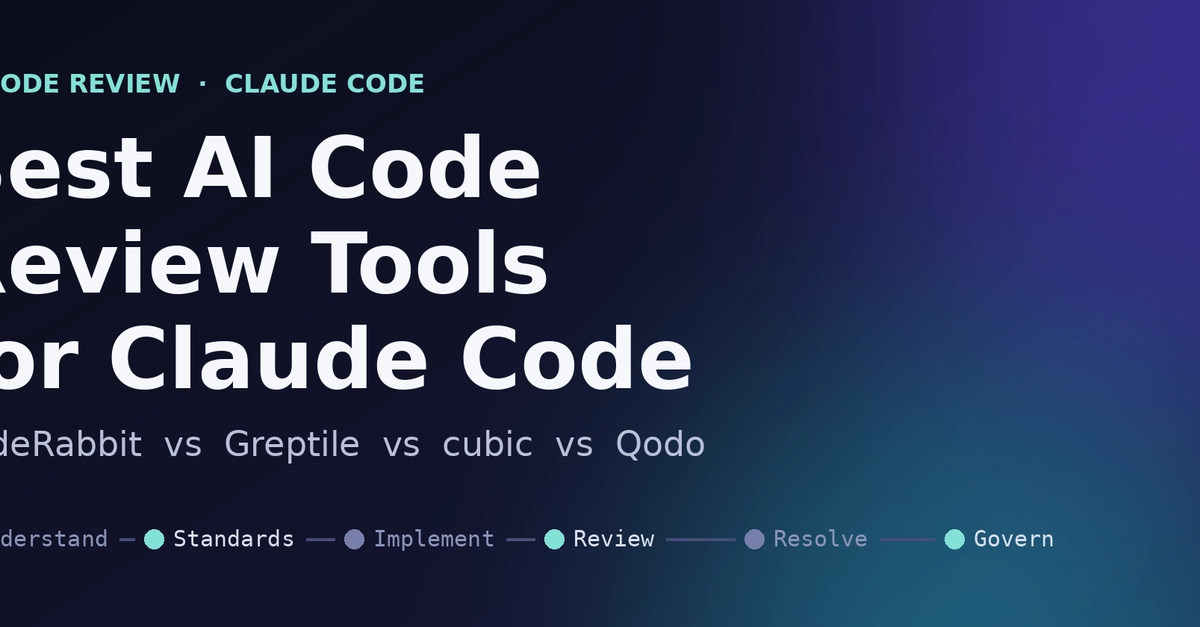
If an agent writes 400 lines of code before a developer ever hits "commit," who is checking the quality? To address this, a new category of "quality layer" tools has emerged. This article evaluates the four leading contenders—Qodo, CodeRabbit, Greptile, and Cubic—as they attempt to bridge the gap between AI-driven implementation and enterprise-grade reliability.
Defining the Quality Layer: What Agents Actually Need
To effectively oversee an AI coding agent, a tool must do more than just flag syntax errors in a pull request. A robust quality layer must operate throughout the entire development lifecycle, rather than acting as a static gatekeeper at the end of the process.
The evaluation criteria for these modern tools are expansive:
- Contextual Awareness: Can the tool understand the full repository architecture, historical data, and complex relationship between files?
- Pre-Generation Standards: Can it inject organizational standards before the code is written, preventing errors rather than just documenting them?
- Independent Review: Does the tool offer an objective third-party analysis, or does it simply ask the AI to "check its own homework"?
- Traceability: Are decisions, resolutions, and findings recorded for future audit?
- Governance: Can teams enforce consistent standards across multiple repositories and diverse agent teams?
Chronology of the Shift: From PRs to Working Trees
Historically, code review began when a developer opened a pull request. However, AI agents work in "dirty" environments—a state where multiple files are modified, deleted, or created, but nothing is yet committed to source control.
The market has split into two camps: those that wait for the PR and those that can analyze a "dirty" working tree.
The "Dirty Tree" Capability
- Qodo: Operates on the local diff plus untracked files, allowing developers to review work before a single commit is pushed.
- Cubic: Directly targets uncommitted work, providing immediate feedback during the "vibe-coding" session.
- CodeRabbit: Provides flexible options, allowing for reviews of staged, unstaged, or untracked edits.
- Greptile: The outlier in this specific metric. It currently focuses on the delta between the current branch and the default branch, meaning it remains "blind" until the agent commits its work.
Supporting Data: Comparative Features and Integration
The integration methods for these tools define how they manifest in the developer’s terminal. While all utilize the Model Context Protocol (MCP) in some capacity, their philosophies diverge significantly.
| Tool | Primary Integration | Core Philosophy |
|---|---|---|
| Qodo | CLI & Marketplace Plugin | Full-lifecycle agentic governance |
| CodeRabbit | MCP Client / CLI | Machine-readable CI/CD feedback |
| Greptile | MCP Server / Plugin | Deep repository analysis & analytics |
| Cubic | MCP Server / ACP | Architecture-neutral, self-billed model |
Qodo: The Holistic Approach
Qodo distinguishes itself by treating the "Understand-Write-Review-Resolve-Govern" cycle as an integrated unit. Its Agentic Toolbox is not a passive review tool; it is an active participant in the coding session. Its "Get Rules" skill, for instance, pulls organizational standards into the context window before the agent starts writing. By the time the code is generated, the agent is already constrained by the team’s secret-handling and validation requirements.
CodeRabbit: The Machine-Readable Powerhouse
CodeRabbit is designed for teams that prioritize automation. Its cr review --agent command is a masterclass in API design for machines, outputting JSONL where every finding is categorized by severity and paired with codegenInstructions. This makes it the premier choice for organizations building custom CI gates, where the goal is to feed review data directly into downstream automated fixers.
Greptile: The Analytics Specialist
Greptile offers a massive library of 19 distinct tools through its MCP server, covering everything from pull requests to complex knowledge base querying. While it struggles with uncommitted work, its strength lies in its ability to synthesize "custom context." It allows teams to store and retrieve team-specific patterns, acting as a highly intelligent, searchable memory bank for the codebase.
Cubic: The Architectural Minimalist
Cubic provides a unique value proposition by running local Claude Code as a subprocess over the Agent Client Protocol (ACP). Because it does not proxy credentials or API calls, it provides a transparent, secure environment where the developer maintains full control over model billing. It is an "architectural choice" for teams who want to keep their stack lean and their costs direct.
Official Responses and Governance Implications
Governance is where these tools transition from "developer convenience" to "enterprise necessity." Qodo’s "Manage Standards" skill represents the most significant step forward in this area. It allows admins to update review standards conversationally. If a team decides that a certain pattern is no longer acceptable, they can adjust the rules within the chat session. This prevents the "stale standard" problem, where developers ignore outdated documentation because it is too cumbersome to update.
In contrast, CodeRabbit and Greptile leave the governance layer to the human team. While they provide excellent reporting, the onus of maintaining and distributing those standards remains external to the agent’s actual execution loop.
The Implications for Engineering Teams
The shift toward agentic development is inevitable. However, the implication for team leads is that the "Human-in-the-loop" model must evolve into a "Human-as-overseer" model.
The Trade-off of "Fixed/Skipped/Reported"
A significant implication of tools like Qodo is the introduction of a formal "resolution contract." By forcing the agent to categorize findings as fixed, skipped, or reported, these tools move code review away from the subjective nature of human commentary. It creates an audit trail that is not just readable by people, but actionable by subsequent agents. This is the foundation of self-healing, self-governing codebases.
The Cost of Quality
Pricing models also reveal the intended audience for these tools. With costs ranging from $24 to $72 per developer per month, and some tools pushing enterprise users to sales teams for custom pricing, the "quality layer" is now a significant line item in the engineering budget. Teams must decide whether they are paying for a reviewer or for a reduction in technical debt.
Strategic Recommendations
- For High-Compliance Teams: Qodo is the clear leader. Its ability to enforce standards pre-generation is a major hedge against security and architectural drift.
- For CI/CD-Heavy Teams: CodeRabbit’s JSONL output and stable severity ladder make it the ideal candidate for building complex, automated pipeline logic.
- For Large-Scale Knowledge Management: Greptile’s extensive toolset and knowledge base capabilities are unmatched for teams managing massive, multi-repo codebases.
- For Cost-Conscious/Custom-Build Teams: Cubic provides the cleanest path to integration, allowing teams to leverage their own model billing and local infrastructure without vendor lock-in.
Conclusion
The era of manual, after-the-fact code review is closing. As agents become the primary authors of our software, the quality of that software will be determined by the quality of the "governance layer" surrounding the agents. Whether through the proactive, standards-driven approach of Qodo or the machine-readable precision of CodeRabbit, the goal remains the same: ensuring that in our rush to build faster, we do not compromise the integrity of what we are building.
The choice of tool now defines the culture of the team. Are you building a system where the agent is a black box that needs checking, or a system where the agent is a governed participant in a well-defined, standard-compliant ecosystem? The answer to that question will define the trajectory of your engineering team in the years to come.


 Nila Kartika Wati
 Lina Hope
 Rifan Muazin
 Asep Darmawan


 Basiran
