
 Ammar Sabilarrohman

The digital marketing landscape is currently undergoing its most significant transformation since the inception of the search engine. As generative AI embeds itself into the core of how users navigate the internet, a pervasive narrative has taken hold: that the era of traditional SEO is over, and the new battleground is "Generative Engine Optimization" (GEO)—the pursuit of visibility within Large Language Models (LLMs) like ChatGPT, Claude, and Perplexity.
However, a comprehensive analysis of 100 websites and over 145 million sessions suggests that the industry may be chasing a phantom. While the allure of being "cited" by an AI chatbot is high, the actual return on investment for businesses lies elsewhere. As the web evolves from a library of links into an "agentic" ecosystem of task-oriented services, brands that focus on LLM traffic metrics are missing the forest for the trees.
The Data: The Reality of LLM Referrals
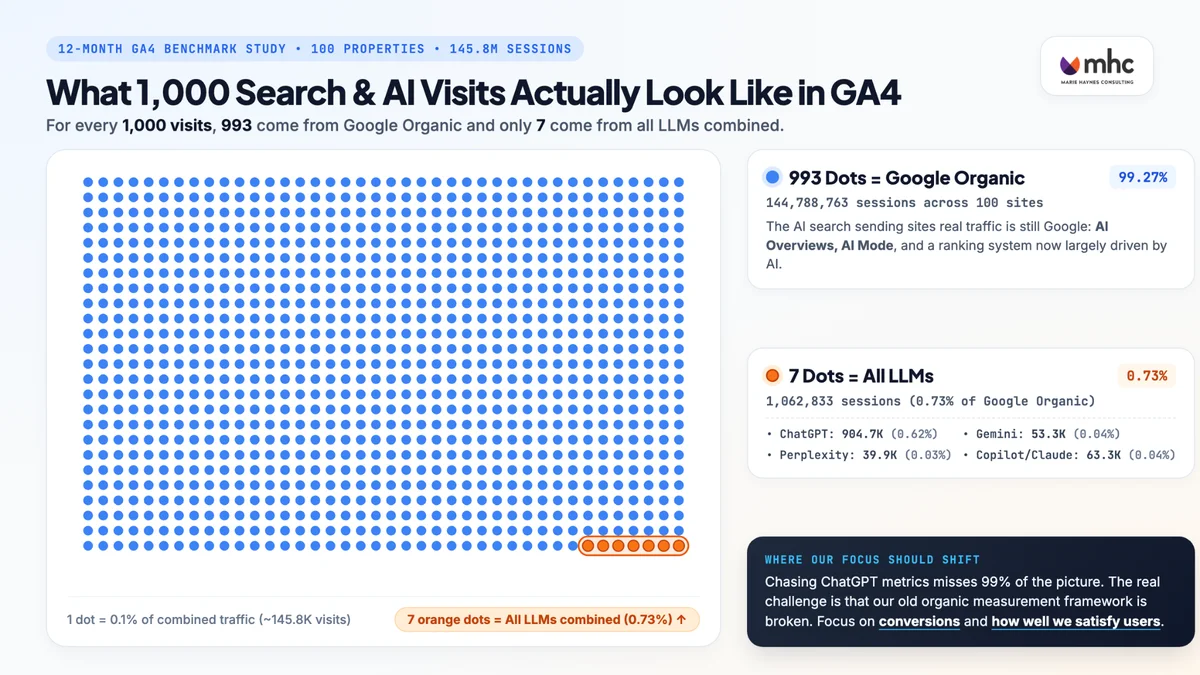
To understand the current state of search, we must look at the numbers. An audit of 100 websites across varying industries and scales revealed a sobering statistic: sessions originating from ChatGPT account for a mere 0.62% of the traffic volume driven by Google Organic search. Even when factoring in the entire ecosystem of LLMs, that figure barely climbs to 0.73%.
This data, spanning a 12-month period, serves as a stark reality check. While LLM adoption has grown, it has not cannibalized Google’s market share in the way many industry pundits predicted.
Chronology of a Plateau
When ChatGPT first surged in popularity, the growth trajectory of its referral traffic to websites was exponential. Marketers, observing these trends, extrapolated that within a few years, LLMs would become the primary gateway to the web.

This prediction has proven false. In August 2025, coinciding with the release of GPT-5, the exponential growth of ChatGPT-driven sessions flatlined. In fact, for many of the sites analyzed, the volume of referral traffic from AI tools has begun a slow, steady decline. The "hype phase" of LLMs as traffic drivers has officially ended, giving way to a more nuanced reality where AI is used more for task completion than for navigation.
Conversions: Quality Over Quantity
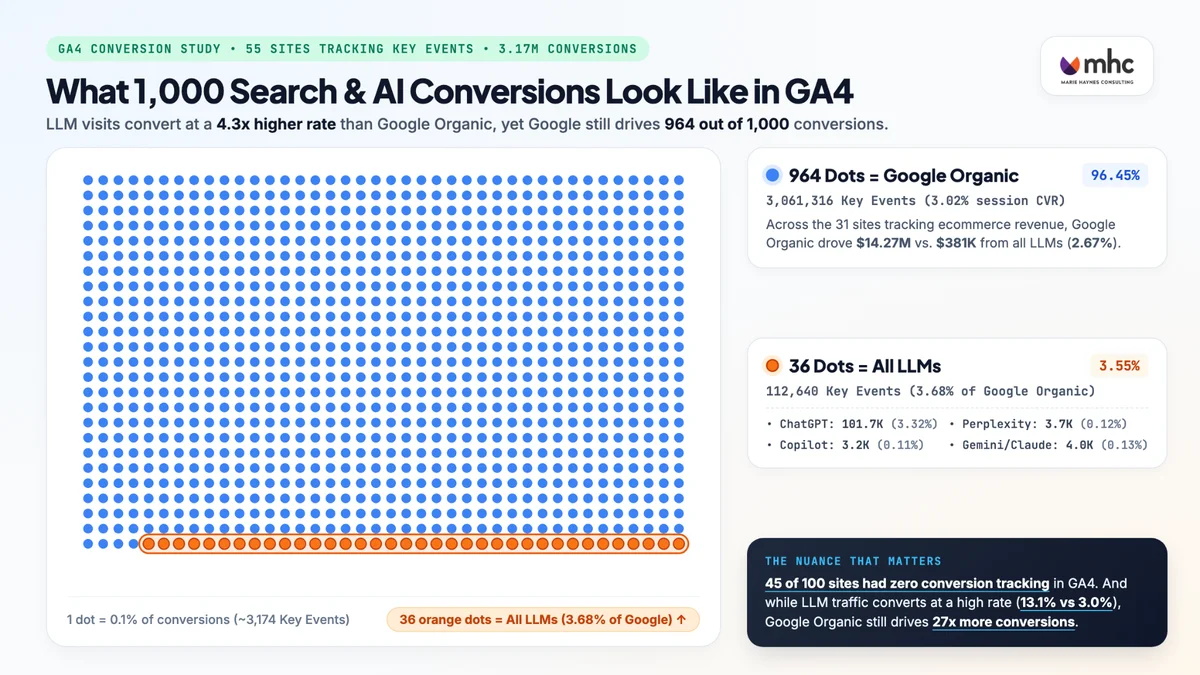
Critics might argue that while traffic volume is low, the quality of traffic from LLMs is superior. The data supports this partially: visitors from ChatGPT do convert at a rate roughly 4.5 times higher than that of Google Organic traffic.
Yet, when placed in context, this statistic is deceptive. Because Google Organic volume is so vastly superior—driving 96.5% of total conversions across the studied sites—it remains the undisputed engine of economic activity. In this specific dataset, Google Organic generated 27 times more conversions than all LLMs combined.
For the average business, the marginal gains found in "optimizing for ChatGPT" are statistically insignificant compared to the impact of maintaining a robust, user-centric presence on Google.
The True Shift: Google as an "Agent Manager"
The most critical takeaway from current search trends is not that AI is replacing Google, but that Google is evolving into an "agent manager."
Google is no longer just a passive directory of links; it is becoming an active intermediary that coordinates tasks. Whether through AI Overviews, the newly introduced "AI Mode," or core ranking systems powered by deep learning, Google is successfully keeping users within its ecosystem.
The frustration felt by publishers regarding the decline of "informational" clicks is a symptom of this transition. If a user can get their answer—or even complete a transaction—without leaving the Google interface, they will do so. For businesses, this means the goal of SEO must shift from "getting the click" to "being the preferred provider for the agent."
The Future: The Agentic Web
As we look toward the next three to five years, the "agentic web" will fundamentally alter the consumer-to-business relationship. Industry leaders, including Google’s Sundar Pichai and DeepMind’s Demis Hassabis, have signaled that the web will soon be navigated by autonomous agents rather than humans.
1. The Universal Cart and Commerce Protocols
Google’s Universal Cart is the prototype for this future. By aggregating products from multiple retailers into a unified checkout within Google Wallet, the platform removes the friction of visiting individual websites.
For retailers, the implication is clear: mastering the Google Merchant Center is no longer optional. It is the technical foundation upon which future agentic transactions will be built. Businesses must ensure their data—pricing, stock status, and product attributes—is perfectly optimized to feed these automated shopping systems.

2. Universal Commerce Protocol (UCP)
The emergence of UCP, a collaboration between Google, Shopify, and Stripe, provides the discovery layer for AI agents to compare inventory and facilitate purchases. As this protocol matures, the ability for an AI agent to purchase a product on behalf of a user without that user ever visiting the business’s website will become common. Success in this era will require SEOs to transition from traditional keyword strategy to "agentic discovery"—ensuring that a brand’s technical endpoints are readable and actionable by non-human interfaces.
3. WebMCP: Exposing Interactive Functions
WebMCP (Model Context Protocol) is the mechanism by which websites will expose their internal functions—such as booking engines, calculators, and specialized forms—to AI agents. While currently in its nascent stages, the ability to "plug" your website’s utility into an agent’s capability set will define the next generation of digital competition.
4. Intelligent Eyewear and Ambient Search
Perhaps the most disruptive development is the rise of "Intelligent Eyewear." With Google’s push into Android XR, search is moving from the screen to the real world. Imagine a user walking through a store, looking at a product, and asking their eyewear to "find me a better price" or "check if this is compatible with my current setup."
This creates an "ambient" search environment where the "See it, Solve it, or Buy it" use case becomes the standard. Businesses that fail to prepare their data and services for these multimodal, location-aware interactions will be invisible in the physical world.
Implications for Strategy: What Should Businesses Do?
The obsession with tracking "mentions in ChatGPT" is a distraction. If your business is not ranking on Google, you are missing the vast majority of your potential audience.
To thrive in the agentic era, businesses must adopt a four-pillar strategy:
- Prioritize Conversion Tracking: A surprising 45% of the studied websites were not properly tracking key events in GA4. You cannot optimize what you do not measure. Define what a successful interaction looks like for your business and track it religiously.
- Focus on User Satisfaction: Google’s ranking systems are increasingly driven by deep learning models designed to predict user satisfaction. Stop writing for algorithms and start optimizing for the human experience.
- Audit Your Technical Infrastructure: Begin exploring how your site might interact with UCP and WebMCP. Does your inventory data flow seamlessly to Merchant Center? Are your booking tools easily accessible to API calls?
- Experiment with Agentic Use Cases: Don’t wait for the technology to reach maturity. Brainstorm how an AI agent might solve a customer’s problem using your services. If you are a plumber, how can an agent diagnose a leak using your site’s tools? If you are a retailer, how can an agent verify your stock in real-time?
Conclusion: Stop Chasing Ghosts
The "Agentic Web" is not a distant science-fiction concept; it is being built in the background of every Google search today. While the industry remains fixated on LLM citations and generative SEO, the real opportunity is being forged in the infrastructure of commerce, interactive protocols, and ambient computing.
The goal is no longer to get a user to visit your website. The goal is to be the provider that Google’s agents trust, the partner that integrates with their tools, and the brand that provides the most value in a frictionless, agent-driven economy. Stop chasing the blue links of the past and start preparing for the automated future.


 Sagoh

 Raul Delapena Setiawan

 Reynand Wu



 Azzam Bilal Chamdy

 Ali Ikhwan
