
 Dwi Wanna
The retail landscape in Austria has undergone a profound transformation over the last decade, shifting from a brick-and-mortar stronghold to a dynamic, digital-first environment. According to the latest comprehensive analysis by RegioData Research, 2025 marked a significant milestone for the Alpine nation: online consumer spending in retail surged to over 16 percent of the total market, up from 14.9 percent in 2024. This growth represents a total e-commerce market volume of approximately 12.4 billion euros, cementing the internet’s role as an essential pillar of the Austrian economy.
For the average Austrian consumer, the digital transition is now a daily habit, with annual online spending reaching roughly 1,400 euros per person. As the market matures, the disparity between product categories has become increasingly pronounced, revealing clear winners in the digital shift.
The Chronology of Digital Adoption in Austria
To understand the current surge, one must look at the trajectory of the last several years. The period between 2020 and 2025 was a catalyst for change, driven initially by global health mandates that forced even the most traditional consumers to experiment with digital purchasing.
- 2020–2021: The Acceleration Phase: The pandemic acted as a forced accelerator. During this period, Austrian retail saw a massive influx of new users who had previously been wary of online payment security or delivery logistics.
- 2022–2023: The Hybrid Consolidation: As physical stores reopened, many analysts predicted a total return to offline retail. However, the data showed a "hybrid" habit formation, where consumers continued to browse online before purchasing in-store (ROPO: Research Online, Purchase Offline) or vice versa.
- 2024: The Competitive Pivot: Retailers began heavily investing in omnichannel strategies. With the online share hitting 14.9 percent, it became clear that digital presence was no longer optional for survival.
- 2025: The New Equilibrium: With the market share hitting 16 percent, the sector has entered a phase of stabilization. E-commerce is no longer a "growth trend" but a foundational element of the retail ecosystem.
Sector-Specific Insights: Where Austrians Spend Online
The RegioData research highlights that not all retail sectors are experiencing the same digital penetration. The divide is primarily determined by the "tangibility" of the product and the convenience of home delivery.
Electronics and Footwear Lead the Charge
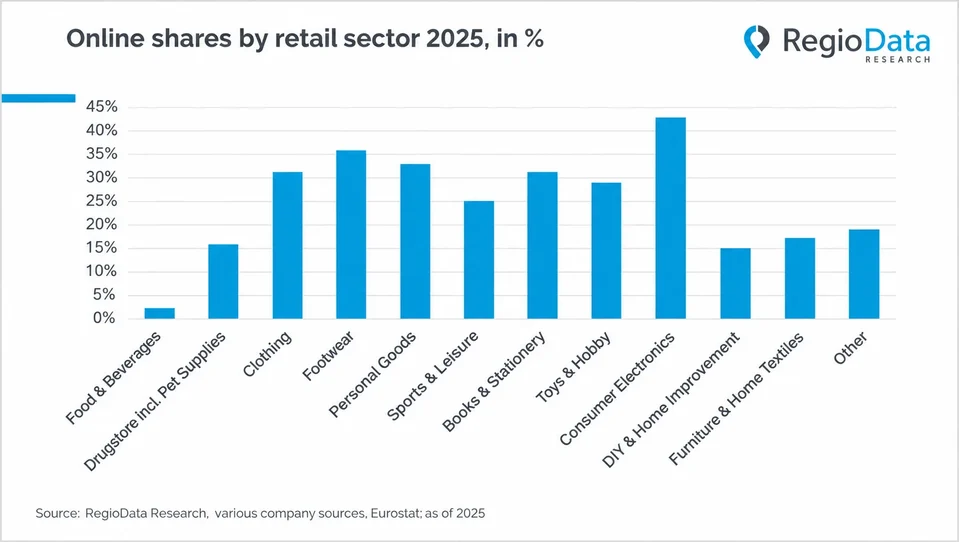
The consumer electronics sector remains the undisputed king of e-commerce in Austria. With 43 percent of all consumer spending occurring online, it is evident that Austrians prefer the deep technical comparisons and price transparency offered by digital platforms for high-value items like smartphones, laptops, and home appliances.

The Fashion and Lifestyle Shift
Footwear follows closely behind at 36 percent, likely bolstered by generous return policies that mitigate the "fit-and-size" risk associated with buying shoes online. Personal goods and clothing hover around the 33 percent and 31 percent marks, respectively. The book industry, which was one of the first to be disrupted by e-commerce globally, remains strong in the digital space at 31 percent, highlighting that the convenience of digital libraries and doorstep delivery of physical copies remains a highly preferred consumer behavior.
Comparative European Benchmarking
When positioned against the broader European Union landscape, Austria occupies a middle-ground position. It is neither a digital laggard nor a hyper-digitized outlier.
- The UK Benchmark: The United Kingdom continues to lead the continent with a staggering 29.3 percent online retail share. The UK’s legacy of early adoption and advanced logistics infrastructure remains the gold standard.
- The German Parallel: Austria is currently mirroring its neighbor, Germany, which reports an online share of 16.8 percent. The cultural and logistical similarities between the two nations suggest that they will continue to track closely in future growth metrics.
- The Emerging Markets: Countries like Serbia, currently at 6.7 percent, represent the "growth frontier" of European e-commerce. As internet penetration and digital payment infrastructure continue to improve in Eastern and Southeastern Europe, these markets are expected to see the fastest percentage growth in the coming years.
The Battle of the Platforms: Local vs. Cross-Border
A critical finding in the 2025 report is the dominance of international, cross-border sellers over domestic Austrian retailers. Currently, only about 40 percent of online spending is retained by local Austrian online stores. The remaining 60 percent flows across borders, primarily to global giants.
The "Big Three" and the Rise of Chinese Retailers
Amazon remains the undisputed leader in the Austrian market, commanding a 35.1 percent market share. The platform’s logistics network and Prime ecosystem create a high barrier to entry for local competitors. However, the rise of discount-focused Chinese platforms has been the most significant market disruption of 2025:
- Temu: Has captured a 5.1 percent share, signaling a strong consumer demand for low-cost, high-volume consumer goods.
- eBay: Maintains a steady 4.1 percent, continuing to serve as a hub for both second-hand and new goods.
- The "China Bloc": When combined, platforms like Temu, Shein, and AliExpress account for 7.9 percent of the Austrian online market. This suggests a shift toward ultra-affordable, fast-fashion, and impulse-buy models.
Implications for the Austrian Retail Economy
The shift toward cross-border digital dominance has significant implications for local stakeholders, policymakers, and urban planners.

Economic Implications
For the local Austrian economy, the outflow of capital to non-EU or global platforms presents a challenge for domestic tax revenue and local employment. While digital sales provide convenience, the "leakage" of retail spending to platforms that do not maintain physical infrastructure in the country puts pressure on the viability of traditional high-street shops.
Strategic Shifts for Retailers
Austrian retailers are being forced to adapt. The successful ones are moving toward:
- Hyper-Personalization: Utilizing AI to offer customer experiences that generic global platforms cannot match.
- Sustainability and Localism: Leveraging the "Made in Austria" brand to appeal to the growing segment of environmentally conscious consumers who prefer local logistics chains.
- Omnichannel Synergy: Converting physical stores into "experience hubs" or local distribution centers to facilitate click-and-collect, thereby reducing shipping costs and increasing foot traffic.
Regulatory and Policy Responses
Governmental bodies in Austria are increasingly looking at the impact of cross-border e-commerce on local competition. There is an ongoing debate regarding the regulation of non-EU marketplaces, particularly concerning product safety standards, VAT compliance, and environmental regulations for packaging and shipping. As these platforms gain more market share, the demand for a "level playing field" from domestic retailer associations is likely to grow louder in the national parliament.
Conclusion: The Path Forward
The data from 2025 provides a clear roadmap of the future of retail in Austria. With a 16 percent online penetration rate, the market is poised for continued, albeit more measured, growth. The future will likely be defined by a delicate balance: the consumer’s demand for the convenience and low pricing of global giants versus the desire for sustainable, local, and high-quality service.
For businesses operating in Austria, the message is clear: digital excellence is no longer a competitive advantage—it is the baseline. Those who can successfully integrate their digital operations with a unique, localized customer experience will be the ones to thrive in this new, competitive landscape. As we look toward 2026 and beyond, the focus will likely shift from simply "being online" to "being the preferred digital partner" in an increasingly globalized retail world.


 Reynand Wu

 Iffa Jayyana

 Raul Delapena Setiawan


 Sagoh

 Azzam Bilal Chamdy

 Ali Ikhwan
