
 Lina Hope
In the mid-19th century, the "boiling frog" fable became a metaphor for the human inability to perceive slow-moving, existential threats. Today, this analogy serves as a harrowing diagnostic for the modern global supply chain. As market volatility, geopolitical instability, and data complexity rise, organizations are failing to adapt, instead choosing to "boil" in the comfort of historic, legacy processes.
By attempting to automate outdated workflows using modern "agentic" AI without first re-evaluating the underlying logic, companies are not innovating; they are merely digitizing their own inefficiency. This article examines the current state of supply chain management, the perils of misaligned automation, and the five-step strategic pivot required to move from reactive survival to proactive resilience.
The Illusion of Progress: Automating the Wrong Things
For many executives, the instinct in the face of supply chain volatility is to deploy technology—specifically Artificial Intelligence (AI) and autonomous agents—to "fix" the problem. However, the current industrial paradigm is plagued by a fundamental error: the confusion of historic practices with "best" practices.
When a company automates an inefficient process, it creates a "faster" version of a bad outcome. The industry is currently witnessing a massive influx of investment into AI agents that execute tasks within legacy architectures. Yet, if the process itself—such as a flawed demand planning cycle or an opaque inventory replenishment logic—is fundamentally broken, agents only serve to scale the dysfunction.
Before investing in the latest LLMs or autonomous agents, leadership must stop and ask: "Does this process make sense?" Without a ruthless audit of existing core workflows, automation acts as a digital bandage on a structural wound.
Defining the Volatility Index
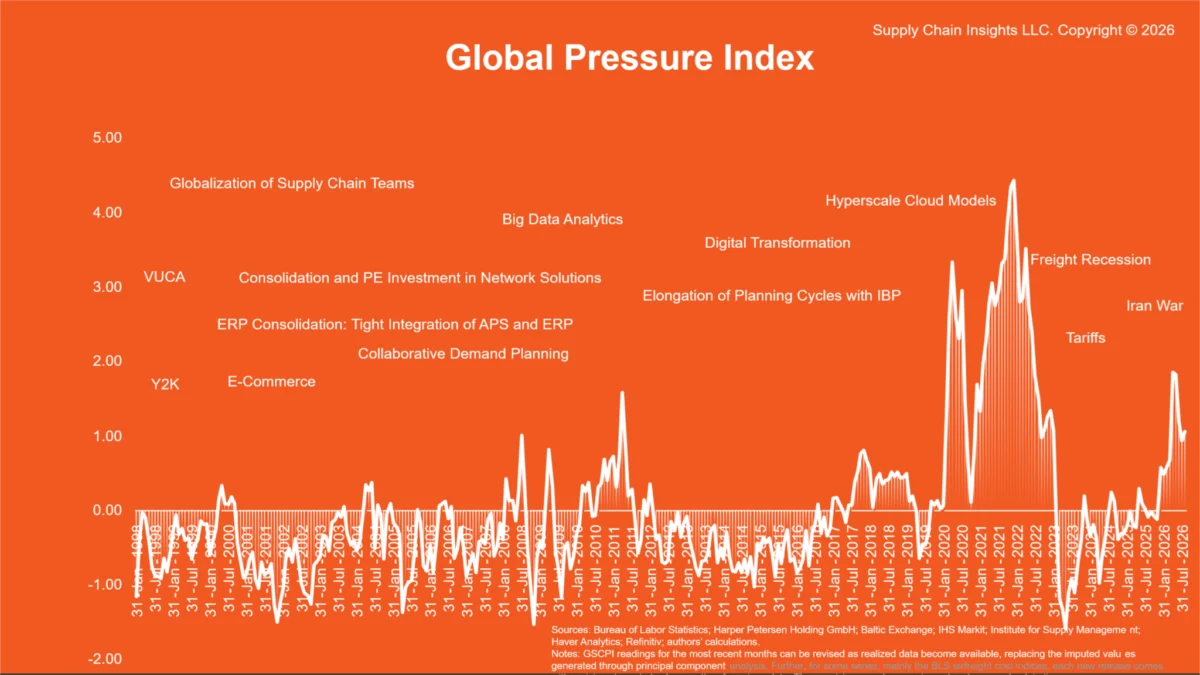
To navigate the current landscape, leaders must first quantify the pressure they are under. The Global Pressure Index serves as a vital diagnostic tool. In monitoring this index, three primary observations are critical:
- Frequency of Disruption: Volatility is no longer an "event"; it is a constant state.
- Breadth of Impact: Modern disruptions are not siloed; they propagate instantly across the end-to-end network.
- Latency in Response: The time between a disruption and an organizational reaction is currently too high, largely due to rigid, outdated planning cycles.
Driving Change: A Five-Step Strategic Framework
To avoid the fate of the frog, organizations must execute a fundamental, five-step shift in their operational philosophy:

- Redefine the Relationship with Data: Move beyond "data collection" toward "data intelligence." This requires building a semantic layer that allows disparate data forms to interact.
- Governance Overhaul: Clarify the "Who, What, and When" of decision-making. Remove the ambiguity that plagues cross-functional teams.
- Upskilling the Human Element: As AI takes over routine tasks, the team’s understanding of supply chain fundamentals must deepen, not atrophy.
- Strategic AI Deployment: Transition from a focus on "agents" to a holistic AI strategy that includes deep learning, reinforcement learning, and neurosymbolic AI.
- Re-architecting "Connection": Shift from "tight integration" (which often leads to the bullwhip effect) to "interoperability" that respects the autonomy of nodes within the network.
The Semantic Revolution: Redefining Data Orchestration
"Orchestration" has become the buzzword of the decade. However, most technology leaders interpret this merely as a mechanical process of moving data from Point A to Point B. True orchestration requires a holistic approach where processes, technology, and organizational workflows are synchronized to achieve specific outcomes.
Currently, roughly 80% of data generated within the supply chain remains unused—an ocean of "dark data" that could provide critical insights. To unlock this, companies must build a semantic layer—a framework that gives context to data. By using techniques like knowledge graphs and entity resolution, firms can finally turn unstructured noise into actionable information.
Furthermore, traditional organizational paradigms must be challenged. If your data strategy is dictated by departmental silos (e.g., procurement vs. sales), you will never achieve a true "Single Version of the Truth." The data strategy must transcend the organizational chart.
Governance: Solving the "Major SCRUM"
The term "SCRUM" is often associated with agile development, but in the context of supply chain planning, it describes a different reality: a disorderly, chaotic struggle for the ball. In many large enterprises, the lack of defined governance—the inability to articulate who holds the authority to make decisions at the regional versus global levels—is a catastrophic bottleneck.
Often, planners operate in a vacuum, lacking clear guidelines on their role. Who is the "Owner"? Who is the "Influencer"? Who must be "Informed"? When these questions are left unanswered, even the most expensive supply chain software fails to deliver results because the human governance layer is missing. Clarity of roles is the ultimate prerequisite for technological success.
The AI Strategy: Beyond the Agentic Hype
There is a dangerous tendency in the C-suite to conflate "AI" with "Agents." While agents (programs that can act autonomously) are impressive, they are not the entirety of the AI landscape. A robust strategy must include:
- Large Language Models (LLMs): For the synthesis of vast amounts of unstructured text.
- Deep Learning & Reinforcement Learning: For predictive modeling and optimization of complex variables.
- Neurosymbolic AI: To combine the reasoning capabilities of logic-based systems with the pattern-matching power of neural networks.
Companies must stop looking for a "silver bullet" agent and start building an AI portfolio that addresses specific, high-value bottlenecks.

Rethinking "Connection" and the Bullwhip Effect
In 2012, the concept of the "Connected Supply Chain" emerged as an evolution of the "Integrated Supply Chain." While the intent was positive, ten years of data suggest that "tightly integrated" supply chains—those with rigid, high-frequency connections to Enterprise Resource Planning (ERP) systems—can actually increase the "bullwhip effect." When every small fluctuation in the market is instantly pushed through a rigid, integrated system, it creates unnecessary systemic risk.
A key discovery in this journey is the disconnect between transactional data and contractual reality. Whether it is a Purchase Order or a Customer Order, the transactional mechanics are often well-managed, but the contractual compliance is handled in the "Wild West."
Contracts—the very documents that define the rules of trade—are frequently disconnected from the systems that execute the orders. Companies must bridge this gap by connecting structured transactional data with unstructured contractual terms. Only then can we move toward "touchless" management that is actually compliant with negotiated terms, rather than just "automated" and error-prone.
Implications for the Future
The supply chain of the future will not be defined by the most expensive software, but by the most disciplined organizations. As we move into an era of unprecedented volatility, the winners will be those who:
- Audit their core processes before applying technology.
- Prioritize governance and role clarity.
- Bridge the gap between transactional systems and contractual reality.
Industry Update: Bridging Education and Execution
To address these challenges, new tools are emerging to assist in the transformation process. The recent partnership between the International Supply Chain Education Alliance (ISCEA) and the AskLora.AI platform represents a step toward democratization of supply chain maturity modeling.
By leveraging 12 years of research and ten years of financial benchmark data, tools like AskLora allow organizations to:
- Assess Maturity: Evaluate governance and inventory guardrails instantly.
- Benchmark Performance: Compare metrics against industry peers to identify potential.
- Gain Strategic Clarity: Use AI to analyze internal strategy documents and provide actionable, objective feedback.
As the industry gathers for events like CSCMP Edge, the conversation must shift away from the "mechanics of the machine" and toward the "strategy of the organization." We are at a boiling point; the companies that jump now—not by reacting to the heat, but by changing the container—will define the next era of global commerce.

 Sagoh

 Ali Ikhwan

 Raul Delapena Setiawan

 Reynand Wu



 Azzam Bilal Chamdy

