
 Basiran
Naming is one of the most deceptively complex challenges in the digital product ecosystem. It is the bridge between human intent and machine execution; it is the shared vocabulary that binds designers, developers, and product managers together. When we fail to name things effectively, we aren’t just dealing with a minor inconvenience—we are introducing friction into the development lifecycle, confusing our users, and creating a "tower of Babel" within our own codebases.
As the industry matures, the importance of a standardized, intuitive, and scalable naming taxonomy has transitioned from a "nice-to-have" to a mission-critical infrastructure component.

Main Facts: The Anatomy of a Naming Crisis
At its core, the problem of naming is a problem of communication. Whether it is a design token, an HTML class, or a feature name, the language we choose dictates how we think about the components we build.
The two extremes of naming failure:

- Over-generalization: When names are too vague (e.g.,
container,box,wrapper), they lose their semantic meaning. This leads to bloated codebases where components are used in ways that were never intended, resulting in "spaghetti" styles that are nearly impossible to maintain. - Over-specification: When names are too rigid (e.g.,
header-red-button-large), they stifle reusability. When the design system evolves or the brand refreshes, these hard-coded names become technical debt that forces developers to perform massive, risky refactors.
Effective naming requires a middle ground: names must be meaningful, scalable, and divorced from visual properties. A button should be named for its role (e.g., action-primary) rather than its appearance (blue-rounded-button).
Chronology: The Evolution of Design Systems
The evolution of naming in digital design has shifted from the "Wild West" era of CSS to the highly structured, tokenized systems we see today.

- Pre-2010 (The Era of Convention): Naming was largely subjective, relying on individual developer preference or simple BEM (Block, Element, Modifier) methodology.
- 2010–2016 (The Rise of Frameworks): The emergence of frameworks like Bootstrap forced a baseline standardization. Naming became centered around utility classes, prioritizing speed over semantic clarity.
- 2017–2021 (The Tokenization Movement): With the birth of complex design systems at companies like Salesforce (Lightning) and Intuit, the industry pivoted toward "Design Tokens." Naming became hierarchical, moving from primitive values (colors/spacing) to semantic aliases.
- 2022–Present (The Multi-Brand Era): Today, organizations are managing massive, multi-brand, multi-themed ecosystems. Modern naming now involves sophisticated taxonomy maps that can handle global shifts in design tokens across dozens of different products simultaneously.
Supporting Data and Best Practices
To navigate the complexities of naming, the design community has curated several essential resources that serve as the industry gold standard.
1. Linguistic Inspiration: Classnames
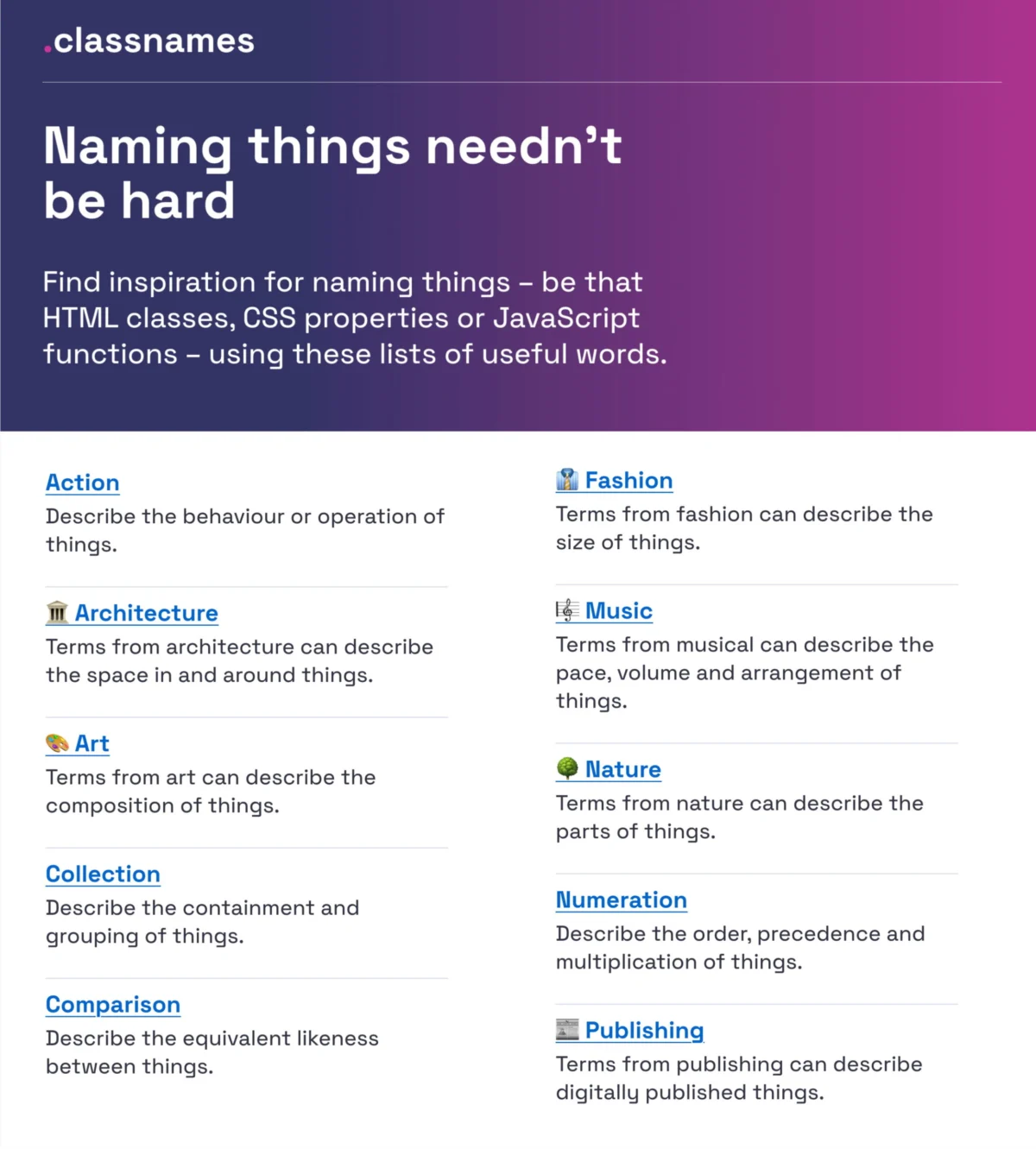
For developers hitting a creative block, Classnames provides thematically grouped lists. By looking at words from architecture, theater, or music, teams can find identifiers that carry weight and meaning without falling into the trap of generic naming.

2. Color Standardization: Color Parrot
Color naming is notorious for being arbitrary. The Color Parrot repository, maintained by David Aerne, manages over 30,000 unique color names. By using a centralized, community-vetted database, teams can ensure that their hex codes are mapped to consistent, descriptive labels, preventing the "light-blue vs. sky-blue" ambiguity.
3. Structural Guidelines: Javier Cuello’s Best Practices
As outlined by Javier Cuello, an effective name follows a logical structure. His guidelines emphasize:

- Brevity: Keep it short.
- Meaning: The name should imply the function.
- Independence: Avoid naming based on visual styles.
- Universal Understanding: The name must be intuitive to everyone on the team, not just the creator.
4. The Token Taxonomy
Intuit’s approach to design token taxonomy serves as a masterclass in scale. By building a system that accommodates multiple products (Mailchimp, QuickBooks, etc.), they proved that tokens should follow a strict hierarchy: Brand > Primitive > Semantic > Component.
Official Industry Responses: The "Component Gallery" and Beyond
The industry has responded to the naming crisis by creating transparent, open-source repositories. The Component Gallery, researched by Iain Bean, acts as a definitive index for how the world’s most successful companies name their UI components.
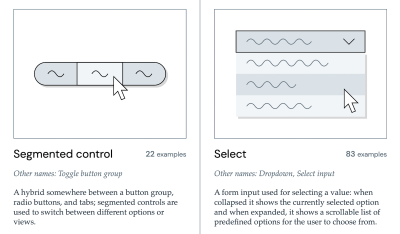
When you struggle to name an "accordion" or a "visually hidden" element, looking at how large-scale systems handle these names prevents "reinventing the wheel." Similarly, tools like Name That UI provide a visual dictionary, ensuring that when we say "modal," we mean "modal," and not a "dialog," "popup," or "overlay."
Implications: The High Cost of Poor Naming
Why does this matter? The implications of poor naming are felt most acutely in three areas:

- Feature Adoption: If a feature is named in a way that doesn’t align with the user’s mental model, they will never find it. As Erin Gannon notes in her research, "What Do We Call This Thing?", feature adoption is a journey of discovery, understanding, and trial. If the name is jargon-heavy, the journey ends at discovery.
- Team Friction: When a developer and a designer use different terms for the same element, it creates "dialect drift." This leads to errors in Jira tickets, confusion in Figma handoffs, and ultimately, a product that feels disjointed to the user.
- Technical Debt: The most expensive cost of bad naming is the inability to refactor. If your CSS classes are tied to specific page layouts or visual states, changing a design requires a complete rewrite of the stylesheet. Proper naming decouples the what from the how, allowing for seamless visual updates.
Strategic Recommendations for Teams
To foster a culture of effective naming, organizations should adopt the following strategies:
- Establish a "Source of Truth": Whether it is a shared spreadsheet or a dedicated design token portal, ensure that every team member knows where the "official" names live.
- Run Naming Sprints: When introducing a new feature, don’t rush the name. Host a session where stakeholders define the job-to-be-done and select a name that reflects the user’s language, not the engineer’s.
- Utilize Taxonomy Maps: For large systems, follow the lead of the Vodafone UK Design System team. Create a visual mapping of your tokens to understand the flow from the primitive level up to the page level.
- Embrace the Backlog: If you identify a naming conflict, don’t feel pressured to fix it immediately if it’s too risky. Document it, put it in the technical debt backlog, and tackle it during a dedicated maintenance cycle.
A Note to the Community
The web is a collaborative project, and the resources mentioned here—from Onym for product naming to Romina Kavcic’s token builder—are testaments to the power of open-source knowledge. By sharing these naming conventions, we collectively make the web more accessible, more maintainable, and significantly less confusing for everyone involved.

As you continue to build, remember: the name you choose today is the foundation for the product you will be iterating on tomorrow. Choose it wisely, name it clearly, and ensure it speaks the language of your users.

 Sagoh

 Asep Darmawan

 Raul Delapena Setiawan

 Reynand Wu



 Azzam Bilal Chamdy

 Ali Ikhwan
