
 Ali Ikhwan
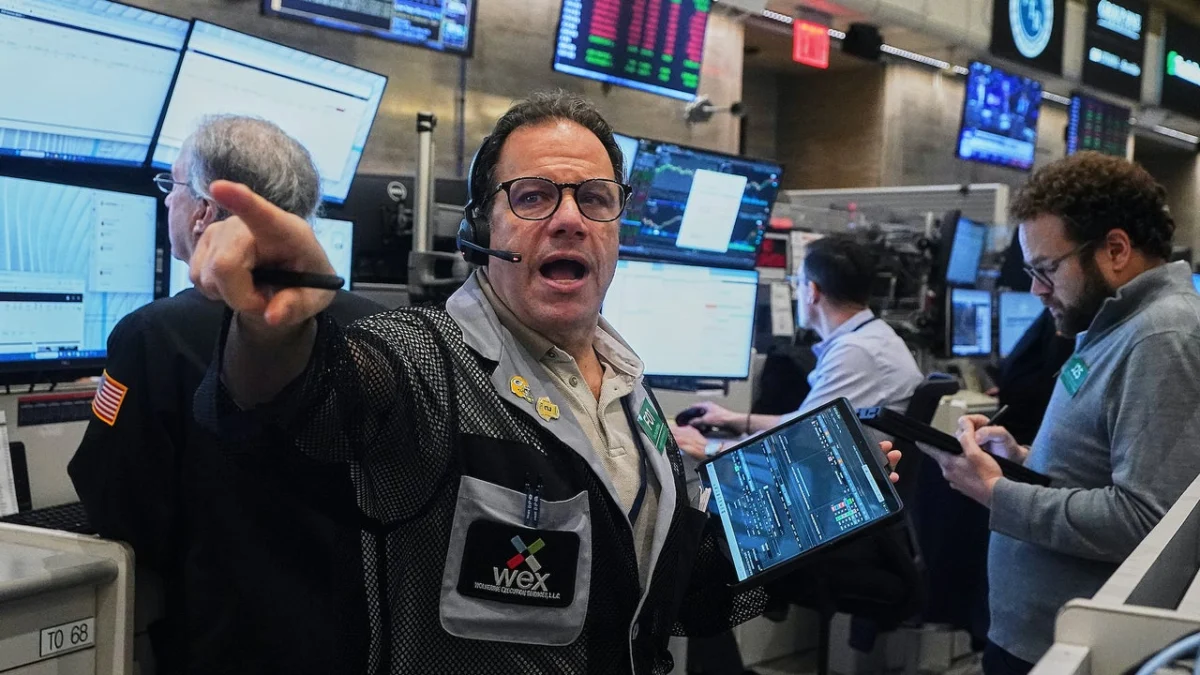
Global equity markets faced a turbulent Thursday as a "perfect storm" of investor fatigue regarding the artificial intelligence (AI) boom and escalating geopolitical instability in the Middle East sent shockwaves through major exchanges. While the broader market attempted to hold its ground, the concentration of capital in high-growth technology stocks proved to be a vulnerability, leading to sharp corrections in the Nasdaq and beyond.
Main Facts: The Tech-Led Retreat
The primary driver of Thursday’s market unease was a decisive shift in sentiment toward artificial intelligence-related equities. Following significant sell-offs in Asian markets—where technology-heavy indices bore the brunt of the downturn—the contagion reached U.S. trading floors.
As of 12:56 p.m. ET, the Nasdaq Composite had plummeted 2.4%, reflecting a broad retreat from the high-multiple growth stocks that have powered the market’s rally for much of the year. The S&P 500, which holds a massive weight in tech giants, shed 1.3%. Conversely, the Dow Jones Industrial Average, which is less exposed to pure-play AI semiconductor and software firms, remained relatively resilient, dipping only 40 points, or 0.1%.
Simultaneously, the energy sector signaled deep-seated anxiety regarding international relations. Oil prices surged to their highest levels since May as markets reacted to the growing threat of direct conflict between Iran and the United States. This geopolitical uncertainty acts as a dual threat to the economy: potentially stoking inflation while acting as a drag on global consumer sentiment.
Chronology of the Sell-Off
The decline did not happen in a vacuum; it followed a series of quarterly earnings reports that, while largely positive in revenue, failed to satisfy the market’s insatiable demand for "perfection."
- Early Asian Session: Markets in Tokyo, Seoul, and Taiwan—hubs for semiconductor manufacturing—opened in the red as traders digested negative guidance from regional tech suppliers.
- Mid-Morning U.S. Trading: As the opening bell rang on Wall Street, the divergence between tech and non-tech sectors became immediately apparent. Investors began rotating out of high-volatility AI stocks and into defensive assets, anticipating a period of consolidation.
- The Midday Slump: By midday, the sell-off in major names like Lam Research and Meta Platforms intensified, dragging the tech-heavy Nasdaq deeper into negative territory.
- Energy Spike: As news cycles focused on potential escalations in the Strait of Hormuz, crude oil prices tracked upward, further squeezing the profit margins of energy-intensive industries and adding to the overall market volatility.
Supporting Data: Why the AI "Magic" is Faltering
The current market correction is rooted in two primary concerns: the cost of capital and the sustainability of valuation multiples.
The Cost of Innovation
To sustain the current AI trajectory, firms must invest billions in hyperscale data centers and the acquisition of increasingly expensive AI-specialized chips. Borrowing costs remain elevated, and as central banks maintain a hawkish stance on interest rates, the capital-intensive nature of building out AI infrastructure is eating into the bottom lines of tech companies.
Valuation Overhang
The "frenzy" of the last two years has seen stock prices climb faster than the actual revenue generated by AI products. Even when companies report growth, the market is no longer satisfied with "good" numbers; it demands "beat-and-raise" performances.
Take the case of Lam Research. The company reported profit and revenue for the summer that exceeded analyst expectations. Under normal circumstances, this would trigger a rally. Instead, the stock tumbled 11.1%. Why? The company provided a quarterly profit forecast with a midpoint slightly below consensus estimates. Having entered the day with a 52.4% year-to-date gain—nearly quadruple that of the S&P 500—the stock was priced for perfection. Any deviation from that trajectory invited aggressive profit-taking.
Similarly, Meta Platforms saw its shares slide 7.4%. While the company reported higher-than-expected revenue, its bottom-line profit fell short of expectations. The market also reacted with skepticism to Meta’s announcement regarding a new class of stock intended to raise capital for further AI investment, signaling to investors that the "cash-burning" phase of the AI build-out is far from over.
Official Responses and Corporate Strategy
Tech executives are currently walking a tightrope. On one side, they must demonstrate to shareholders that they are at the vanguard of the AI revolution—the "Muse AI agent" development being a prime example for Meta. On the other side, they are forced to justify the massive capital expenditure (CapEx) required to maintain that lead.
Financial analysts noted that the decision by Meta to issue a new class of stock is a tacit admission that organic cash flow, while strong, may not be sufficient to cover the astronomical costs of competing in the AI arms race. This move has introduced a new layer of uncertainty regarding shareholder dilution and long-term capital allocation strategy.
Energy sector officials, meanwhile, are monitoring the geopolitical situation with caution. The rise in oil prices is not merely a supply-side issue; it is a signal that institutional investors are hedging against a potential kinetic conflict in the Middle East, which could disrupt global supply chains and lead to a sudden, sharp spike in energy costs that would further complicate the Federal Reserve’s battle against inflation.
Implications for the Future
The implications of this market shift are profound and multifaceted.
1. A Shift in Risk Appetite
Investors are moving away from the "growth at any price" mentality that defined the AI boom. We are likely entering a period of "selective growth," where companies must prove that their AI investments are translating directly into operational efficiencies and margin expansion rather than just top-line revenue growth.
2. The Inflation-Energy Nexus
If oil prices remain at elevated levels, the disinflationary trend that many economists were counting on could be reversed. Higher energy costs permeate every corner of the global economy, from transportation and logistics to manufacturing. If this persists, the Federal Reserve may be forced to keep interest rates higher for longer, further exacerbating the cost-of-borrowing problem that is currently strangling tech infrastructure projects.
3. Market Resilience Beyond Tech
The relative stability of the Dow Jones Industrial Average suggests that the broader economy remains somewhat disconnected from the volatility of the tech sector. If the sell-off in AI stocks continues, investors may shift their focus toward sectors that have been overlooked during the AI gold rush—such as industrials, financials, and healthcare—which could provide a floor for the broader indices even if the Nasdaq continues to face headwinds.
Conclusion: The Road Ahead
The market’s reaction this Thursday serves as a stark reminder that even the most transformative technologies are not immune to the laws of finance. As the AI sector matures, the era of unbridled optimism is giving way to a more rigorous, data-driven assessment of value. With geopolitical tensions adding an unpredictable variable to the mix, the coming quarter is shaping up to be a critical test of resilience for both the technology sector and the global economy at large. Investors should prepare for continued volatility as the market recalibrates its expectations in a world of high interest rates and global uncertainty.


 Reynand Wu

 Sagoh

 Raul Delapena Setiawan


 Azzam Bilal Chamdy

