Azzam Bilal Chamdy
In the pursuit of financial independence, many individuals treat their bank accounts like fortress walls. They save with relentless discipline, bypass luxuries, and defer gratification, all under the assumption that these sacrifices will build a "cushion" for a golden, carefree retirement. However, a growing body of anecdotal and financial evidence suggests that this strategy is fundamentally flawed. If you wait too long to begin "decumulating"—or spending—your wealth, you risk wasting the very years you worked so hard to secure.
You aren’t just saving money; you are trading your most vibrant decades for a number on a screen. By the time many reach the traditional retirement age of 65, the desire, the physical ability, and the curiosity required to enjoy that wealth have often evaporated.
The Reality of Late-Life Consumption: A Chronology of Declining Utility
To understand the trajectory of spending, one must observe the shift in priorities as people age. This phenomenon is often best viewed through the lens of one’s own parents, who serve as a living mirror for the future.
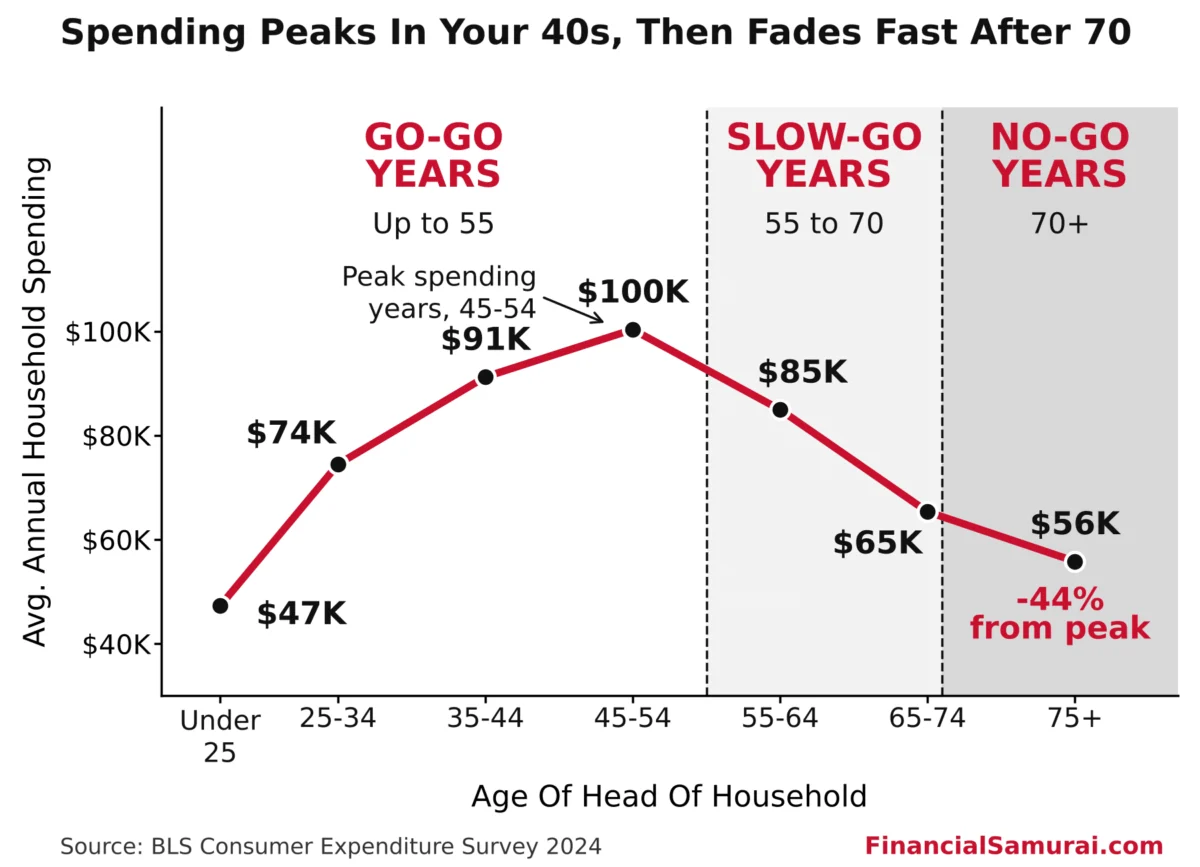
The "Go-Go" Years (Ages 45–65)
For many, the window of optimal consumption begins around age 45. By this time, careers are often established, dependents are becoming more self-sufficient, and physical health remains relatively robust. This is the period where travel, hobbies, and high-impact experiences yield the highest "return on life."
The "Slow-Go" Years (Ages 66–75)
As individuals enter the traditional retirement age, a subtle but distinct shift occurs. The drive for adventure often wanes. Even when financial barriers are removed—such as when a child offers to fully fund a luxury cruise or an exotic excursion—many retirees decline. This is not due to a lack of funds, but a change in the internal architecture of their desires. The energy required for international travel, the risks associated with health, and a preference for routine begin to outweigh the allure of novelty.
The "No-Go" Years (Ages 76+)
Beyond the age of 75, for many, the focus turns entirely inward. Entertainment becomes passive—hours of television, simple board games, or sedentary hobbies. The muscle memory of decades of frugality makes it psychologically impossible to pivot to a life of abundance. At this stage, the money that was intended to fund "golden years" remains untouched, eventually becoming an inheritance rather than a tool for enjoyment.
Supporting Data: The Compounding Trap of Behavioral Frugality
Financial planning often obsesses over the compounding interest of assets, but it rarely accounts for the compounding nature of behavior. Thrift is not merely a strategy; for lifelong savers, it becomes an immutable part of one’s DNA.
When a person spends 40 years telling themselves "no," they build a psychological barrier that is nearly impossible to dismantle. Even when presented with a spreadsheet proving they could safely spend $50,000 more per year without jeopardizing their security, the lifelong saver will still agonize over a $12 purchase.
The Failure of the "Safe Withdrawal Rate"
The traditional 4% safe withdrawal rate (SWR), while a staple of financial planning, has become increasingly conservative in the modern era. Since 2012, market performance has significantly outpaced the expectations of many retirees. Consequently, many individuals who achieved financial independence early find their net worth continuing to balloon even while they are "retired." They are living on the interest of their interest, while the principal remains an untapped, dormant monument to their past work.
The Cost of Inaction
The most tragic implication of this behavior is that the money remains trapped. It is not being used for high-quality experiences, better healthcare, or family memories. Instead, it is often lost to market volatility or eventually transferred to heirs who, while appreciative, would likely have preferred more time with a parent who was energized and present during their final active years.

Official Perspectives: The Philosophy of Intentional Spending
Financial experts and planners are increasingly advocating for a more "front-loaded" approach to retirement spending. The argument is simple: wealth is a tool, not a scoreboard.
"The goal of financial independence is not to die with the largest number in your account," says one industry analyst. "It is to optimize your life for experiences and time."
Many professionals now suggest that retirees should adopt a "spending floor and ceiling." By modeling what "too much" spending looks like—and realizing that most people are nowhere near that ceiling—retirees can gain the confidence to authorize their own spending. Modern financial tools, such as those provided by firms like Empower, allow users to "x-ray" their portfolios and run sophisticated retirement planners that show exactly how much they can afford to spend without ever hitting zero.
Implications: Changing the Trajectory
If you recognize yourself in the habits of a lifelong saver, it is time to pivot. The goal is to avoid the "cruel joke" of the FIRE (Financial Independence, Retire Early) movement: that the very discipline required to build wealth can become the cage that prevents you from enjoying it.
1. Intentional Consumption
Set a "YOLO" fund—a specific amount of money earmarked for discretionary, high-joy experiences that you have historically denied yourself. Whether it is business-class travel, a hobby you’ve been putting off, or upgrading your living environment, the goal is to break the "no" habit.
2. Shore Up Confidence with Insurance
Often, the fear of spending stems from a "what if" mentality. What if I need that money for medical care? What if my family is left without support? Term life insurance is a cost-effective way to mitigate these fears. By outsourcing the risk to an insurance company, you free up your capital to be used for your own quality of life.
3. Shift from Consumption to Creation
If you find that you truly do not enjoy "spending," shift your focus to high-value activities that are low-cost. Investing in your physical health, your social circles, or your intellectual pursuits can provide more utility than material goods. The goal is to move from passive entertainment (like hours of television) to active engagement (like travel or skill-building) while you still have the physical mobility to do so.
4. The 15-20 Year Window
Recognize that your window of peak activity is finite. If you are 45, you have roughly two decades to spend with vigor. If you are 65, that window is closing. Acknowledge that the money will almost certainly be there at 75, but your capacity to use it for joy will not.
Conclusion: A Legacy of Experience
There is a profound irony in the contentment that many elderly individuals find in their frugality. While they may appear "deprived" to the outside observer, they are often perfectly at peace. However, for those who are currently in the thick of their accumulation years, the lesson is clear: do not let the muscle of frugality atrophy your capacity for joy.
Ultimately, the goal of wealth is to provide the freedom to live without unnecessary worry. If you are still working, stressing, and hoarding, you are not truly free. The money is a tool; use it to craft a life that you will look back on with satisfaction, rather than a balance sheet you will look back on with regret. Because when the final chapter is written, the only currency that will have mattered is the time you spent, not the numbers you left behind.


 Muslim

 Rifan Muazin

 Ammar Sabilarrohman

 Asep Darmawan

 Asro

 Layla Zulfa

 Nila Kartika Wati