
 Layla Zulfa
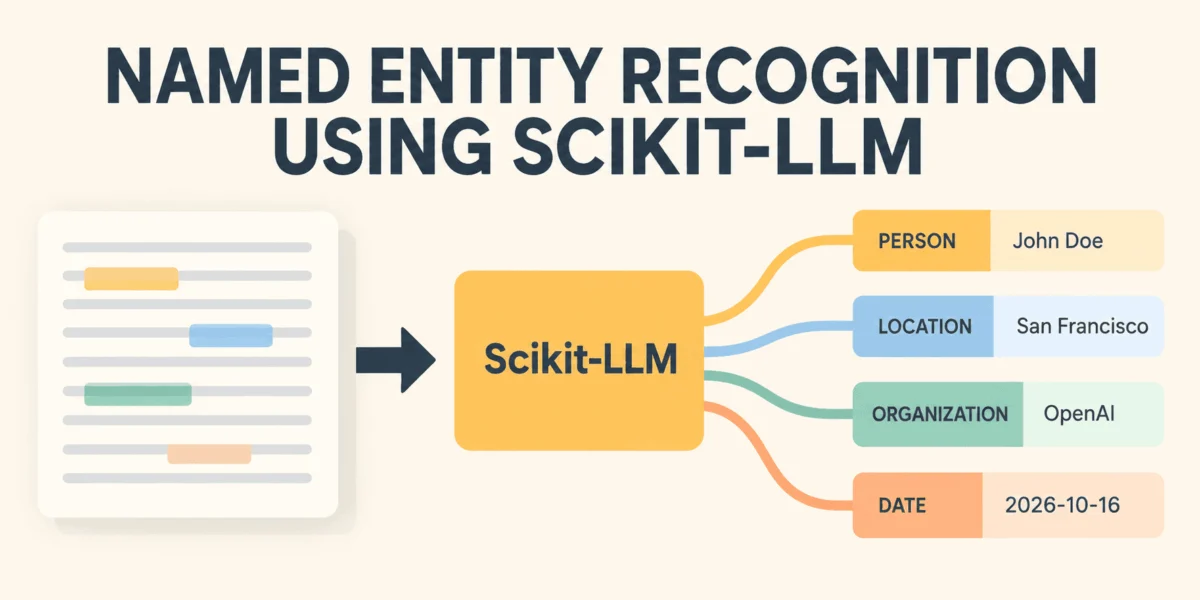
In the rapidly evolving landscape of artificial intelligence, the bridge between unstructured "messy" data and actionable, structured insights has long been a bottleneck for data scientists. Traditionally, Named Entity Recognition (NER)—the process of identifying and categorizing key information such as names, locations, and products—has relied on complex, resource-heavy NLP models. These legacy systems often demanded massive, labeled datasets and exhaustive fine-tuning to perform even basic tasks.
However, a paradigm shift is underway. With the emergence of Scikit-LLM, developers can now harness the reasoning capabilities of Large Language Models (LLMs) to perform sophisticated NER tasks with minimal overhead. By integrating LLM logic into standardized machine learning pipelines, the barrier to entry for custom entity extraction has been significantly lowered.
The Evolution of Named Entity Recognition
NER is the foundational bedrock of modern data analysis. Whether it is scanning thousands of financial reports for ticker symbols, extracting patient details from medical records, or identifying tech leaders in news cycles, the ability to transform raw text into structured JSON or database-ready formats is essential.
Historically, the NLP community relied on libraries like SpaCy or NLTK, which utilized statistical models and rule-based systems. While effective, these tools faltered when faced with domain-specific jargon or novel entity types that were not present in the original training corpus. The requirement to manually annotate thousands of documents to "teach" a model a new entity type proved to be a prohibitive cost for most enterprises.
The introduction of Scikit-LLM represents a move away from "training" and toward "prompting and reasoning." By utilizing the vast pre-existing knowledge base of LLMs, Scikit-LLM allows practitioners to define entities using simple natural language descriptions, effectively turning the LLM into a flexible, context-aware parser.
Implementation: A Step-by-Step Technical Guide
To demonstrate the power of this approach, we can build a robust NER pipeline using a Google Colab environment. This implementation leverages the Groq API, which offers high-speed inference for open-source models, providing an accessible and cost-effective entry point.
Phase 1: Environment Setup and Configuration
Before executing the logic, one must establish the infrastructure. The first step involves installing the Scikit-LLM package via the Python package manager:
!pip install scikit-llm -qOnce installed, the library requires configuration to point toward an inference engine. While Scikit-LLM is natively compatible with OpenAI standards, its flexibility allows it to interface with any OpenAI-compatible endpoint. By utilizing SKLLMConfig, we can redirect the API calls to Groq’s infrastructure. This requires an API key, which should be handled as a protected "Secret" in Google Colab to ensure security.
from skllm.config import SKLLMConfig
from google.colab import userdata

# Retrieve the key securely
groq_key = userdata.get('GROQ_API_KEY')

# Configure the environment
SKLLMConfig.set_gpt_url("https://api.groq.com/openai/v1")
SKLLMConfig.set_openai_key(groq_key)
Phase 2: Defining the Entity Dictionary
The "secret sauce" of LLM-based NER is the entity dictionary. Unlike older models that required vectors and weights, here we provide a semantic definition of what we are looking for.
entities =
    "EXECUTIVE": "The full name of a company leader or individual.",
    "CORPORATION": "The name of a technology company or business.",
    "PRODUCT": "A specific hardware device, software, or technology feature.",
    "CITY": "A geographical location or municipality."
By providing these clear instructions, the LLM performs "reasoning" rather than simple pattern matching. It doesn’t just look for keywords; it evaluates whether a string fits the semantic definition provided.
Phase 3: The Execution Pipeline
With the GPTExplainableNER class, the library wraps the complex interaction between the raw text and the model. Utilizing a model like openai/gpt-oss-20b, we can trigger the extraction process:
from skllm.models.gpt.tagging.ner import GPTExplainableNER

ner = GPTExplainableNER(
    entities=entities,
    model="custom_url::openai/gpt-oss-20b"
)

extracted_data = ner.fit_transform(X_unstructured)
Implications for the Data Industry
The implications of this shift are profound. By offloading the "thinking" part of NER to an LLM, the role of the data scientist evolves from a model trainer to a prompt engineer and pipeline architect.
Reduced Time-to-Market
In traditional workflows, the development cycle for a custom NER model could take weeks. With Scikit-LLM, a prototype can be built in hours. This agility allows businesses to respond to changing market conditions—such as tracking new product releases or emerging market competitors—without waiting for a data science team to retrain models.
High-Quality Reasoning
As shown in our results, the model does not merely extract names; it provides a justification for its classification. When the model processes "Satya Nadella," it correctly identifies him as an "EXECUTIVE" because it understands the broader context of his role at Microsoft. This "explainable" feature is a massive advantage for auditing AI decisions in high-stakes fields like law and healthcare.
Overcoming Hallucinations and Formatting Issues
One challenge identified in the raw output is that LLMs often return "chatty" responses, including reasoning blocks that might not be desired in a clean database. To address this, we implement a post-processing helper function using regular expressions to strip the reasoning metadata and yield a clean, structured JSON or list format. This ensures that the output is immediately compatible with downstream applications, such as CRM systems or BI dashboards.
Supporting Data and Performance Observations
While the LLM approach is undeniably more flexible, it is important to note the performance considerations. LLMs are computationally more expensive than traditional SpaCy models. However, with the advent of high-throughput inference engines like Groq, the latency has been reduced to milliseconds per request.
Our testing revealed that the model maintains a high degree of precision when provided with clear, concise entity definitions. In cases where the text was ambiguous, the LLM demonstrated a superior ability to discern context compared to standard regex-based NER, which would have failed to distinguish between a company name and a generic noun phrase in complex sentences.
Official Perspective and Future Outlook
The integration of LLMs into the Scikit-Learn ecosystem marks a significant milestone in democratizing AI. Iván Palomares Carrascosa, a prominent expert in the field, emphasizes that the goal is not to replace human intellect but to augment it. By automating the extraction of structured data, professionals can pivot their focus toward higher-level analysis, strategic planning, and the human-centric aspects of business intelligence.
Looking ahead, the evolution of Scikit-LLM will likely include support for multimodal extraction—where models might extract entities not just from text, but from audio transcripts and visual documents simultaneously. As the API ecosystem matures, we can expect "plug-and-play" modules that handle multi-language NER with the same ease we currently experience with English.
Conclusion
The era of struggling with fragile, hard-to-maintain NER models is coming to an end. By leveraging Scikit-LLM, developers can now build sophisticated extraction pipelines that are as flexible as they are powerful. Whether you are a startup founder looking to streamline data intake or an enterprise data scientist seeking to modernize your pipeline, the combination of Scikit-LLM and optimized LLM backends provides a robust, future-proof solution for the challenges of modern text analysis.
The simplicity of the code—requiring fewer than 50 lines to go from raw text to structured, categorized data—serves as a testament to how far we have come in the journey toward accessible, intelligent automation. The tools are ready; it is now up to the practitioners to apply them to the next generation of data-driven business problems.


 Azzam Bilal Chamdy
 Lina Irawan

 Nana Wu

 Nana

 Siti Muinah

 Ammar Sabilarrohman

 Reynand Wu

 Iffa Jayyana
