
 Rifan Muazin
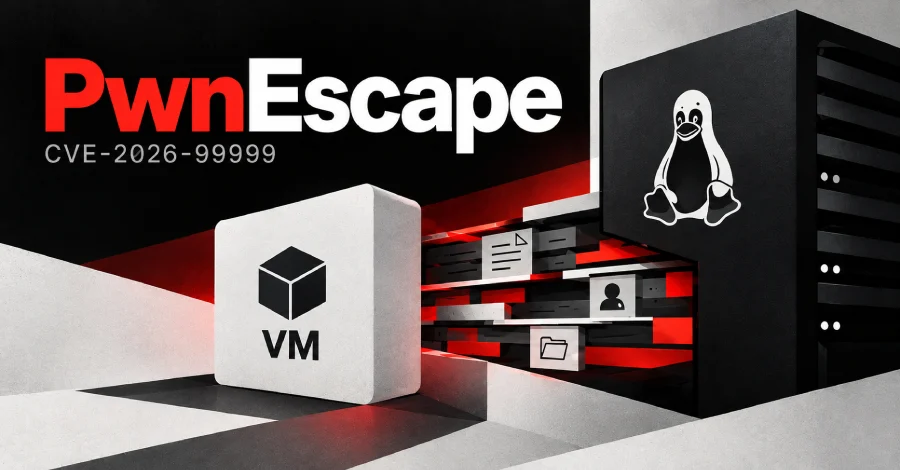
A newly disclosed and highly critical vulnerability within the Linux kernel has sent shockwaves through the cybersecurity and cloud computing industries. Tracked as CVE-2026-99999 and colloquially dubbed "PwnEscape," the flaw provides a pathway for code executing within a restricted virtual machine (VM) to breach the host environment, read sensitive host memory, and potentially execute arbitrary code.
The discovery was made during a high-stakes security challenge hosted by Vercel, a leading cloud platform provider. Unlike typical application-level bugs, PwnEscape resides in the core networking stack of the Linux kernel, a shared layer that serves as the foundation for virtually all modern cloud infrastructure. While the vulnerability was reported privately and responsibly, its potential to bypass the foundational isolation mechanisms that keep multi-tenant cloud environments secure makes it a significant concern for infrastructure architects worldwide.
The Anatomy of the Flaw: What is PwnEscape?
At its core, PwnEscape is a memory-related vulnerability localized within the Linux kernel’s networking subsystem. The flaw stems from improper handling of specific network packet structures. When a virtual machine—even one hardened with advanced sandboxing—sends a specially crafted network packet, the host’s kernel can be tricked into processing that packet in a way that leaks host memory data back to the guest.
According to technical analysis provided by Paulos Yibelo of the security research firm pwn.ai, the exploit achieves three distinct outcomes:
- Memory Disclosure: The guest can extract approximately 32 bytes of host memory per packet, allowing for the potential theft of sensitive kernel data.
- Denial of Service (DoS): By sending two specially crafted packets, an attacker can trigger a kernel panic, effectively crashing the host machine and rendering every other workload (sandbox) running on that host inaccessible.
- Remote Code Execution (RCE): By chaining the memory leak and the kernel corruption, an attacker can theoretically gain administrative (root) control over the underlying host.
Crucially, the vulnerability is not a misconfiguration of any specific cloud provider’s platform. Because it exists in the Linux kernel itself, any environment running a vulnerable kernel version—regardless of whether it is a public cloud provider or an on-premises enterprise data center—is potentially susceptible.
A Chronology of Discovery: AI-Driven Research
The identification of PwnEscape marks a milestone in the integration of Artificial Intelligence into security research. The flaw was unearthed during Vercel’s recent $1 million "Sandbox Challenge," which invited security professionals to attempt to break out of their highly secure Firecracker-based microVM environments.
The team at pwn.ai utilized an internal, AI-assisted research harness they call "Omega-Pwn." This system, which integrates elements of the SingularityNET OmegaClaw architecture, allowed the researchers to maintain complex code traces and experimental hypotheses across long-running sessions. The primary reasoning engine for the discovery was "GPT-5.6 Sol," which performed the heavy lifting of source-code analysis.
According to Yibelo, the researchers were able to identify the flaw in just three days of concentrated effort, with the total cost of the operation amounting to less than $700 in API tokens. This efficiency highlights a growing trend: AI is rapidly becoming a force multiplier for vulnerability research, capable of identifying deep-seated, complex kernel issues that might otherwise evade human analysts for months or years.
Following the identification of the flaw, the team validated their findings in a laboratory setting. They meticulously matched the environment to Vercel’s production configuration to ensure the proof-of-concept was accurate. While they successfully demonstrated root command execution in their lab, they were careful to note that this was a controlled result, not a claim that they had successfully compromised Vercel’s production customer data.

Supporting Data: Why This Matters for Cloud Multi-Tenancy
The severity of CVE-2026-99999 is rated at 9.3 out of 10, categorizing it as "Critical" by the Linux kernel maintainers and the National Vulnerability Database (NVD). The reason for this high score lies in the nature of modern cloud computing.
Most major cloud providers utilize a "shared-kernel" model. Even when using strong isolation technologies like Firecracker or AWS’s Nitro system, the underlying host kernel remains the single point of failure. If the host kernel is compromised, the "walls" between virtual machines are essentially bypassed.
Vercel’s infrastructure, which relies on Firecracker microVMs running on bare-metal Amazon EC2 hosts, was the subject of the testing. Because these microVMs are designed to be lightweight, they share the host’s kernel networking stack to optimize performance. PwnEscape exploits this specific shared infrastructure. It is important to emphasize that this is not a failure of Firecracker or Vercel’s security posture; rather, it is a flaw in the fundamental networking code that the entire Linux ecosystem relies upon.
Vercel confirmed that throughout their $1 million challenge, which saw 1,285 total reports, no researcher was able to access actual customer files, secrets, or application data. The threat remains theoretical and lab-bound, with no current evidence of in-the-wild exploitation.
Official Response and Mitigation Strategies
The Linux kernel maintainers, led by developers such as Red Hat’s Michael S. Tsirkin, acted swiftly to address the flaw. The fix, officially identified as commit 6785011f8b16, introduces a new validation check that prevents packet checksum data from pointing into the IPv4 header before the kernel initiates processing.
This fix has been backported to all supported stable branches of the Linux kernel. System administrators are advised that simply patching the guest OS is insufficient; the host kernel must be patched, and the system must be rebooted to fully mitigate the risk.
Fixed Versions Table
| Stable Branch | First Fixed Version |
|---|---|
| 5.10 | 5.10.272 |
| 5.15 | 5.15.223 |
| 6.1 | 6.1.190 |
| 6.6 | 6.6.159 |
| 6.12 | 6.12.113 |
| 6.18 | 6.18.57 |
| 7.2 | 7.2.11 |
Note: Many Linux distributions apply security patches directly to their own kernel builds without incrementing the primary version number. Administrators should verify the patch status using their distribution’s security advisory tools rather than relying solely on the kernel version number displayed by uname.
For those unable to patch immediately, Vercel recommends the implementation of "defense-in-depth" measures. These include:
- Disabling Nested Virtualization: Reducing the attack surface of the microVMs.
- Jailer Enforcement: Ensuring the microVM process runs with the absolute minimum set of system permissions.
- Strict Host Hardening: Maintaining up-to-date firmware and kernel versions on the host level as a priority.
Implications for the Future of Security
The discovery of PwnEscape has several long-term implications for the cybersecurity landscape:

1. The Era of AI-Assisted Exploitation
The fact that a sophisticated kernel vulnerability was discovered with only $700 in API tokens and a three-day window serves as a wake-up call for software vendors. We are entering an era where the barrier to entry for high-level vulnerability research is dropping. Security teams must now assume that any "unknown" bugs in their codebase are likely being hunted by AI models capable of processing millions of lines of code in seconds.
2. The Fragility of Shared Infrastructure
PwnEscape underscores the inherent risks of shared-kernel multi-tenancy. While the performance benefits of sharing a kernel are massive, the security trade-off is that a single vulnerability can compromise an entire cloud cluster. This may drive future architectural shifts toward "kernel-less" or "unikernel" environments, where each guest has a fully independent, immutable kernel, thereby removing the shared networking stack as a single point of failure.
3. The Necessity of Continuous Security Challenges
Vercel’s decision to run an open, high-stakes security challenge proved to be a masterful move. By paying researchers to find these flaws before malicious actors do, they effectively "crowdsourced" the hardening of their infrastructure. The $242,000 paid out across the challenge was a small price to pay to identify a critical, industry-wide vulnerability that could have otherwise been weaponized by state-sponsored actors or organized cybercriminal syndicates.
4. The "Defense in Depth" Reality
The maintainers have noted that the current fix is "deliberately partial." It acts as a defensive measure rather than a total re-architecture of the networking stack. This acknowledges that the current way packets enter the kernel is inherently complex and potentially prone to further issues. The cybersecurity community must treat this as a temporary patch and prepare for more comprehensive architectural changes to the Linux kernel’s networking subsystem in the coming years.
Conclusion
CVE-2026-99999 serves as a stark reminder that the digital world is built upon complex, aging foundations. While the Linux kernel is arguably one of the most rigorously tested pieces of software in existence, the sheer scale and complexity of its networking stack provide a vast surface area for vulnerabilities.
The collaborative nature of this disclosure—from the AI-assisted research of pwn.ai to the rapid, transparent response of the Linux kernel maintainers and Vercel—exemplifies the best practices of modern cybersecurity. As we look toward an future increasingly dependent on cloud-native architectures, the lessons learned from PwnEscape will be vital in ensuring that the shared layers of our digital world remain as secure as they are performant.
Administrators are urged to prioritize the deployment of the patched kernels listed above. In the race between attackers and defenders, the presence of AI-driven research tools means that the margin for error is smaller than ever. Staying patched, remaining vigilant, and adopting a defense-in-depth mindset are the only reliable strategies to survive in an evolving threat landscape.


 Basiran
 Iffa Jayyana

 Raul Delapena Setiawan

 Reynand Wu

 Sagoh


 Azzam Bilal Chamdy

 Ali Ikhwan
