
 Neng Nana
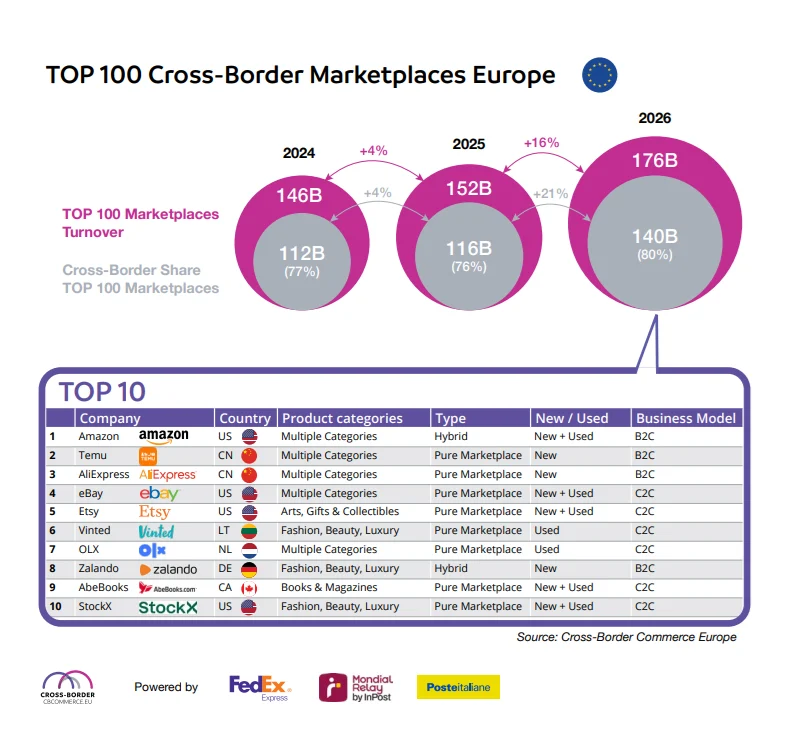
The European e-commerce landscape is undergoing a profound structural transformation, characterized by the meteoric rise of massive, multi-national marketplaces that are successfully dismantling traditional retail borders. According to the seventh edition of the "Top 100 Cross-Border Marketplaces Europe" report, published by Cross-Border Commerce Europe (CBCommerce), the continent’s premier digital platforms are not merely growing—they are becoming the primary engines of European retail.
The data reveals that the 100 most influential marketplaces operating within Europe are projected to reach a collective gross merchandise volume (GMV) of 175.8 billion euros. Perhaps more telling than the sheer volume is the geographic reach of these transactions: 79.5 percent of this revenue is derived from cross-border sales, a figure that is not only robust but is trending steadily upward.
The Core Data: A Trajectory of Unprecedented Growth
The numbers presented in the latest CBCommerce report paint a picture of a market that has matured beyond its infancy and is now entering a period of aggressive, consolidated growth. The report indicates that by 2026, cross-border sales generated by these top 100 entities are expected to reach a staggering 139.8 billion euros. This milestone would mean that nearly 80 percent of the total GMV handled by these platforms will originate from consumers purchasing from vendors based outside their own domestic borders.
Scaling Towards 2027
The momentum is expected to accelerate as we move into the latter half of the decade. Projections for 2027 suggest that the total GMV of the top 100 marketplaces will climb by approximately 8 percent, pushing the total valuation to roughly 190 billion euros. Crucially, the cross-border component is set to outpace the overall market growth, with an expected 10 percent increase to 154 billion euros. Consequently, by 2027, the proportion of total GMV attributed to cross-border sales is forecasted to hit 81 percent, signaling a future where the "domestic-only" marketplace model becomes increasingly obsolete in the eyes of the European consumer.
Chronology of Change: From Local Outlets to Global Giants
To understand how we reached this point, one must look at the evolution of European e-commerce over the past decade.
- The Early Years (2015–2018): During this period, the European market was highly fragmented. Consumers largely shopped within their national borders, relying on established high-street retailers who had launched modest digital storefronts. Marketplaces were primarily domestic, and logistics were not optimized for international, high-volume shipping.
- The Digital Acceleration (2019–2021): The global pandemic served as a massive catalyst. With physical retail shuttered, European consumers were forced to look toward digital-first platforms. International giants, particularly those with sophisticated logistics networks, filled the void, acclimating consumers to the ease of cross-border shopping.
- The Era of Global Competition (2022–2024): This phase saw the entry and rapid scaling of international platforms. Aggressive marketing, coupled with highly efficient supply chain management, allowed these players to capture significant market share from local retailers who were struggling to adapt their legacy infrastructure to a borderless digital reality.
- The Modern Era (2025–Present): We are now in a phase defined by AI-driven personalization and regulatory scrutiny. The "Top 100" are no longer just retailers; they are tech ecosystems. The current landscape is defined by the dominance of platforms like Amazon, Temu, and AliExpress, which utilize advanced algorithms to anticipate consumer demand before the consumer even begins their search.
The Titans of the Industry: Ranking the Top 10
The CBCommerce report highlights a tier of "super-platforms" that dominate the European mindshare and wallet share. The ranking criteria are rigorous, measuring success through a combination of cross-border sales volume, search engine optimization (SEO) performance, geographic market penetration, and total website traffic.
The Big Three
- Amazon: Retaining its position as the undisputed incumbent, Amazon’s infrastructure in Europe remains the gold standard. Its ability to integrate local fulfillment centers with a seamless cross-border logistics network makes it the primary benchmark for all competitors.
- Temu: The meteoric rise of Temu has been one of the most significant disruptors in recent history. By leveraging direct-to-consumer logistics and highly aggressive pricing models, Temu has successfully captured a massive slice of the European market, particularly among younger, value-conscious demographics.
- AliExpress: As a veteran in the cross-border space, AliExpress continues to bridge the gap between Asian manufacturing powerhouses and European retail demand. Its focus on product variety and price competitiveness remains its primary defensive moat.
The remaining top-tier entities, while varying in regional focus, all share a common trait: they operate with a pan-European mindset, viewing the EU not as a collection of disparate nations, but as a single, cohesive economic territory.
Official Perspectives and Industry Response
The researchers behind the report, led by the analytical team at CBCommerce, suggest that the shift toward cross-border dominance is not merely a trend, but a fundamental realignment of how European retail functions.
"European marketplace commerce is entering a new era," the report states. Industry analysts note that while consumer demand for variety and price is the primary driver, the supply side is undergoing a "logistical revolution." International platforms are no longer satisfied with shipping from distant hubs. They are actively investing in local European infrastructure—warehousing, last-mile delivery partnerships, and local customer support centers—to shorten delivery times and reduce the friction that historically deterred cross-border shoppers.

However, the report also highlights that this growth is not without its detractors. Regulatory bodies across the EU are increasingly concerned about the impact of these platforms on local tax revenues, environmental sustainability, and the competitive landscape for small-to-medium-sized enterprises (SMEs).
Implications: A Landscape Transformed
The implications of this data-driven shift are vast and affect every stakeholder in the European economy.
1. The Death of Distance
For the consumer, the concept of "geographic distance" has been rendered largely irrelevant. The expectation is now for a uniform, high-speed shopping experience regardless of where the warehouse is physically located. This places immense pressure on traditional retail, which must now compete on price and logistics efficiency rather than simply on proximity to the customer.
2. The AI and Social Commerce Frontier
AI-driven product discovery is fundamentally changing the retail funnel. Traditional search bars are being replaced by predictive feeds that use social commerce algorithms. Platforms that successfully integrate social media engagement with instant, one-click cross-border purchasing are seeing the highest conversion rates. The report notes that these technologies are not just "add-ons"—they are the primary tools used by the top 100 to capture and retain market share.
3. The Regulatory Layer
The "complexity" mentioned in the report refers to the tightening web of EU regulations. From the Digital Services Act (DSA) to stricter import tax requirements and sustainability mandates, the largest platforms are now facing a period of intense compliance pressure. The winners of the next decade will be the platforms that can balance aggressive growth with the complex legal requirements of operating across dozens of distinct regulatory jurisdictions.
4. The Future of Local Retail
Local European retailers are at a crossroads. To survive, they must either become niche specialists that offer products the global giants cannot, or they must leverage the very same marketplaces they compete with to reach a wider, cross-border audience. The report suggests that the most successful local players are those that have adopted a "hybrid model"—maintaining a strong local brand presence while utilizing the massive, cross-border distribution networks of the top-tier marketplaces.
Conclusion: The Road Ahead
The trajectory for the next few years is clear: the European marketplace ecosystem will continue to consolidate around the most efficient, tech-forward, and logistically agile platforms. As cross-border sales push toward the 80 percent mark of total GMV, the digital border in Europe will effectively disappear.
For businesses, investors, and policymakers, the message is unequivocal: the future of European retail is not found on a single high street or within a single nation. It is found in the fluid, borderless, and increasingly automated world of the Top 100 cross-border marketplaces. The competition is fierce, the stakes are rising, and the companies that prioritize infrastructure, AI-driven discovery, and seamless logistics will define the commercial character of the continent for years to come.


 Reynand Wu

 Iffa Jayyana

 Raul Delapena Setiawan


 Sagoh

 Azzam Bilal Chamdy

 Ali Ikhwan
