
 Pevita Pearce
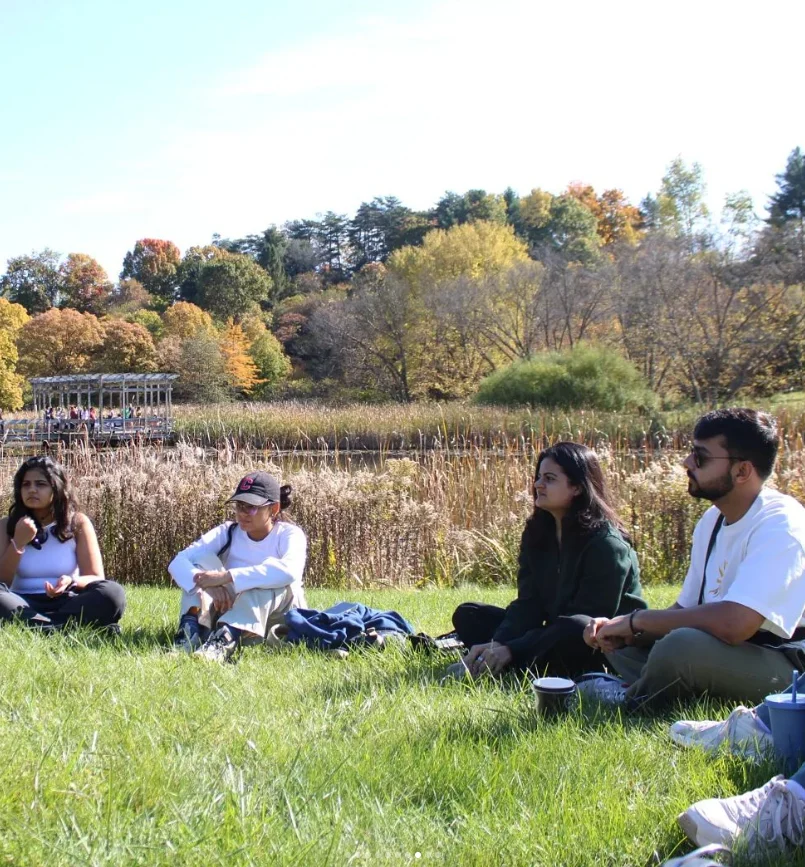
In 1984, Don Rakow was a graduate student at Cornell University, navigating the high-pressure academic environment that defines elite higher education. When the weight of his studies became suffocating, he didn’t head to a therapist’s office; he headed to the campus gardens. “They were my sanctuaries,” Rakow recalls. “Those gardens were essential for me to maintain balance and to survive.”
Thirty years later, Rakow returned to Cornell, this time as a professor of plant science. He found himself witnessing a new generation of students grappling with a mental health crisis far more severe than the one he had experienced. As faculty members scrambled to address rising rates of anxiety and depression, Rakow proposed a solution rooted in his own past: the campus itself.
His vision evolved into NatureRx, a pioneering program that treats nature not merely as a scenic backdrop, but as a legitimate clinical intervention. Today, this initiative sits at the heart of a burgeoning movement known as "social prescribing," which is rapidly reshaping how U.S. colleges support student well-being.
The Evolution of a Campus Movement
The transition from academic theory to clinical practice was a decade-long journey. In the early 2010s, a series of student suicides at Cornell intensified the urgency for mental health support. The university responded by expanding traditional services—hiring more counselors and training staff in crisis intervention—but it also embraced Rakow’s radical idea: embedding nature-based referrals into the formal healthcare process.
NatureRx began as a student-run club hosting nature walks and outdoor activities. It soon matured into a formal partnership with Cornell Health. Today, physicians can embed “nature prescriptions” directly into a student’s electronic health record, allowing the university to track the efficacy of outdoor exposure alongside traditional therapies like medication and cognitive-behavioral therapy.
The program’s reach has since expanded far beyond Ithaca. In 2019, Rakow co-founded the Campus Nature Rx Network with Professor Dorothy Ibes of the College of William & Mary. With support from the REI Cooperative Action Fund, the network provides free resources to any university looking to implement nature-based prescribing. To date, nearly 120 institutions have joined the movement, signaling a shift toward holistic wellness in higher education.
A Crisis of Unprecedented Proportions
To understand why universities are turning to gardens and basketball courts for help, one must look at the alarming data regarding student mental health.
Historically, campus mental health support was minimal. Princeton University didn’t hire its first psychiatrist until 1910, and it took another four decades for counseling services to become standard across U.S. campuses. However, the last fifteen years have seen a tectonic shift. Between 2009 and 2015, the demand for counseling services began to outpace enrollment growth by a wide margin.

A comprehensive study of 350,000 students across 373 campuses between 2013 and 2021 revealed a harrowing trend: reported cases of depression rose by 135 percent, and anxiety by 110 percent. The most recent Healthy Minds Study (2024-25) confirmed that 37 percent of students now report moderate to severe depressive symptoms, with nearly one in four struggling with chronic feelings of isolation. Faced with these numbers, campus counseling centers are overwhelmed, with 86 percent of directors reporting that they cannot keep up with the surge in demand.
The Science of the "Nature Prescription"
Critics often ask: Is a walk in the park truly medicine? The physicians involved in these programs are quick to point to the physiological evidence.
Dr. Jonathan Keffer, a physician at Cornell Health, frames these prescriptions in clinical terms. “This is actually physiologically proven medical treatment,” Keffer explains. Research confirms that spending time in nature—even for as little as 10 minutes—activates the parasympathetic nervous system. This process lowers cortisol levels, the body’s primary stress hormone, effectively "cooling down" the nervous system.
For students, this often manifests as improved focus and emotional regulation. In 2024-2025, Cornell Health providers issued over 2,200 nature prescriptions. Follow-up surveys yielded promising results: 88 percent of respondents reported an improvement in mood, and 85 percent felt less stressed.
However, program coordinators emphasize that this is not a panacea. “Spending time in nature is not a cure-all,” Rakow notes. “It is intended to complement, not replace, traditional counseling or medication.” By integrating these habits into a treatment plan, doctors are teaching students how to manage their stress before it escalates into a clinical crisis.
Beyond Nature: The Rise of Social Prescribing
While Cornell has pioneered nature-based interventions, the broader field of "social prescribing" is taking root across the country. Originating in the UK in the 1980s, social prescribing involves connecting patients to non-medical, community-based activities—such as arts, movement, or volunteer service—that address the root causes of distress.
Stanford University and the Arts
At Stanford University, the focus has shifted toward the arts. Through a partnership with SocialRx, students can be referred to a "care navigator" who assesses their interests and schedules. A student might be prescribed nine "doses" of culture, ranging from pottery classes to live theater performances. Data from the initiative shows that 84 percent of referred students attend their activities, and 80 percent report a measurable improvement in their mental health.
The University of Michigan’s Comprehensive Approach
The University of Michigan has taken the concept a step further. After conducting a massive survey of 1,400 students to understand why they weren’t engaging in campus activities, the university discovered that the barriers weren’t just a lack of opportunities—they were time management, social anxiety, and a lack of social confidence.

In response, the university launched ExperienceRx and the Institute for Social Prescribing. These initiatives aim to treat the "whole student" by prescribing everything from shared community meals to structured service projects. “A lot of students are 70 percent of the way there,” says Lindsey Mortenson, chief mental health officer at the University of Michigan. “They just need someone to help them take that last step.”
Implications for Higher Education
The shift toward social prescribing represents a fundamental change in the university’s role. For decades, the model was reactive: wait for a student to break down, then offer clinical intervention. The new model is proactive and community-integrated.
At the University of Oregon, students can now take a dedicated undergraduate course on social prescribing, learning how to design their own wellness programs. At NYU, Professor David Hollander uses a course titled "How Basketball Can Save the World" to teach students about the intersection of sport, community, and mental health. His students, in turn, have launched HoopsRx, a program that connects middle schoolers with local basketball leagues to combat loneliness.
Ani Minic, a sophomore and soccer player at NYU, participated in the HoopsRx flyer campaign last spring. For her, the project was a homecoming to a truth she had realized as a child: that the field, the court, and the garden are more than just places to move—they are places to belong.
Conclusion: A New Standard of Care
As universities continue to struggle with budget constraints and provider shortages, social prescribing offers a cost-effective, scalable, and deeply human solution. It acknowledges that the student experience is not merely an academic journey, but a developmental one that requires connection to the physical world and to one another.
Whether it is a "nature prescription" at Cornell, an arts referral at Stanford, or a basketball program at NYU, these initiatives are proving that sometimes the best way to treat the modern mind is to reintroduce it to the simple, restorative power of the community and the natural world. As Don Rakow says, there is a "greater awareness that there need to be more tools" for student well-being. By turning the campus into a site of healing, these universities are ensuring that the next generation of students has more than just a degree—they have the tools to remain balanced in an increasingly volatile world.


 Nana Muazin
 Layla Zulfa

 Raul Delapena Setiawan

 Reynand Wu

 Sagoh


 Azzam Bilal Chamdy

 Ali Ikhwan
