
 Basiran
You have meticulously crafted a Reel. The concept is sharp, the editing is precise, and the aesthetic is polished. You hit "publish" with high expectations, only to watch the view count stall at a few hundred impressions, never to move again. Meanwhile, a seemingly low-effort clip from a complete stranger catapults to millions of views. It is easy to blame the "luck of the draw," the shadow ban, or the mysterious whims of the algorithm. However, the reality is far more calculated.
Going viral on Instagram is not a product of chance; it is a mechanical process governed by specific data signals. Every piece of content you publish undergoes an initial "test run" with a limited audience segment. Instagram’s distribution engine—the recommendation system—only expands the reach of that content if the audience responds in specific, measurable ways. If you are serious about understanding how to scale your reach, you must look past the myth of the algorithm and master the three pillars of content performance: the Hook, the Hold, and the Share.
What Actually Makes an Instagram Post Go Viral?
At its core, a viral post is one that Instagram’s distribution system deems worthy of showing to a wider audience of non-followers. According to Adam Mosseri, Head of Instagram, the platform’s ranking system is predicated on three critical signals: watch time, likes, and sends.
While likes contribute to the initial ranking, Mosseri has noted that "sends" carry significant weight, particularly when a post is being introduced to accounts that have no prior relationship with the creator. In the context of 2026, virality is defined as a post that keeps strangers watching and, more importantly, prompts them to pass it on to others.
The Chronology of Engagement: The First Hour
"Initial engagement velocity" refers to the speed at which a post gathers interactions immediately following publication. While Instagram does not explicitly disclose a "first-hour rule," internal data and creator observations confirm that the platform exposes new content to a small, targeted test group. If this group interacts—by liking, commenting, or watching through—the algorithm expands the content’s reach to a larger, more diverse pool.
This early period is the crucible of your post’s performance. If the velocity is low, the signal remains weak, and the distribution halts. If the velocity is high, the algorithm recognizes the post as "popular" and continues the distribution cycle.
The Hook-Hold-Share Framework: A Strategic Breakdown
To optimize for the algorithm, creators must treat each Reel as a journey consisting of three distinct stages. By analyzing your Instagram Insights, you can identify exactly where your audience is abandoning your content and apply corrective measures.
| Stage | Objective | Primary Metric | Where to Check |
|---|---|---|---|
| Hook | Stop the scroll in 3 seconds | Initial Engagement Velocity | Skip Rate |
| Hold | Keep people watching | Watch Time / Completion | Retention Chart |
| Share | Give a reason to pass it on | Shares and Sends | Sends per reach |
Stage 1: The Hook (Stopping the Scroll)
You have approximately three seconds to prevent a user from swiping past your content. This is where the "Skip Rate"—the percentage of viewers who swipe away immediately—becomes your most important metric.
1. Implement Pattern Interrupts
Human attention is fickle. To stop the scroll, you must break the rhythm of the user’s feed. This can be achieved through sudden movement, unexpected framing, or a jarring audio transition. For example, a bakery might skip the introduction and open with a knife halfway through a cake. In February 2025, Duolingo mastered this with a minimalist black screen announcing the "death" of their mascot. The shock value forced users to stop and engage, resulting in over 38,000 comments.
2. Leverage Text-Overlay Hooks
A significant portion of users consume content on mute. If your hook relies solely on audio, you lose that audience. A punchy text-overlay that promises value or teases a transformation ensures the hook lands regardless of the volume settings.
3. Strategic Timing
Data from over 250,000 Reels suggests that posting when your audience is most active is essential for maintaining early velocity. For most global accounts, the window between 8:00 AM and 12:00 PM (Monday through Thursday) serves as a baseline, but you should refine this by analyzing your specific follower activity in Insights.
The Hold: Keeping Viewers Watching to the End
Once you have successfully stopped the user, you must maintain their attention. According to recent industry benchmarks, videos significantly outperform static posts in terms of reach, but only if they can sustain viewer interest.
The Role of Retention
Instagram’s retention charts are your best friend. A flat retention line indicates a highly engaged audience, while a steep drop-off at the start suggests your hook didn’t deliver on its promise.
1. Front-Load the Value
Do not save your best moment for the end. In the short-form video era, you must lead with the payoff. If you are sharing a tutorial, show the finished product in the first second, then guide the viewer through the process.
2. Pattern Breaks to Prevent Atrophy
Even with a great topic, viewers lose interest if the visual rhythm is static. Incorporate a "pattern break"—a zoom, a new camera angle, or a text pop—every few seconds. This resets the viewer’s attention span and signals the brain to re-engage with the content.
3. Optimize for Depth, Not Just Length
While short-form is king, "tight" does not always mean "short." SocialPilot’s 2025 trends report found that Reels between 60 and 90 seconds often achieved 24% more shares, provided there was no "dead air." If the story requires time, take it—but ensure every frame adds value.
The Share: The Distribution Multiplier
Shares and sends are the "holy grail" of Instagram growth. A "save" indicates a user wants to revisit the content, but a "send" is an endorsement—it is the digital equivalent of a recommendation.
Crafting Content Worth Sending
To go viral, you must create content that makes the viewer think of someone else.
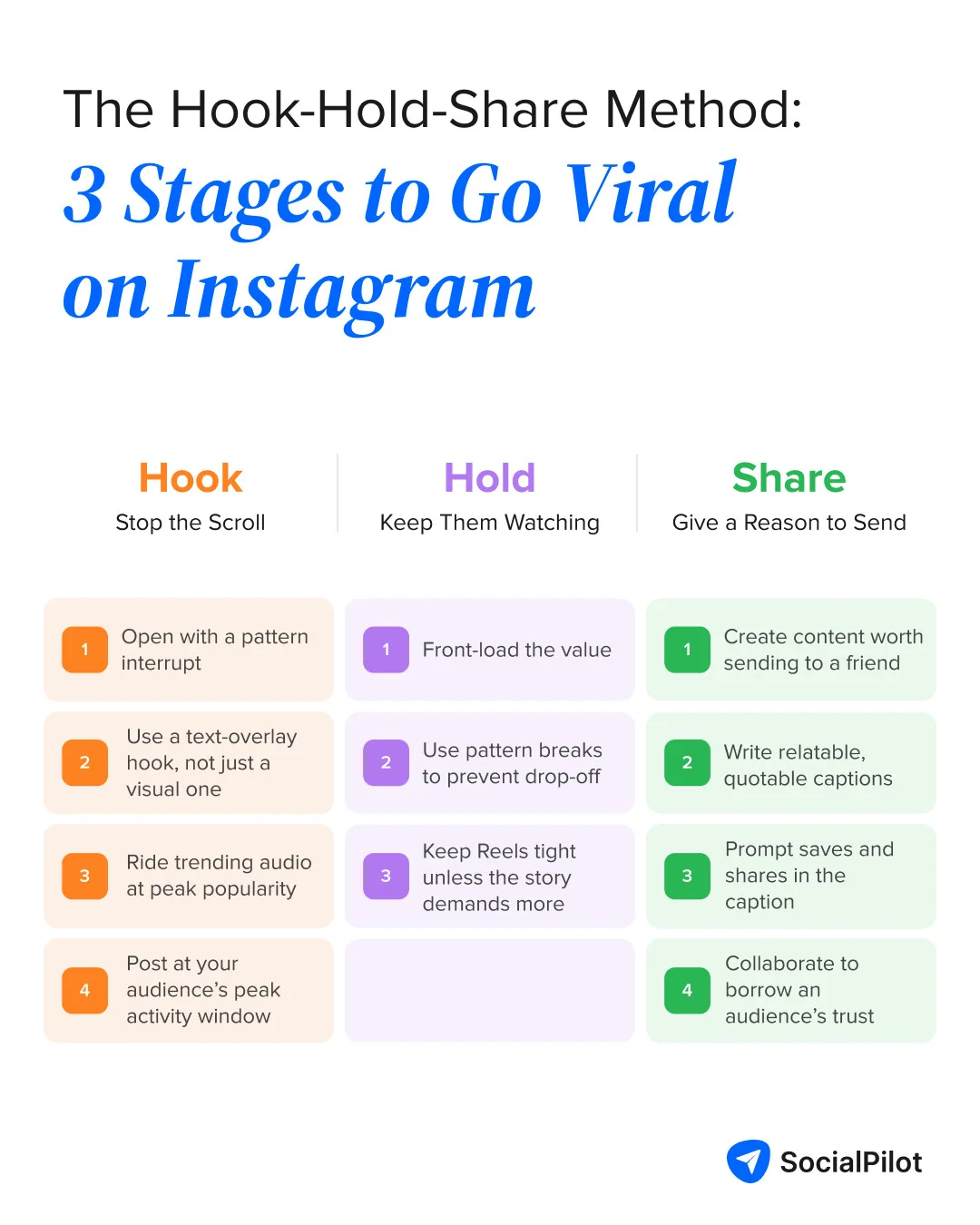
- Relatability: Content that says, "This is so us," or "I need to show this to [Name]."
- Utility: Information that solves a problem, such as a life hack or a recipe.
- Identity: Content that aligns with a viewer’s self-image, making them look smart or funny for sharing it.
The Power of the Caption
Captions remain a vital, yet often underutilized, tool. Research shows that longer, more descriptive captions (300+ characters) can drive 70% more comments. Use your caption to provide context, share a story, or explicitly prompt the user to share the post with a specific person or group.
Implications: What is "Viral" for Your Account?
Virality is relative to your current audience size. A 10,000-view Reel is a minor event for an account with 500,000 followers, but for a micro-influencer with 2,000 followers, it is a massive breakout.
The Multiplier Rule:
A common benchmark for "virality" is achieving 3x to 10x your average view count. If your account typically nets 500 views per post, a reach of 1,500 to 5,000 is a significant success. If you find your posts are reaching only your existing followers, your content lacks the "send-ability" required to penetrate non-follower circles.
Official Guidelines and Future-Proofing
In 2026, the strategy regarding hashtags has shifted significantly. With Instagram capping hashtags at five per post, the "hashtag-stuffing" era is over. Hashtags now serve as a categorization tool for the algorithm to understand your content’s niche, not as a primary driver of reach.
The Originality Rule
Instagram’s recommendation system heavily favors original content. If your account is flagged for consistently posting unoriginal or recycled content, your visibility will be restricted. Even if you edit a video, adding simple watermarks or speed changes is often insufficient; you must add value, context, or original narration to be eligible for broad recommendation.
Trial Reels: The Scientific Approach
Instagram’s "Trial Reels" feature is the most honest way to test your content. By allowing the platform to serve your content to a test group and providing metrics within 24 hours, you can A/B test different hooks and edits. If a trial performs well, Instagram will naturally amplify it.
Conclusion: The Path to Consistent Growth
Virality is not an accident; it is the result of a rigorous, data-driven approach to content creation. Before you publish your next Reel, ask yourself three questions:
- Did I stop the scroll? (Is the hook a pattern interrupt?)
- Did I keep them watching? (Is the retention line flat?)
- Did I provide a reason to send? (Is the content relatable or useful enough to be shared?)
If the answer to any of these is "no," return to the drawing board. By mastering the Hook, the Hold, and the Share, you move from hoping for a viral hit to engineering one. In an era of algorithm-driven discovery, the creators who win are those who understand that every view is a test, and every post is an opportunity to prove their value to the machine.


 Reynand Wu
 Iffa Jayyana

 Raul Delapena Setiawan


 Sagoh


 Azzam Bilal Chamdy

 Ali Ikhwan
