
 Azzam Bilal Chamdy
In a significant move to refine the user experience within its generative AI search interfaces, Google has announced a series of five major updates to how links and source attribution are presented in "AI Mode" and "AI Overviews." These changes, outlined by Hema Budaraju, VP of Product Management at Google, represent the latest phase in the company’s ongoing effort to balance the efficiency of AI-generated summaries with the necessity of driving traffic to the original publishers and creators who provide the foundational data.
As Google continues to integrate AI into its core search product, the tension between providing comprehensive answers and maintaining the integrity of the open web has become a focal point of industry debate. These updates aim to address concerns regarding source visibility and the "black box" nature of AI responses by providing more direct pathways to official documentation and trusted publishers.
The Core Updates: A Breakdown of Changes
Google’s latest announcement focuses on five distinct adjustments to the UI and UX of AI-powered search results. These changes are designed to increase the visibility of source material and offer users more context regarding the information they are consuming.
1. Increased Frequency of Inline Links
Google is doubling down on "inline links"—the clickable citations embedded directly into the text of an AI response. According to the company, these links are now being placed higher in the response structure than in previous iterations. The goal is to ensure that as a user reads through an AI-generated summary, the primary sources are immediately accessible, reducing the friction involved in verifying the claims made by the model.
2. Official Site "Task-Based" Modules
For search queries that are highly specific or task-oriented—such as searching for airline refund policies or government services—Google is testing a new, dedicated section at the very top of the AI response. This section will feature links to official sites, complete with additional context explaining why these sources are the primary authorities for the user’s request.
3. Enhanced Visual Design for Source Links
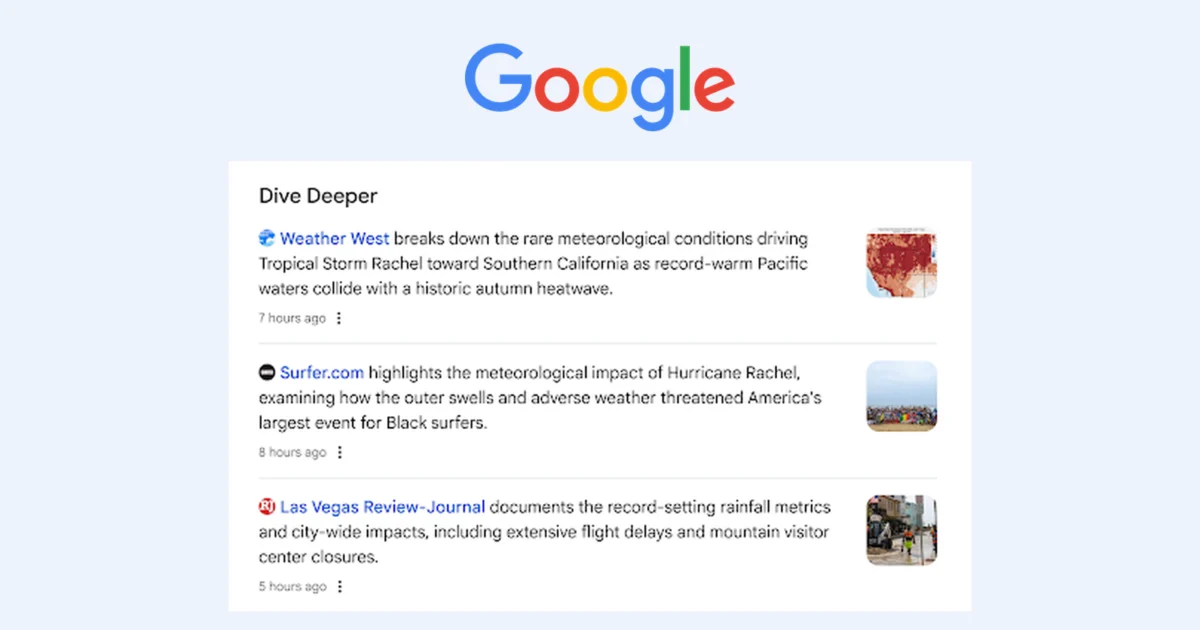
At the conclusion of many AI responses, Google is introducing image thumbnails and a more prominent, "clickable" design for the "Dive Deeper" section. This move is intended to draw the user’s eye to the end of the summary, encouraging continued exploration of the topic through curated, relevant articles.

4. Global Expansion of Timely Article Carousels
Google is rolling out its carousel feature for "timely articles" to more geographic locations and languages. These carousels are designed to highlight news and developments on trending topics, specifically prioritizing a user’s "Preferred Sources."
5. Integration of Creator and Publisher Search Profiles
In a move to foster greater connection between audiences and content creators, Google is testing the inclusion of creator and publisher names within video results in AI Mode. Clicking these names will direct users to the creator’s official Search profile, which aggregates their various contributions across the web.
Chronology of Google’s AI Search Evolution
To understand the weight of these updates, one must look at the timeline of Google’s rapid AI integration over the past year.
- May 2024: Google first introduced the "Preferred Sources" feature and began surfacing carousels for developing topics. At this time, the company signaled its intent to provide users with more control over the types of content they see, allowing them to explicitly favor certain publishers.
- June 2024: Google launched "Search Profiles" for creators and publishers. This was a strategic move to centralize a creator’s digital footprint—including videos, articles, and social media presence—into a single, verified hub within the Search ecosystem.
- October 2024: The current announcement, which further deepens the connection between these previously siloed features (like Search Profiles) and the AI interface, demonstrates an iterative design strategy where Google is actively "plugging in" its existing tools to solve the discoverability issues inherent in generative AI.
Supporting Data: The Rise of "Preferred Sources"
One of the most compelling metrics shared by Google is the growth of the "Preferred Sources" feature. Since its inception earlier this year, the number of users actively curating their search experience via this tool has increased by over 700%.
While Google has remained tight-lipped regarding specific user counts or the exact methodology used to quantify this growth, the trend is clear: users are seeking more agency over the algorithms that dictate their search results. By allowing users to signal their preferred publishers, Google is effectively decentralizing the "authority" of its AI, shifting some of the curation power back to the user.
However, the effectiveness of these tools relies heavily on publisher engagement. For a site to be eligible for these new AI-driven features, it must be properly configured in Google Search Console. Google’s documentation indicates that publishers need to ensure their content is specifically enabled for generative AI features to gain the benefits of these increased link placements and carousel inclusions.

Official Perspective and Implementation
Hema Budaraju’s announcement underscores a critical shift in how the company views the relationship between AI and traditional web traffic. By prioritizing "official sites" for task-based queries, Google is essentially creating a "verified path" for users. This is particularly vital in the context of misinformation, where AI hallucinations could theoretically lead users to unofficial or potentially harmful sources.
Regarding the implementation of Search Profiles within AI Mode, Google is proceeding with caution. As of mid-October, official help documentation was still in the process of being updated to reflect these changes. Current requirements for a Search Profile include:
- Geographic Availability: Primarily limited to the US, Canada, and India.
- Follower Thresholds: A minimum of 10,000 followers on a major platform (YouTube, Instagram, X, or TikTok).
- Age Restrictions: Only available to users over the age of 18 with a verified Google Account.
These strict eligibility criteria suggest that Google is positioning Search Profiles as a premium tool for established creators, rather than a broad-spectrum feature for all web content.
Implications for Publishers and SEO Strategy
For the professional SEO community and content publishers, these changes present both challenges and opportunities.
The "Link Position" Paradox
It is important to note a technical nuance regarding Search Console reporting: Google assigns all links within a single AI Overview a singular position in search rankings. Consequently, while moving an inline link higher up in the text may improve the user experience and potentially increase click-through rates (CTR), it does not necessarily change the "reported position" of that link in search data analytics. Publishers should focus on the quality of their content and their inclusion in "Preferred Sources" rather than obsessing over the micro-placement of individual links.
The Value of "Preferred Sources"
If your site is not currently optimized for AI Search, you are missing a growing segment of traffic. The integration of site branding into carousels and "Dive Deeper" sections makes the "Preferred Source" designation more valuable than ever. To stay ahead, publishers should:

- Audit Search Console: Ensure your site is fully optimized for generative AI discovery.
- Cultivate Brand Loyalty: Encourage readers to "follow" or "add" your site to their preferred list using the deep-link buttons provided by Google.
- Optimize for Profiles: If you are a creator or publisher, ensure your Search Profile is active and linked correctly to your content.
Future-Proofing
Google’s trajectory suggests that the "AI Search" environment will become increasingly personalized. As the AI becomes more adept at identifying which sources a user trusts, the disparity between "trusted" and "untrusted" sites will likely widen. Publishers who fail to establish a verifiable presence—through Search Profiles and high-quality, authoritative content—may find themselves excluded from the most prominent positions in AI-generated responses.
Conclusion: The Path Ahead
Google’s latest updates serve as a reminder that the AI search revolution is still in its infancy. By implementing these five changes, the company is demonstrating a willingness to iterate based on feedback from both users and the publishing community.
While the "official site" links and expanded carousels provide immediate benefits for user clarity, the true test will be how these features scale across different languages and global markets. For now, the takeaway for digital stakeholders is clear: transparency and source verification are no longer optional. As AI takes on a larger role in how we access information, the sites that can prove their authority and build direct relationships with their audiences will be the ones that thrive in this new, machine-mediated landscape.
As Google continues to test and refine these features, publishers should remain vigilant, monitor their Search Console performance, and leverage every available tool to ensure their content remains a visible, trusted part of the AI-powered web.


 Ammar Sabilarrohman
 Sagoh

 Raul Delapena Setiawan

 Reynand Wu




 Ali Ikhwan
