
 Siti Muinah
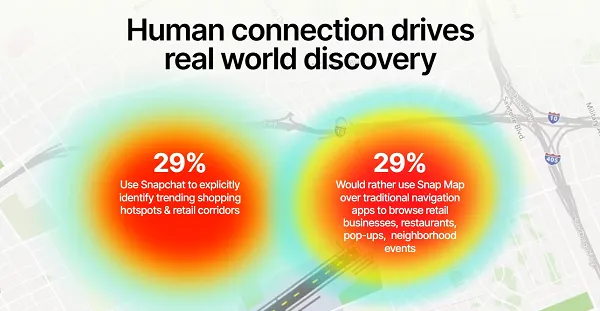
In the evolving landscape of digital navigation, a quiet revolution is taking place. While the traditional utility of maps—getting from point A to point B—remains dominated by giants like Google and Apple, a new player is asserting its influence in the realm of "social discovery." Snap Inc. has recently unveiled a comprehensive report detailing how its platform, Snap Map, is transitioning from a simple friend-tracking tool into a potent engine for real-world business discovery.
However, as Snap makes a compelling case for brands to shift their marketing focus toward social maps, the data presents a nuanced picture. While the platform offers unique opportunities for word-of-mouth-style organic growth, it faces stiff competition from established navigation utilities that still command the majority of consumer attention.
Main Facts: The New Landscape of Mapping
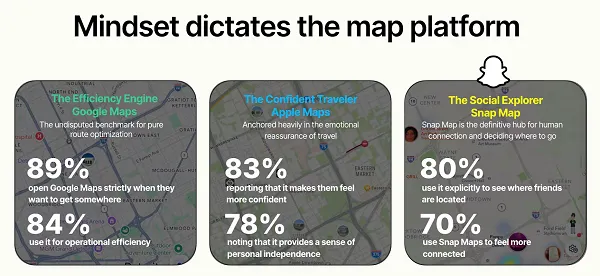
The core finding of Snap’s latest study is that users no longer rely on a single application for all their location-based needs. Instead, the digital map ecosystem has bifurcated into two distinct categories: utility-focused maps and social-focused maps.
Google Maps and Apple Maps retain their status as the primary tools for navigational utility—finding addresses, calculating ETAs, and checking business hours. Conversely, Snap Map has carved out a unique niche defined by social context. Users are increasingly turning to the platform not to find the quickest route to a destination, but to see where their friends are congregating and what culturally relevant events are occurring in their immediate vicinity.
For marketers, this represents a fundamental shift. Snap argues that brands can no longer rely solely on search-intent-driven traffic; they must now cultivate a presence in the social spaces where consumers are "hanging out" and building cultural consensus. By leveraging features such as bookmarking and location-based social proof, brands can tap into a more organic, recommendation-led form of discovery that is often missing from static, search-based map listings.
Chronology: The Evolution of Snap Map
To understand the current strategy, one must look at the progression of Snap Map since its inception. Initially launched as a feature to allow users to share their real-time location with friends, the map was primarily a privacy-centric communication tool.
- 2017: The Launch: Snap introduced Snap Map, allowing users to share locations with friends and view "Our Story" content based on geographic location.
- 2020-2021: The Pivot to Discovery: Recognizing the potential for local engagement, Snap began integrating business listings and "Places" features. This allowed users to bookmark local spots and view store details directly within the map interface.
- 2023-2024: Data-Driven Expansion: Partnering with research firms eye square and Horizon, Snap launched an extensive survey of 17,000 digital map users across major markets, including the U.S., U.K., France, Germany, Canada, and Saudi Arabia.
- Present Day: Snap is now positioning its platform as an essential "social map" for businesses, attempting to bridge the gap between digital interaction and real-world foot traffic.
Supporting Data: Understanding the User Base
The scale of this research provides significant insight into modern consumer behavior. The survey covered a diverse demographic aged 13 to 44, providing a snapshot of the most active social media users.
Key data points from the study include:
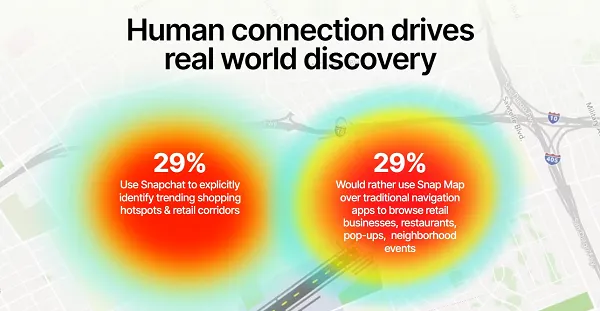
- High Engagement: Snap Map currently boasts 450 million monthly active users globally.
- Social Coordination: 76% of users consult the map to locate friends, while 27% use it as a primary tool to coordinate face-to-face meetups.
- Discovery Potential: Approximately one-third (33%) of respondents indicated they use Snap Map specifically to discover new businesses.
- The "Snapchat Advantage": Consumers are 2.9 times more likely to report discovering their favorite real-world businesses on Snapchat compared to other social platforms.
However, the inverse of this data is equally critical. If only one-third of users are leveraging Snap Map for discovery, it leaves a clear majority (over 70%) who primarily rely on other map tools for business information. This creates a strategic crossroads for brands: while Snap offers a high-conversion environment for a specific, younger demographic, it remains an auxiliary channel rather than a replacement for traditional search engine optimization (SEO) on Google or Apple Maps.
Official Responses and Strategic Vision
Snap Inc. has been vocal about its vision for the future of the platform. In its official commentary accompanying the report, the company emphasizes that brands must adapt to a "universally browsing" mindset.
"To reach an audience that is gathering social proof and deciding where to go, brands must look beyond utility maps and show up on social maps where consumers actively hang out and discover culture," a company spokesperson stated.
Snap posits that the traditional map is being "transformed into an interactive canvas." By utilizing "Promoted Places" and incentivizing user check-ins, brands can transform a passive location pin into an active, social recommendation. Snap’s leadership argues that this "ripple effect"—where a user sees a friend is at a location, expresses interest, and then visits the location themselves—is far more powerful than a cold, search-based result on a utility map.
Implications for Marketers and Business Owners
The implications for the marketing industry are profound. Businesses must now evaluate their "map footprint" across three distinct categories:
1. The Utility Layer (The Baseline)
Google Maps and Apple Maps are non-negotiable. Because they are the primary source for address, phone number, and hours, they remain the foundation of any business’s digital presence. Ignoring these is akin to being invisible to a customer who has high purchase intent.
2. The Social Layer (The Growth Engine)
Snap Map represents the growth potential. For restaurants, retail brands, and entertainment venues, this is where "social proof" lives. If your brand is not showing up on the social maps used by Gen Z and Millennials, you are missing out on the "word-of-mouth" traffic that occurs when friends see each other at popular venues.
3. The Integration Strategy
The most successful brands will be those that integrate both. This means maintaining precise, up-to-date information on Google for the "need-to-know" customer, while simultaneously creating a compelling, social-friendly experience on Snap Map for the "want-to-go" customer.
The Future of Social Discovery
As we look toward the future, the competition between utility and social maps is likely to intensify. Google has already begun integrating more social features into its own maps, such as "Follow" buttons and community-driven updates. Conversely, Snap is leaning into the intimacy of its user base to foster a level of trust that traditional search engines cannot replicate.
The data provided by Snap serves as a vital reminder that "discovery" is not a monolithic activity. Sometimes a user wants to find the closest pharmacy (Utility); other times, they want to know where the "it" crowd is hanging out on a Friday night (Social).
For brands, the lesson is clear: the modern customer journey is fragmented. Relying on a single map tool is a strategy of the past. To capture the full spectrum of consumer interest, marketers must ensure they are visible in the places where people search for facts, and the places where they share their experiences.
Snap’s push into the discovery space is not just an attempt to sell ad inventory; it is a recognition of how digital culture is increasingly tethered to the physical world. While Snap Map may not yet have the universal penetration of a utility map, its unique ability to influence social behavior makes it a critical frontier for brands looking to build authentic, community-driven connections in the real world.
Conclusion
Snap’s report confirms what many digital strategists have suspected: the "social map" is the new frontier for brand engagement. While the data shows a clear divide between the usage of utility maps and social maps, the potential for driving organic growth via social discovery is too significant to ignore.
Brands that succeed in the coming years will be those that treat Snap Map as a community hub rather than a directory. By incentivizing check-ins, leveraging promoted listings, and fostering a presence that feels like part of the social fabric rather than an advertisement, businesses can tap into the 450 million active users who are already using the platform to decide where their next real-world experience will take place.
Ultimately, while the utility of traditional maps will never go away, the future of business discovery is increasingly being written in the social, interactive, and highly personal language of Snap Map. Brands that ignore this shift do so at their own peril, risking irrelevance in a digital age that prioritizes social proof over cold, algorithm-driven search results.


 Reynand Wu
 Iffa Jayyana

 Nana Wu

 Nana

 Ammar Sabilarrohman
