
 Azzam Bilal Chamdy
In the high-stakes world of software development, reliability is the bedrock of productivity. For millions of developers, GitHub is not merely a code repository—it is the central nervous system of their workflow. However, maintaining such a massive, distributed platform requires constant, often invisible, engineering refinement. In a recent update covering the months of August and September, GitHub’s engineering team provided a candid look at their ongoing infrastructure transformation, while acknowledging that the path to a more resilient future is occasionally punctuated by service disruptions.
The Strategy: Availability, Capacity, and Features
GitHub’s current engineering mantra is a hierarchy of needs: Availability, then Capacity, then Features. This prioritization reflects a broader industry shift toward "infrastructure-first" development. Over the past two months, the team has focused heavily on reducing shared-database pressure, implementing rigorous overload controls, expanding headroom for GitHub Actions, and migrating production workloads to Azure.
The migration to the cloud is a monumental task. As of October 7, approximately 120 of 160 production services have been deployed in the Central US region, with 13 of 51 primary MySQL databases successfully transitioned. The shift is already yielding measurable results: Azure currently handles 65.4% of core application read traffic, 48.3% of Git read traffic, and a staggering 80.2% of stream-processing traffic.
However, this transition has not been without friction. GitHub faced a temporary pause in deployment and traffic increases on September 11 due to uneven capacity across availability zones. While permanent ramps resumed on September 18, the team missed their aggressive September 30 target for a full regional deployment. These challenges underscore a vital reality: the complexity of modern cloud architecture means that even with sophisticated planning, real-world conditions often dictate the pace of progress.

Chronology of Incidents: September Under the Microscope
While engineering progress continues behind the scenes, September saw two significant incidents that highlighted the fragility of legacy systems and the complexities of new feature rollouts.
Incident 1: The Database Bottleneck (September 13)
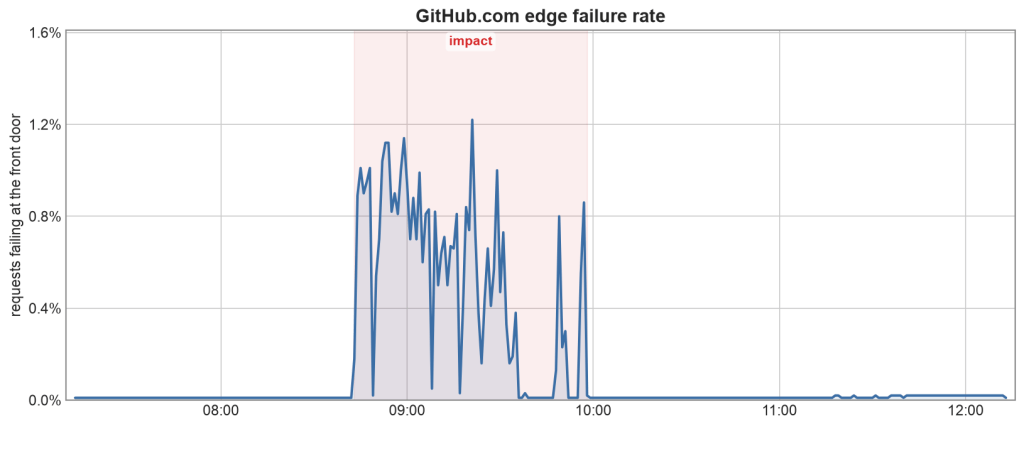
On September 13, at 09:16 UTC, GitHub experienced a performance degradation that lasted for one hour and 28 minutes.
- The Root Cause: A background data-cleanup job, intended to maintain system health, inadvertently triggered a failure. While the job was equipped with a safeguard to throttle writes if database replicas fell behind, the mechanism failed to account for incoming traffic on the primary database server. This oversight caused the job to continue unabated until the primary server hit its connection limit.
- The Compounding Factors: The impact was exacerbated by two critical flaws in the architecture. First, there was a lack of "fail-fast" timeouts on database calls, causing request handlers to hang while waiting for the saturated database. Second, an aggressive retry loop around token creation kept pushing write requests into the system, effectively preventing the database from recovering.
Incident 2: The Copilot Review Failure (September 28)
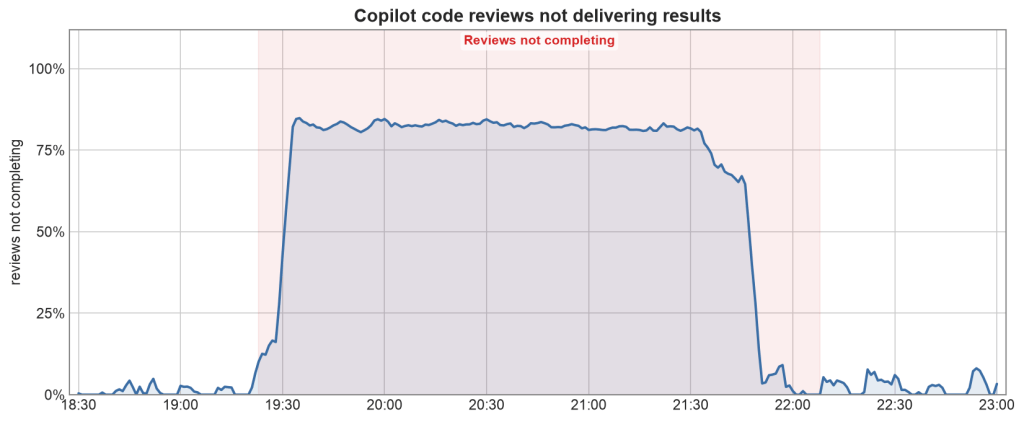
Less than a month later, on September 28 at 21:16 UTC, users of GitHub Copilot’s code review feature encountered a 52-minute disruption.
- The Root Cause: The failure stemmed from a change in the service responsible for delivering review results. The system was designed to return two versions of a review: a "limited" copy (without comments) and a "full" copy (with comments). A deployment error caused the service to send the full copy only to a subset of customers.
- The Impact: Because the system could not properly construct a review for the affected users, it reported a successful job completion despite no actual review being delivered. Because monitoring failed to detect the silent failure, the issue persisted until developers began flagging incomplete reviews, eventually triggering an automated alert for the incident response team.
Supporting Data: Infrastructure Optimization
Despite these setbacks, GitHub’s data suggests that their broader infrastructure work is paying dividends in system efficiency.
- Database Cleanup: By moving 24 authentication-core tables off the oldest shared database, the team successfully removed approximately one million queries per second from its replicas. Furthermore, cleaning up 980 million unnecessary rows from the issues and pull request database reclaimed 1.8 terabytes of storage.
- Deadlock Reduction: Weekly deadlocks, a common pain point for large-scale databases, have dropped by approximately 77% compared to their June peak.
- GitHub Actions Headroom: The Actions platform saw significant optimization. Redis operations were reduced by 28%, and CPU usage dropped by 30%. A new infrastructure cache further reduced Redis bandwidth by 84% and improved median response times for inventory requests by 96%.
- Resilience Patterns: Half of all sampled pull request traffic is now capable of continuing with limited functionality if a shared dependency fails. Additionally, dynamic database traffic routing has proven effective; during a September 23 spike in activity, one service group automatically expanded from 14 to 19 instances to maintain performance.
Official Response and Mitigation Strategies
GitHub’s leadership has emphasized that these incidents serve as vital "lessons learned." Following the September 13 database incident, the team has taken several steps to ensure such a scenario is not repeated. They are implementing immediate database timeouts to ensure the system fails fast rather than hangs. They are also re-engineering the retry logic for token creation to prevent "thundering herd" scenarios that saturate databases during recovery.
Regarding the Copilot failure, the response was more focused on visibility. The engineering team is enhancing the monitoring of the review delivery service to ensure that the absence of a "full" response is detected immediately. They have also implemented stricter validation checks for service changes to ensure that architectural updates cannot silently degrade the quality of output for subsets of users.
Perhaps most importantly, GitHub has formalized its "overload control" mechanisms. These controls allow responders to protect high-priority API and web workflows by programmatically rejecting lower-priority requests during periods of extreme saturation. This ensures that even during a partial outage, the most critical operations—such as pushing code or authenticating—remain functional.
Implications for the Developer Community
What does this mean for the average developer? For one, it signals that GitHub is moving away from a monolithic, "one-size-fits-all" infrastructure toward a more modular, cloud-native architecture. While this transition is inherently risky, the data shows that the platform is becoming increasingly self-healing.
The move toward "limited functionality" during outages is a significant paradigm shift. Instead of a total service blackout, GitHub is engineering for "graceful degradation." This means that even if a backend dependency fails, developers might still be able to perform core tasks while non-essential features remain offline.
However, the missed migration targets and the accidental regional disruptions in September highlight the difficulty of managing a platform that is effectively the "internet’s code base." For GitHub, the pressure is mounting to deliver on their promise of a fully distributed, highly available Azure-based infrastructure.
As they move toward the end of the year, the primary challenge remains: scaling their infrastructure to keep pace with the massive growth in AI-assisted coding and global collaboration, all while maintaining the rock-solid reliability that the developer community demands. The "Availability, Capacity, Features" framework will continue to be the yardstick by which their progress is measured. As the dust settles on these recent incidents, the engineering team appears committed to the idea that true speed in development is only possible when the underlying infrastructure is robust enough to absorb the shock of constant change.


 Siti Muinah
 Reynand Wu
 Layla Zulfa
 Nana
Nana
 Pevita Pearce
 Rifan Muazin

 Iffa Jayyana