
 Ali Ikhwan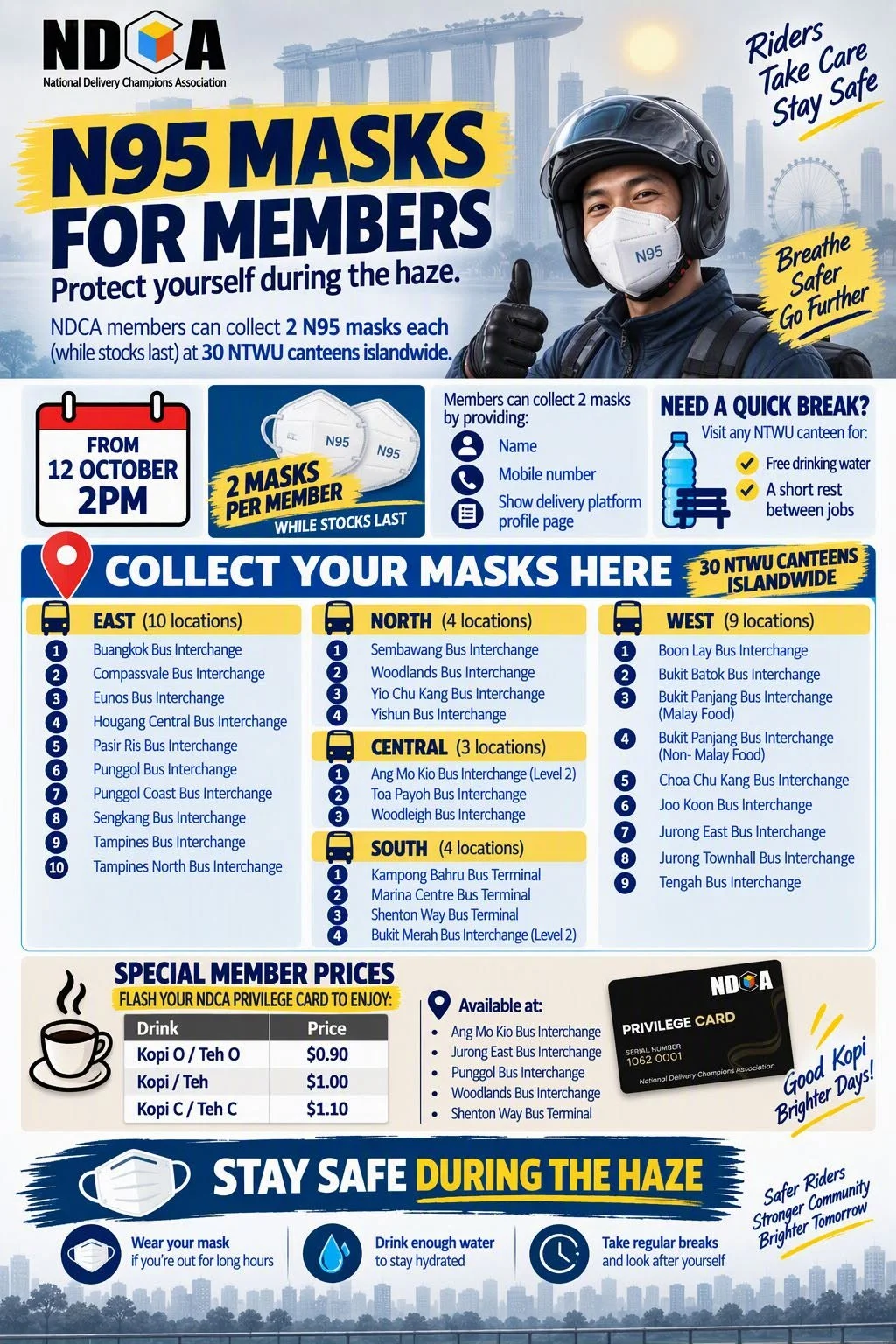
In an era where environmental fluctuations increasingly dictate the rhythms of urban life, the safety of frontline workers has become a paramount concern for Singapore’s labor movement. As the haze once again casts a grey veil over the city-state, a massive coordinated effort has been launched to protect those most exposed to the elements: delivery riders and public transport workers.
The National Delivery Champions Association (NDCA) and the National Transport Workers’ Union (NTWU), under the umbrella of the National Trades Union Congress (NTUC), have spearheaded a multi-pronged initiative. This support system includes the distribution of N95 masks, the opening of transit rest areas to gig workers, and the provision of subsidized refreshments, marking a significant step in the integration of platform worker welfare into the broader national labor framework.
Main Facts: A Unified Front Against Environmental Hazards
The core of the current relief effort lies in the unprecedented accessibility of resources for outdoor workers. For the first time, NTWU canteens—traditionally reserved for bus and rail staff—have opened their doors to the wider delivery rider community. This gesture of solidarity transforms 30 bus interchanges and terminals across the island into "haze havens."
1. Islandwide Mask Distribution
The NDCA, in partnership with major platform operators Grab and foodpanda, has secured a steady supply of N95 masks. These are being distributed at 30 strategic locations, including major bus interchanges and terminals. The choice of N95 masks is critical, as these respirators are designed to filter out at least 95% of airborne particles, including the PM2.5 pollutants that characterize haze conditions.
2. NTWU Canteens as Rest Sanctuaries
Beyond equipment, the initiative addresses the physiological needs of workers. All delivery riders, regardless of their platform affiliation, are now permitted to enter NTWU canteens to refill their drinking water and take breaks. This addresses a long-standing challenge for gig workers who often struggle to find free, accessible rest areas during their shifts.
3. Subsidized Refreshments for NDCA Members
To further alleviate the physical strain of working in poor air quality, NDCA members can access coffee and tea at specialized rates. At five key transit hubs—Ang Mo Kio, Jurong East, Punggol, Woodlands, and Shenton Way—beverages are priced starting from just S$0.90. This financial reprieve, while small per cup, serves as a significant gesture of support for workers whose margins are often tight.
4. Protection for Public Transport Staff
Simultaneously, Singapore’s four primary public transport operators—Go-Ahead Singapore, SBS Transit, SMRT, and Tower Transit—have activated their internal haze protocols. N95 masks have been made readily available to all bus and rail workers, recognizing that their roles often require long hours in non-air-conditioned environments or outdoor interchanges.
Chronology: From Air Quality Warnings to Active Intervention
The mobilization of these resources did not happen in a vacuum. It is the result of a rapid response to deteriorating air quality indices and a proactive stance by the Ministry of Manpower (MOM).
- Early October: Regional hotspots and shifting wind patterns began to elevate the Pollutant Standards Index (PSI) in Singapore. The government issued preliminary advisories urging employers to monitor air quality and prepare personal protective equipment (PPE).
- October 12: The Singapore government officially activated the haze subsidy scheme. This health-based initiative caps the cost of medical treatment for haze-related conditions at S$10 for eligible Singaporeans, ensuring that the financial burden of healthcare does not deter workers from seeking help.
- October 13: Yeo Wan Ling, Assistant Secretary-General of NTUC and a key advocate for platform workers, took to social media to announce the formal collaboration between the NDCA and NTWU. This announcement served as the official launch of the canteen access and mask distribution program.
- Ongoing: Union leaders and supervisors at transport hubs began a "ground-up" push, encouraging workers to collect their masks and reminding them of the importance of hydration and rest.
Supporting Data: The Logistics of Care
The scale of the initiative is reflected in the logistics of the distribution network. By utilizing existing infrastructure—the bus interchanges—the unions have ensured that support is located where the workers already are.
| Feature | Details |
|---|---|
| Total Collection Points | 30 Bus Interchanges & Terminals |
| Special Price Locations | AMK, Jurong East, Punggol, Woodlands, Shenton Way |
| Beverage Price | Starting from S$0.90 (for NDCA members) |
| Mask Type | N95 (Surgical-grade filtration) |
| Participating Operators | Grab, foodpanda, SBS Transit, SMRT, Go-Ahead, Tower Transit |
The Ministry of Manpower’s haze advisory remains the guiding document for these actions. The advisory stipulates that for PSI levels above 100 (Unhealthy range), the use of N95 masks is recommended for those performing outdoor work. If the PSI exceeds 200 (Very Unhealthy), the intensity of outdoor work must be reduced, and the frequency of rest breaks increased.
Official Responses: Advocacy and Corporate Responsibility
The response from labor leaders and industry stakeholders emphasizes a "human-first" approach to the gig economy and public service.

Yeo Wan Ling (NTUC Assistant Secretary-General):
In her address, Yeo Wan Ling highlighted the importance of the "Platform-Union" ecosystem. She extended her gratitude to the canteen operators and platform partners, noting that the initiative is a direct application of the MOM haze advisory. "Staying hydrated and getting adequate rest are crucial," she noted, while also making a pointed request to platform companies: "Platform operators can help by reminding riders to rest and hydrate, and by not penalising them for taking slightly longer to complete jobs during this period."
The National Transport Workers’ Union (NTWU):
The union focused on the unique vulnerability of transport staff. "Public transport workers spend long hours outdoors, on roads, at interchanges, and along rail lines," the union stated. Their message was one of internal vigilance and mutual care, urging workers to "look out for one another" and monitor their health closely.
The National Delivery Champions Association (NDCA):
The NDCA’s messaging took a community-centric tone, calling on the general public to play their part. By encouraging commuters and customers to show "appreciation, respect, and dignity" toward delivery riders and transport staff, the association aims to foster a more empathetic social environment during a period of shared environmental stress.
Implications: A New Standard for Worker Welfare
The implications of this coordinated response extend far beyond the current haze season. This initiative signals several shifts in the Singaporean labor landscape.
1. The Normalization of Platform Worker Protections
For years, delivery riders were viewed as "independent contractors" with limited access to union facilities. By opening NTWU canteens to NDCA members, the line between "traditional" employees and "platform" workers is blurring. This suggests a future where gig workers are more fully integrated into the social safety nets provided by the labor movement.
2. Environmental Resilience as an Occupational Health Standard
As climate change makes extreme weather events—including haze, heatwaves, and flash floods—more frequent, this initiative sets a precedent for how organizations must respond. Occupational Health and Safety (OHS) is no longer just about preventing accidents on the job; it is about mitigating the health risks posed by the environment. The rapid deployment of N95 masks and rest areas demonstrates that Singapore’s unions are treating environmental hazards with the same level of urgency as mechanical or operational risks.
3. Corporate Accountability and "Slow Logistics"
Yeo Wan Ling’s call for platform operators not to penalize riders for delays is a significant challenge to the "instant gratification" model of the gig economy. It advocates for a "slow logistics" approach during crises, where worker safety takes precedence over delivery algorithms. If platforms like Grab and foodpanda successfully implement non-punitive measures during the haze, it could lead to a broader discussion on how "efficiency" is measured in the delivery sector.
4. Social Cohesion and Public Empathy
The call for public respect for transport and delivery workers highlights the "invisible" nature of these roles. By bringing these workers into the spotlight during the haze, the unions are humanizing the workforce that keeps the city moving. This social capital is essential for maintaining a resilient workforce that feels valued by the society it serves.
Conclusion
The joint effort by the NDCA, NTWU, and Singapore’s transport and platform operators represents a robust defense against the health risks of the haze. By providing the tools for protection (masks), the space for recovery (canteens), and the policy framework for safety (MOM advisories), these organizations are ensuring that the city’s essential workers are not left to face the elements alone. As the haze eventually clears, the legacy of this collaboration—a more inclusive and protective labor environment—is likely to remain a permanent fixture of Singapore’s industrial relations.
For workers on the ground, the message is clear: your health is not a secondary concern to the mission of delivery or transport. For the public, the reminder is equally vital: the person delivering your meal or driving your bus is navigating a challenging environment to keep your life convenient. Respect and dignity, it seems, are just as important as an N95 mask in weathering the storm.


 Azzam Bilal Chamdy
 Nana Wu
 Layla Zulfa
 Nana
Nana
 Pevita Pearce
 Rifan Muazin

 Iffa Jayyana