
 Siti Muinah
The global transition to electric mobility, long championed by environmental advocates and tech-forward governments, has recently found an unlikely and turbulent accelerant: geopolitical instability. Despite a concerted effort by the Trump administration to stifle the growth of the electric vehicle (EV) sector in the United States, a dramatic escalation in Middle Eastern tensions—specifically the late-February 2026 conflict involving Iran—has triggered a global surge in EV adoption. As crude oil prices skyrocketed following the disruption of vital transit routes, the economic calculus for millions of consumers shifted overnight, turning the EV from a luxury niche into an urgent, pragmatic necessity.
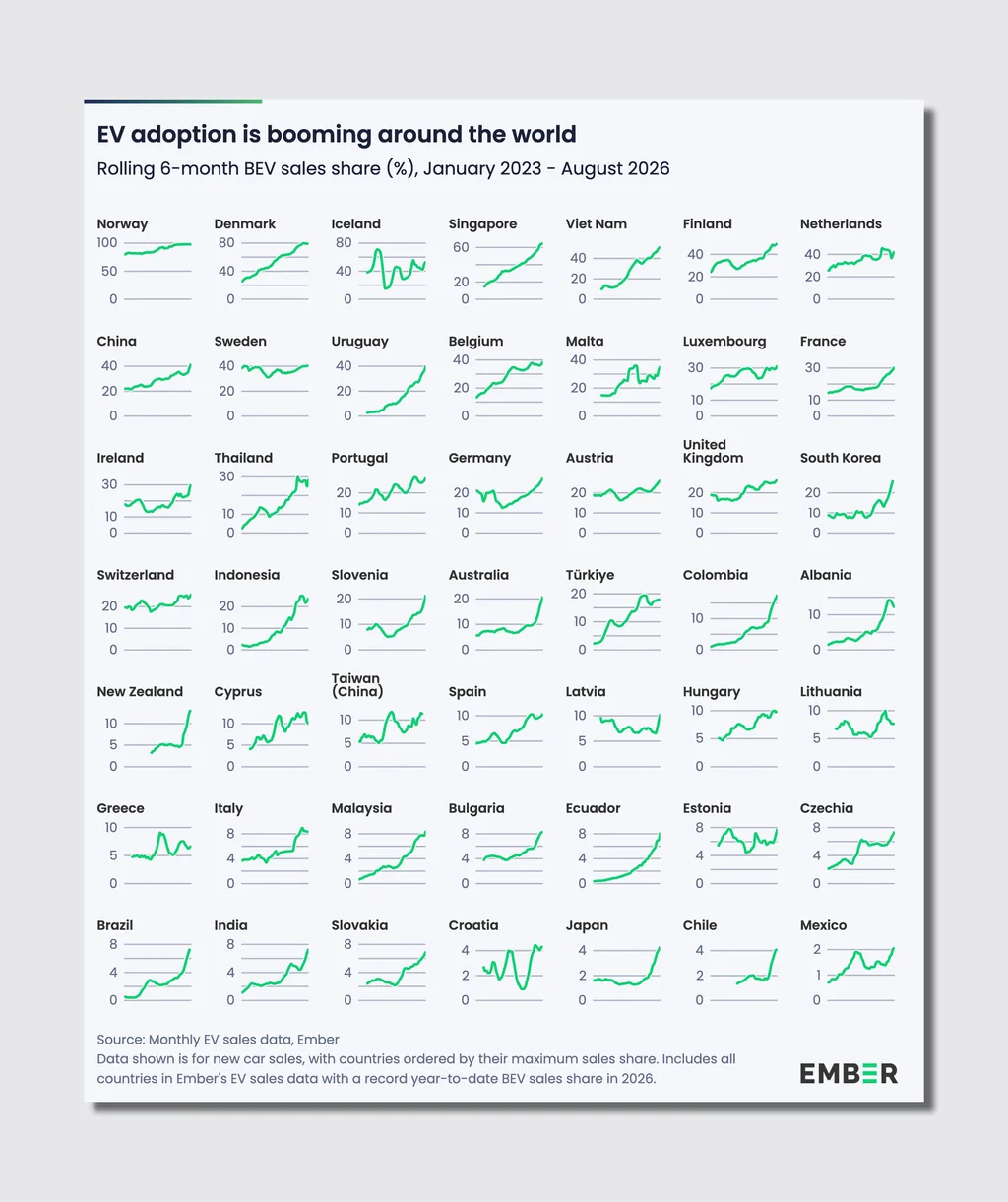
A comprehensive new report from Ember, an influential energy think tank tracking the pulse of the automotive market across 56 nations, provides empirical evidence of this paradigm shift. The data reveals that 49 of these 56 countries have reached record-breaking EV market penetration in 2026, suggesting that the "war-driven" energy crisis has effectively bypassed political roadblocks to solidify a new, permanent trajectory for global transportation.
The Chronology of a Market Shift
The catalyst for this transformation was the closure of the Strait of Hormuz in March 2026. This critical maritime chokepoint, through which a significant portion of the world’s oil supply flows, became the epicenter of a geopolitical shockwave. As the conflict escalated, international oil markets reacted with extreme volatility. Within weeks, fuel prices at the pump hit historic highs in Europe, Asia, and the Southern Hemisphere, leaving commuters and commercial fleets vulnerable to the whims of global instability.
Pre-Crisis vs. Post-Crisis: The Data
The period immediately following the March closures witnessed an unprecedented acceleration in EV sales. Ember’s data highlights a stark divergence between the pre-crisis period (September 2025–February 2026) and the subsequent months (March 2026–August 2026):
- New Zealand: Experienced a massive 165% growth in EV sales compared to the previous six months, a significant jump from its pre-crisis growth trajectory.
- Australia: Saw its EV adoption rate climb from a modest 5% growth to 136% in the wake of the price shocks.
- Chile: Recorded a 124% increase in sales, reflecting the rapid response of emerging economies to volatile fossil fuel costs.
- India: Despite starting from a lower baseline, India saw its adoption rate surge by 58%, moving from a 2% share in 2024 to 7% by August 2026.
This data suggests that the fear of future price spikes, combined with the immediate sting of high fuel costs, acted as a primary driver for consumer behavior that had previously been tepid or indifferent.
Supporting Data: A Global Snapshot of Adoption
While the U.S. market has struggled under protectionist policies and fluctuating administrative support, the rest of the world has reached a point of no return. Norway, the world’s undisputed leader in electrification, saw its EV market share reach an astounding 98% of new vehicle sales by August 2026. However, the true story lies in the "middle tier" of nations that have rapidly caught up to the leaders.
Denmark now boasts an 80% market share for EVs, while Iceland stands at 50%. Perhaps most impressive are the nations that have moved from single-digit adoption to substantial market presence in under two years. Countries such as Singapore, Vietnam, Finland, and the Netherlands have seen EV market shares climb between 20% and 60%.
In Germany, the intersection of record-high fuel prices—reaching approximately $8.52 per gallon by August 2026—and aggressive pro-EV policy initiatives created a "perfect storm." By late summer, battery electric vehicles accounted for 27.5% of total new car sales in Germany, representing a 50% year-over-year increase. Uruguay, a country that has spent over a decade incentivizing clean energy, hit a record 38% market share, proving that long-term policy infrastructure acts as a vital safety net during moments of global economic crisis.
Official Perspectives and Analytical Insights
The rapid uptake of electric vehicles is not solely the result of panic-buying at the fuel pump; it is also the culmination of long-term strategic planning by global manufacturers.
Euan Graham, a senior energy analyst at Ember, notes that the timing was fortuitous. "First, you had fuel efficiency standards—which basically means a lot of manufacturers suddenly started bringing out more affordable electric car models at the start of this year—and then there was also some more direct policy support in places like Germany," Graham explains. "So, all of that has meant that as consumer interest in EVs has risen and as petrol prices have risen, consumers have also had more affordable electric car models to choose from."
The convergence of policy-mandated affordability and the urgent need for fuel independence has created a self-sustaining cycle. When consumers are presented with lower-cost entry models during a period where fossil fuel volatility is high, the "total cost of ownership" argument for EVs becomes impossible to ignore.
The Global vs. Domestic Disconnect
While the global EV market has grown by 11% year-over-year for the first eight months of 2026, this number actually masks the true scale of the boom. When the U.S. and China—where domestic sales have hit a period of stagnation—are removed from the equation, the growth rate of the rest of the world stands at a staggering 45%.
This indicates a growing divide. The U.S. administration’s efforts to slow EV growth, intended to protect domestic fossil fuel interests, have inadvertently left the American consumer exposed to global market volatility that the rest of the world is now actively insulating itself against. As other nations move toward energy autonomy through electrification, the U.S. risks becoming an outlier, tethered to a volatile oil market while its global peers pivot toward a more stable, electricity-based future.
Implications for the Future
The implications of the 2026 surge are profound and multi-faceted:
1. The Death of the "Niche" Argument
For years, skeptics argued that EV adoption was driven solely by government subsidies and environmental altruism. The 2026 data shatters this narrative. When fuel prices spike due to geopolitical conflict, adoption becomes a matter of economic survival. This shift implies that the EV market has reached a level of maturity where it functions as a rational economic hedge against global instability.
2. Energy Security as a Driver of Innovation
The closure of the Strait of Hormuz acted as a wake-up call for nations heavily dependent on oil imports. Governments that previously viewed EV adoption as a climate goal are now reframing it as a matter of national security. By reducing reliance on imported crude, nations are finding that they can protect their economies from the geopolitical maneuvers of adversarial powers.
3. Supply Chain Resilience
The rapid growth in emerging markets like India, Chile, and Vietnam suggests that global manufacturing is successfully diversifying. As more countries adopt EVs, the pressure to localize supply chains for batteries and components will increase, likely leading to further price reductions and improved accessibility.
4. The U.S. Policy Paradox
The irony of the current situation is striking. By actively discouraging EV adoption, the current U.S. administration has left its citizens as the most vulnerable to the very oil price spikes that the rest of the world is using as an excuse to accelerate their transition away from fossil fuels. As the global automotive industry increasingly aligns with electric standards, the U.S. may find itself facing a significant "competitiveness gap," as domestic manufacturers struggle to keep pace with the technical and scale-based advancements of their international counterparts.
Conclusion
The 2026 EV surge is more than just a spike in sales charts; it is a fundamental reconfiguration of how the world powers its mobility. While the conflict in Iran was the catalyst, the momentum behind the electric transition is now being sustained by a combination of consumer pragmatism, aggressive policy, and the undeniable economic benefits of moving away from fossil fuels.
As the world looks toward 2027 and beyond, the lesson of the past eight months is clear: geopolitical crises may slow global trade, but they have proven to be the most effective accelerant for the clean energy transition. The era of the internal combustion engine is not ending because of environmental policy alone; it is ending because, in a world defined by instability, the electric motor has become the most secure choice for the future.


 Neng Nana

 Asro
Asro
 Jia Lissa
 Dwi Wanna