
 Siti Muinah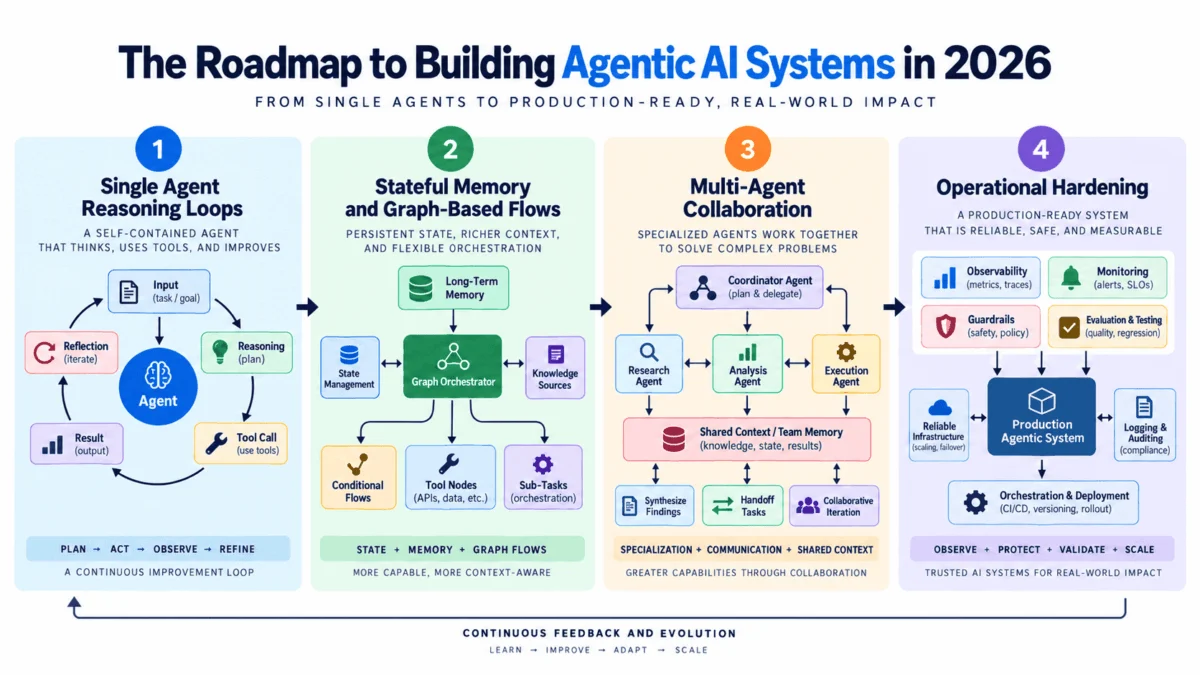
The transition from passive language models to active, autonomous agents represents the most significant paradigm shift in software engineering since the dawn of cloud computing. As "agentic AI"—systems capable of autonomous planning, tool utilization, and iterative problem-solving—moves from research labs into core production infrastructure, developers are facing a new reality. The era of the simple, single-turn chatbot is rapidly closing, replaced by multi-step, goal-oriented systems that drive code review pipelines, orchestrate complex research, and manage internal enterprise operations.
However, bridging the gap between a compelling demo and a reliable production-grade agent is a formidable engineering challenge. It requires a departure from traditional software paradigms toward a framework defined by state management, failure recovery, sandboxed execution, and rigorous, trajectory-based evaluation.
Main Facts: The Agentic Shift
At its core, an agent is defined by its ability to perceive an environment, select actions via defined tools, and utilize the outcomes of those actions to refine its decision-making process. Unlike standard large language model (LLM) calls, which are stateless and linear, agentic systems operate in a recursive loop.
This evolution brings three primary technical hurdles to the forefront:
- Structured Tool Interaction: Agents must communicate with external APIs (databases, web search, code interpreters) using strict schemas to prevent cascading failures.
- Dynamic Context Assembly: Managing the "memory" of a long-running agent is a critical performance and cost factor, requiring sophisticated logic to summarize or retrieve information rather than simply stuffing the context window.
- Systemic Reliability: Moving beyond single-turn interactions introduces the necessity for observability—knowing exactly why a system failed after a ten-step sequence, rather than just knowing that it failed.
Chronology of Development: From Logic to Collaboration
To understand the trajectory of agentic development, we must view it as a four-level maturity model. Each level builds upon the last, moving from the individual "brain" to the collective "team."
Level 1: Anatomy and Cognitive Architectures
Before orchestrating a team of agents, one must master the single-agent loop. The foundational paradigm here is the "ReAct" (Reasoning and Acting) pattern, which forces models to articulate their internal logic before executing a tool call. Modern engineering mandates strict output validation—using frameworks like Pydantic—to ensure the model’s tool outputs are machine-readable.
Level 2: Stateful Memory and Graph-Based Flows
Brittle agents fail because they lose context. The shift to production-ready systems involves implementing Stateful Memory—episodic, semantic, and short-term—which allows an agent to learn from its past steps. Furthermore, linear chains are being replaced by directed acyclic graphs (DAGs) via tools like LangGraph, allowing for branching logic where an agent can choose different paths based on the success or failure of previous steps.
Level 3: Multi-Agent Collaboration
When a task exceeds the capabilities of a single agent, developers are turning to multi-agent topologies. Whether employing a hierarchical "boss-worker" structure or a "peer-to-peer" collaborative model, the design of inter-agent communication protocols is essential. Standardized message schemas prevent "telephone game" errors, where information degrades as it moves between specialized agents.
Level 4: Operational Hardening and Observability
The final stage is the transition to "System Engineering." This involves building "circuit breakers" to stop runaway loops, sandboxing code execution in secure environments (such as Docker or E2B), and implementing trajectory-level evaluation.
Supporting Data and Engineering Paradigms
The engineering community is coalescing around a specific set of tools and standards. As noted in current industry trends, the Model Context Protocol (MCP) is emerging as a universal standard for connecting agents to data, effectively solving the "silo" problem where agents were once restricted to the proprietary toolsets of their framework providers.
- Validation: Strict Pydantic schemas reduce tool-call failure rates by an estimated 60% in production environments.
- Observability: Tracing tools like LangSmith and Arize Phoenix have become non-negotiable. Without these, developers are "flying blind," unable to audit the intermediate reasoning steps that lead to hallucinations or loop traps.
- Security: Sandboxing is the primary defense against prompt injection and malicious code execution, with WebAssembly (Wasm) and cloud-based ephemeral environments serving as the standard for high-security enterprise deployments.
Official Perspectives: The Industry View
Industry experts, including AI educator Vinod Chugani, emphasize that the shift to agentic systems is fundamentally an increase in "engineering responsibility."
"Agentic AI systems represent a real shift in how software behaves: from passive tools that respond to queries, to active systems that pursue goals across extended time horizons," says Chugani. This shift necessitates a move away from "black-box" testing toward "trajectory evaluation," where the quality of the process is weighted as heavily as the final result.
The consensus among major players like Anthropic and Microsoft (via the AutoGen project) is that agent reliability is not a feature you add at the end of the build cycle; it is an architectural requirement that must be integrated at the data-schema level.
Implications for the Future of Work
The rise of autonomous agent systems has profound implications for software architecture and the workforce:
1. The Rise of "Agentic DevOps"
We are witnessing the birth of a new operational category. "Agentic DevOps" involves managing the lifecycle of non-deterministic systems. Developers must now monitor for "token exhaustion" and "looping failure" with the same intensity that they monitor server CPU and memory usage.
2. Shift in Talent Requirements
The market is shifting away from pure prompt engineers toward "Agentic Systems Architects." These individuals need a deep understanding of graph theory, distributed systems, and structured data validation, rather than just natural language proficiency.
3. The "Human-in-the-Loop" Necessity
Despite the push for autonomy, the most successful enterprise deployments incorporate "Human Approval Gates." These are checkpoints in the graph where the agent pauses, presents its plan, and waits for a human signature before proceeding with high-stakes actions, such as database writes or external communications.
4. Economic Efficiency
By replacing monolithic, high-latency models with a team of smaller, specialized agents, companies are finding that they can significantly reduce operational costs while increasing task accuracy. Smaller models, when guided by clear protocols and structured schemas, often outperform massive, general-purpose models in specialized domain tasks.
Conclusion: Building for the Long Term
The roadmap to 2026 is clear: building agentic AI is not about finding the "smartest" model; it is about building the most resilient system. The investment in hardening—through state management, secure sandboxing, and rigorous observability—is not optional. It is the differentiator between a prototype that collapses under pressure and a robust system that scales.
For developers and organizations looking to lead in this space, the advice is consistent: build each layer deliberately. Start with single-agent tool validation, move to stateful graph-based flows, design strict inter-agent protocols, and finally, wrap everything in a comprehensive observability framework. As the complexity of our systems grows, our discipline in defining them must grow to match.


 Nila Kartika Wati
 Ali Ikhwan
 Raul Delapena Setiawan
 Nana
Nana
 Muslim
 Asep Darmawan
 Neng Nana