
 Azzam Bilal Chamdy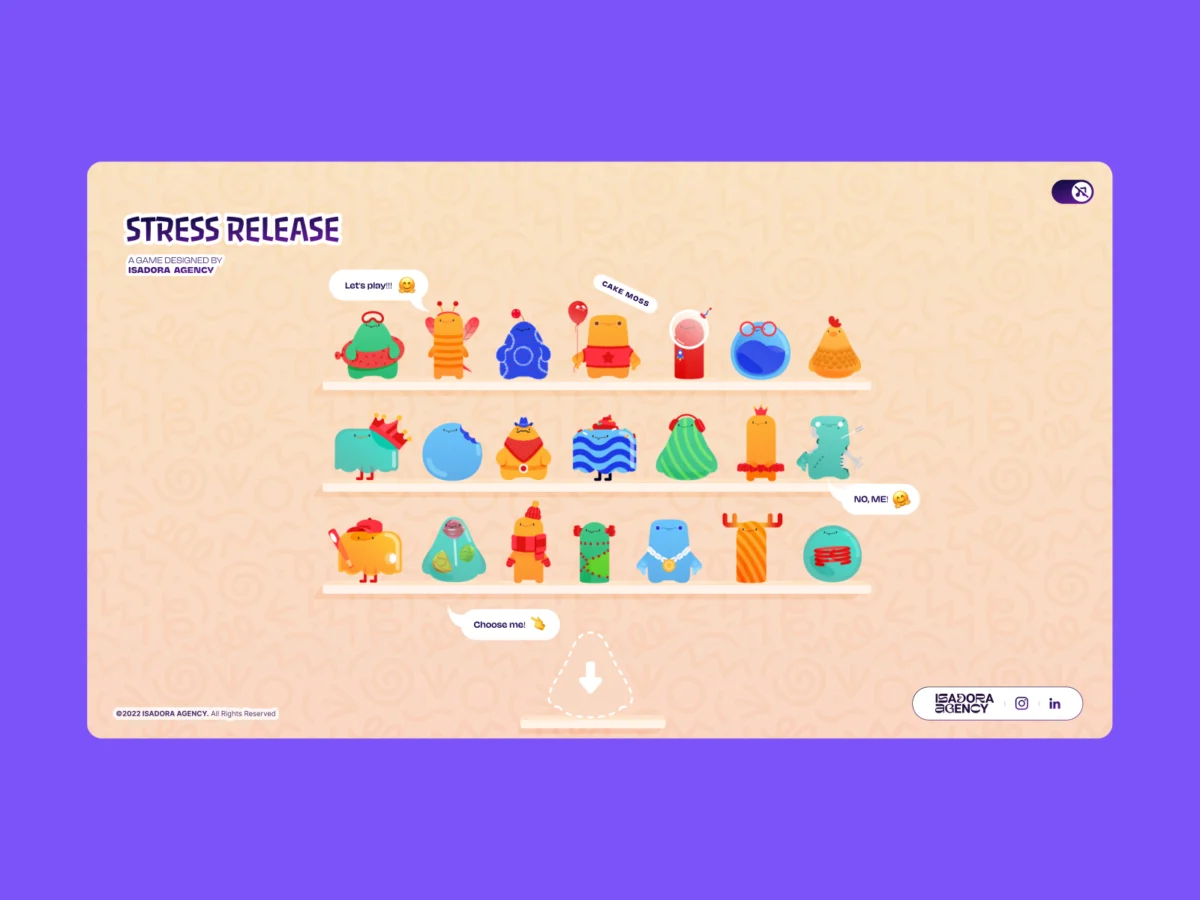
In the modern landscape of web development, the pursuit of "tactile" design—interfaces that respond with weight, squish, and physical realism—often leads developers directly to the door of physics engines. Libraries like Matter.js or Cannon.js have become the industry’s default response to gamification. However, for the team at Isadora Agency, the challenge of building Stress Release, a digital stress-relief toy, forced them to reconsider whether physics engines were truly the right tool for the job.
When the goal is "intentional motion"—the specific, frame-by-frame artistry of an animator—algorithmic physics can feel imprecise, even messy. By shifting their architectural strategy, the team at Isadora Agency proved that you can achieve a deeply immersive, highly responsive experience without a single line of WebGL or external physics libraries, relying instead on programmatic Lottie state controls, DOM manipulation, and precise distance-based mathematics.
The Design Requirements: A Case for Deterministic Motion
The genesis of Stress Release was simple: provide burnt-out creatives with a digital outlet to smash, stretch, and distort UI characters. Yet, the technical implementation was anything but straightforward. The design team had created bespoke, hand-crafted JSON Lottie files. These weren’t just assets; they were performances. A "mega squeeze" reaction, for instance, required a meticulously timed 181-frame build-up, followed by an equally specific release sequence.
When the team prototyped these assets using standard physics engines, the results felt disjointed. "Physics engines produce plausible motion, but in our case, the animators produced intentional motion," explains Alexey Kopytin. Physics engines are designed for chaos: they calculate gravity, friction, and collision vectors in real-time. If an animator spends hours perfecting the "snap" of a character’s eye or the subtle bounce of a rubberized limb, a physics engine’s tendency to approximate motion can inadvertently overwrite that creative nuance.
The team realized that to honor the artistry of the animation, they needed absolute deterministic control. They required an architecture that treated the interaction layer not as a simulation engine, but as a precise trigger for the animation layer.
The Architectural Shift: Mapping DOM to Lottie
To maintain this level of control, Isadora Agency pivoted away from WebGL. Instead, they utilized the native Lottie runtime to handle SVG rendering directly within the DOM. By treating the browser’s document object model as the canvas, the team gained the ability to manipulate elements using standard CSS, JavaScript event listeners, and simple, high-performance math.

The Mathematics of "The Hit"
The key to making the experience feel "tactile" lies in spatial accuracy. To give the user the sensation that they are physically touching a character, the team implemented a radial input mapping system. This system calculates the user’s click relative to the character’s center point and uses the Pythagorean theorem to determine the exact distance of the impact.
The logic is elegant in its simplicity:
- Coordinate Translation: Every click is measured against the character’s center point within its local coordinate space.
- Distance Calculation: Using
Math.hypot(a, b), the code determines the distance from the center. - Zone Mapping: The result maps to a "concentric zone" system—effectively a digital dartboard. A click near the center yields maximum points and the most intense squish, while a peripheral tap results in a lighter reaction.
This spatial mapping ensures that when a user clicks, the accompanying particle effect or "explosion" animation is repositioned precisely to the $(x, y)$ coordinate of the click. This creates an immediate, visceral sense of feedback: the player knows exactly where they hit, and the UI reacts to that specific point.

Chronology of the Interaction Loop
The development cycle for Stress Release followed a rigid, iterative timeline focused on perfecting the click-feedback loop.
- Phase 1: Conceptualization. Defining the "personality" of the characters through character cards and storyboarded reaction states.
- Phase 2: Animation Export. Animators generated Lottie JSON files with distinct frame segments for "idle," "light," "medium," and "heavy" reactions.
- Phase 3: Logic Implementation. Developers built the event listeners to capture clicks and translate them into coordinates.
- Phase 4: State Management. Using
playSegmentsto jump between predefined animation loops, ensuring that the transition from an idle state to an interaction state was seamless. - Phase 5: Performance Tuning. Optimization of Lottie quality and speed to ensure that 21 simultaneous animations on the "shelf" screen did not degrade the user experience on lower-powered mobile devices.
Performance Optimization: Managing the Cost of Lottie
While the Lottie-based architecture provided aesthetic superiority, it brought a significant technical challenge: performance overhead. Rendering 21 complex, layered animations simultaneously on a shelf screen is a taxing process for mobile browsers.
To mitigate this, the team implemented a multi-tiered optimization strategy:

- Quality Scaling: The team dynamically adjusted the Lottie
setQualityproperty. On the shelf view, where many characters are visible, they reduced the rendering quality to 50% to minimize the load on the browser’s interpolation engine. When a user enters the individual play view, the quality is bumped back to 100%. - Speed Management: By setting the
setSpeedproperty to 0.6 on the shelf animations, they reduced the number of frame calculations required per second without sacrificing the visual "charm" of the idle loops. - State Locking: To prevent the animation engine from being overwhelmed by rapid, consecutive clicks, the team implemented a state-lock (
canPlayAnim). This ensures that the engine finishes the current "squish" sequence before accepting new inputs, preventing animation flickering.
Implications for Future UX Engineering
The success of Stress Release carries significant implications for the future of interactive web design. It challenges the "physics-first" dogma that has permeated the industry for the last decade.
1. Art Direction Over Simulation
The primary implication is that technology should be a servant to the design, not a master. When the goal is to elicit a specific emotional response—such as stress relief—the precision of a human animator is often superior to the randomization of a physics engine. By choosing programmatic control, Isadora Agency proved that you can achieve a more "human" feel by explicitly coding the desired reaction.
2. The Power of "Small" Tools
The use of DOM-based SVG rendering for high-interaction environments highlights that modern browsers are far more capable than many developers assume. By leveraging native CSS variables for responsive scaling and the Lottie API for sequence control, the team created a robust, cross-device experience that didn’t require the overhead of a heavy WebGL framework.

3. Sustainable Interactivity
As web performance becomes an increasingly important metric for SEO and user retention, the ability to build "tactile" experiences that don’t rely on massive JavaScript bundles or heavy GPU-bound processes is a distinct advantage. This approach allows for high-fidelity animations to exist within a lightweight, accessible framework.
Conclusion
The Isadora Agency’s approach to Stress Release serves as a masterclass in architectural decision-making. By opting for programmatic state control, they successfully bridged the gap between high-end motion design and web performance. They demonstrated that for developers tasked with building "bouncy" or "squishy" interfaces, the answer isn’t always the latest physics library—sometimes, it’s just a bit of math, a well-defined state machine, and a clear commitment to the animator’s vision.
In an era where websites are becoming increasingly homogenized by standard templates, Stress Release stands as a reminder that the most compelling user experiences are born when developers stop simulating reality and start crafting intentional, human-centered motion.


 Ammar Sabilarrohman
 Lina Hope
 Basiran
 Neng Nana
 Nana Muazin
 Jia Lissa
 Laily UPN
 Asep Darmawan