
 Sagoh
Sagoh
In the rapidly evolving landscape of Large Language Model (LLM) deployment, the pursuit of efficiency has become the primary bottleneck for developers and enterprises alike. As models grow in parameter count and complexity, the hardware requirements to serve them have skyrocketed. While techniques like weight quantization, kernel optimization, and specialized inference engines—such as vLLM or TensorRT-LLM—have become industry standards, they often hit a wall regarding latency. Enter speculative decoding, a revolutionary approach that promises to squeeze more performance out of existing GPU infrastructure without the need for additional hardware.
Among the latest innovations in this space, DeepSeek’s DSpark stands out as a sophisticated evolution of speculative decoding. By blending the raw speed of parallel token drafting with the contextual accuracy of sequential processing, DSpark is redefining the speed-to-accuracy ratio in autoregressive generation.
The Core Mechanics: What Makes DSpark Unique?
To understand why DSpark is generating excitement, one must first understand the limitations of traditional speculative decoding. In standard speculative setups, a small, "draft" model generates a sequence of potential future tokens in parallel. A larger, "target" model then verifies these tokens in a single pass. If the draft model is accurate, the target model accepts multiple tokens at once, significantly reducing the number of sequential inference steps.
However, parallel drafting has an inherent flaw: because the draft model generates tokens simultaneously, later tokens in the draft block lack the context of their immediate predecessors, leading to lower acceptance rates.
The Hybrid Advantage
DSpark disrupts this by employing a hybrid architecture. It utilizes a parallel backbone for speed, but integrates a lightweight sequential component. This allows subsequent tokens in a drafted block to "see" and incorporate information from the tokens predicted earlier in the same pass. The result is a higher-confidence draft that is significantly more likely to be accepted by the target model.
Furthermore, DSpark incorporates a confidence-thresholding mechanism. If the draft model lacks confidence in a specific token, the system can dynamically drop that part of the sequence, preventing the target model from wasting precious compute cycles verifying low-probability output.
Chronology: From Concept to Implementation
The journey of DSpark from a research paper to a functional tool in the developer’s toolkit highlights the velocity of the open-source AI community.
- Conceptualization: DeepSeek introduced DSpark as a solution to the "draft-accuracy" trade-off inherent in models like Medusa and EAGLE.
- Integration: The maintainers of llama.cpp, the de-facto standard for running LLMs on local hardware, quickly recognized the potential of DSpark and began integrating support for it into the core repository.
- Benchmarking: With the release of Qwen3-8B and its corresponding DSpark draft model, the community gained the ability to run real-world tests.
- Optimization: Current development is focused on expanding model support, as the current requirement for a specialized draft model remains the primary hurdle to universal adoption.
Practical Application: Benchmarking DSpark with Qwen3-8B
To quantify the impact of DSpark, we conducted a rigorous test environment using llama.cpp on a standard NVIDIA GPU setup. The objective was to measure the "apples-to-apples" performance difference between a standard inference run and a DSpark-enabled run.
Setup and Environment
Building from source was essential to access the latest DSpark implementations. Utilizing cmake with CUDA support enabled, we ensured the hardware could handle both the primary Qwen3-8B model and the smaller DSpark draft model simultaneously.
- Target Model: Qwen3-8B-Q4_K_M (4.7 GB)
- Draft Model: DSpark-Qwen3-8B-Q8_0 (1.2 GB)
- Hardware: Standard CUDA-enabled GPU (offloading all layers via
-ngl all).
The Baseline
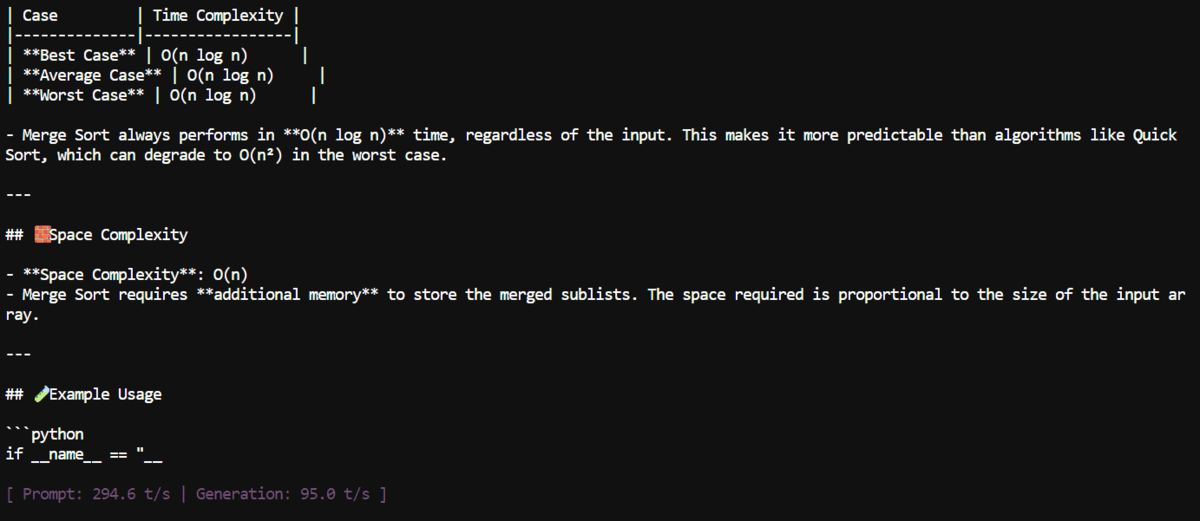
Running the standard Qwen3-8B model without speculative decoding yielded a steady 95.0 tokens per second (t/s). This serves as our control, representing the current ceiling of standard inference for this specific hardware and model configuration.

The DSpark Performance
By loading the draft model via the -md flag and enabling the speculative engine with --spec-type draft-dspark, we repeated the exact prompt. The results were immediate and measurable:
- Generation Throughput: 124.9 t/s
- Performance Gain: ~31.5% increase in generation speed.
This gain is not merely a theoretical exercise; it represents a tangible improvement in user experience. For applications involving long-form content generation, a 31% boost translates to significantly lower latency and a more fluid, conversational feel.
Supporting Data and Comparative Analysis
| Configuration | Prompt Speed (t/s) | Generation Speed (t/s) |
|---|---|---|
| Qwen3-8B (Baseline) | 294.6 | 95.0 |
| Qwen3-8B + DSpark | 88.0 | 124.9 |
As noted in the table above, while prompt-processing speed (the time taken to "read" the initial input) actually decreased slightly, the autoregressive generation speed saw a massive jump. In real-world deployments, users rarely care about the initial prompt ingestion speed as much as they care about how quickly the model streams the final answer. DSpark excels precisely where it is needed most.
Official Perspectives and Industry Implications
DeepSeek’s own internal reports have been even more optimistic than our local tests. When deployed on high-end infrastructure with models like DeepSeek-V4, the team reported gains between 60% and 85%.
The Developer’s Dilemma: DSpark vs. MTP
While the results are impressive, industry experts remain pragmatic. Multi-Token Prediction (MTP) remains the most "practical" choice for developers. MTP is model-agnostic, requires less complex infrastructure, and is supported by a wider range of hardware targets.
The consensus, however, is clear:
- DSpark is the superior choice for high-throughput, high-accuracy needs where specific draft models are available.
- MTP is the workhorse for general-purpose, rapid deployment.
The implication here is a modular future. We are moving toward a world where the "draft model" will eventually be considered a standard component of an LLM release, much like tokenizer files or configuration JSONs.
Conclusion: Is DSpark Ready for Prime Time?
DSpark is an extraordinary piece of engineering, but it is currently in a state of "early access" maturity. For developers who are comfortable building from source and working with the latest llama.cpp commits, it offers a compelling path to significant speedups.
However, the primary barrier remains ecosystem support. Until more models are released with pre-trained DSpark draft companions, its utility will be limited to a handful of popular open-source models.
Final Takeaways:
- Performance: DSpark provides a ~30%+ boost in generation speed for local models, with potential for much higher gains on large-scale infrastructure.
- Ease of Use: If you have the models, implementing it in llama.cpp is straightforward, involving only a few command-line flags.
- Future Outlook: As the standard for speculative decoding matures, we expect to see "drafting" become an automated part of the training process, rendering manual setup obsolete.
For now, DSpark is a high-performance tool for the enthusiast and the professional alike. It challenges the status quo of inference and demonstrates that we are far from hitting the ceiling of what our current hardware can achieve through intelligent software design. As the AI community continues to refine these techniques, the dream of "instantaneous" LLM interaction is becoming less of a goal and more of a predictable technical milestone.

 Neng Nana
 Evan Lee Salim
 Raul Delapena Setiawan
 Reynand Wu


 Azzam Bilal Chamdy
 Ali Ikhwan