
 Nana Muazin
Welcome to Carbon Brief’s DeBriefed—an essential analysis of the week’s most consequential developments in the climate landscape.
The global climate trajectory has shifted from a distant warning to an immediate, visceral reality. This week, the world witnessed the devastating synergy of extreme heat and uncontrollable wildfires, forcing a re-evaluation of what constitutes a "normal" climate. From the urban corridors of Europe to the dense forests of North America, the message from the environment is clear: the era of climate stability has effectively ended.
I. Main Facts: The "Firewave" Phenomenon
The headline of the week is undoubtedly the emergence of the "firewave"—a term gaining traction as record-breaking heat synchronizes with massive wildfire outbreaks across the Northern Hemisphere.
In France, emergency services were pushed to their limits as wildfires engulfed the historic Fontainebleau forest near Paris. The scale of the emergency was such that authorities were forced to deploy water-dumping aircraft to siphon supplies directly from the River Seine, a stark visual representation of the intersection between urban infrastructure and environmental crisis.
Across the English Channel, the United Kingdom is struggling to adapt to a new, hostile climate reality. According to data from the Financial Times, the UK endured 25 non-consecutive days with temperatures exceeding 30°C this summer, including nine consecutive days above 34°C. These aren’t mere anomalies; they represent a fundamental shift in the British climate, placing unprecedented strain on national health services and infrastructure designed for cooler climes.
Simultaneously, the North American continent is grappling with a thick, toxic blanket of smoke. Canada’s ongoing wildfire season has created a massive orange haze that has drifted south, blanketing regions across Ontario and the northern United States. The BBC reports that air quality in major population centers has plummeted, forcing millions to reconsider outdoor activity and exposing the transboundary nature of climate-induced disasters.
II. Chronology of a Crisis
The descent into these conditions was not instantaneous, but the acceleration has been marked by a series of events over the past few days:
- Monday: Reports surfaced regarding the catastrophic death toll from previous heatwaves, with over 10,000 fatalities in Europe linked to heat stress. Meanwhile, initial data on global oil demand began to show slight fluctuations amid the chaos.
- Tuesday: The crisis intensified as Paris battled its forest fires and the US faced a persistent "heat dome," while political rhetoric regarding fossil fuels—specifically coal—saw a resurgence in some sectors, complicating the path to mitigation.
- Wednesday: The UK Met Office released a definitive report declaring that climate extremes are no longer "events," but the "new normal." Concurrently, severe flooding in Pakistan and legislative cuts to climate initiatives in the US underscored the volatility of the global response.
- Thursday: Canada’s evacuation efforts hit a critical juncture as wildfire smoke reached record density, while international climate policy discussions shifted toward the revamping of EU carbon markets and the controversial reduction of overseas climate aid by the UK government.
- Friday: A week of intensity closed with a focus on the socioeconomic fallout of the heat, as scientists continued to process the data proving that a massive percentage of early-summer deaths were directly attributable to human-caused climate change.
III. Supporting Data: The Quantitative Cost
The data backing these events is sobering. A key indicator of progress—or the lack thereof—was the revelation that Amazon deforestation in Brazil dropped by 38% in the first half of 2026 compared to the previous year. While this represents a significant victory under the current Brazilian administration, it is tempered by the massive carbon releases currently occurring in the Northern Hemisphere.
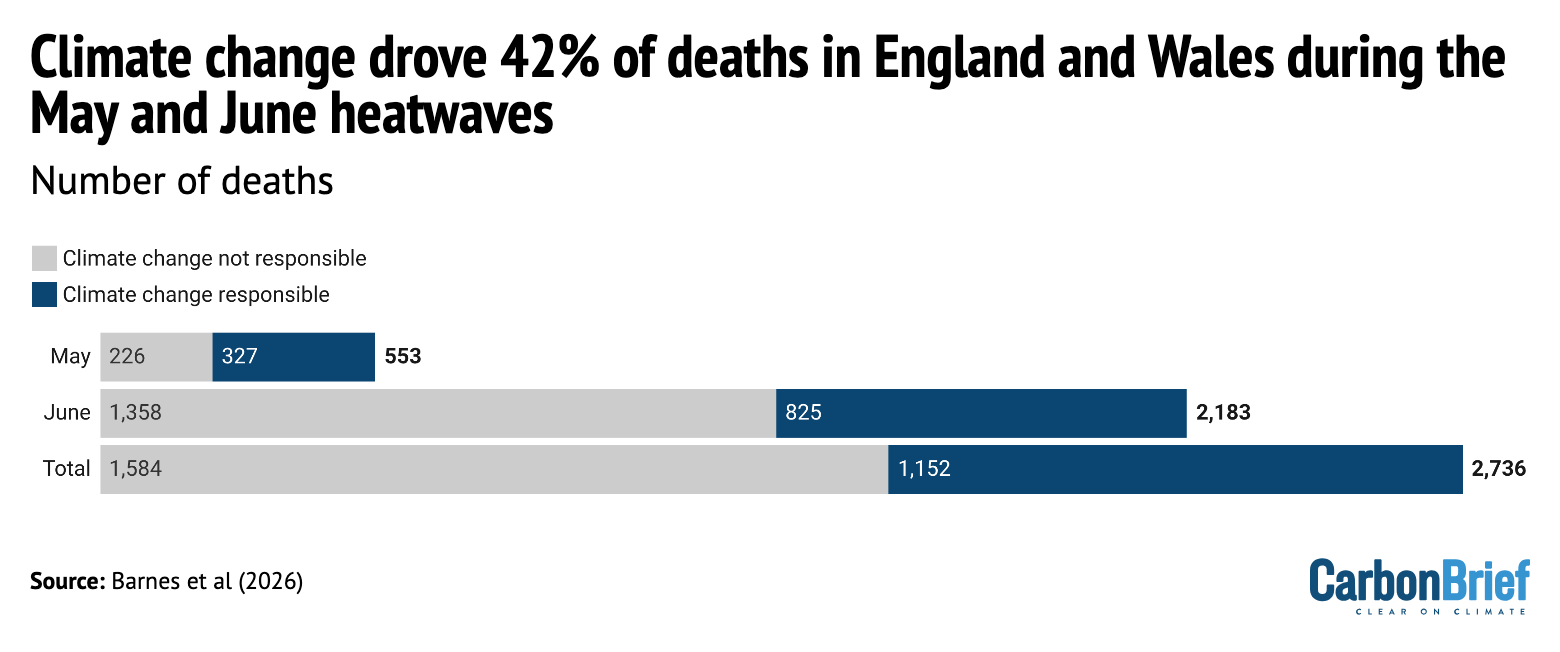
Perhaps the most harrowing statistic of the week comes from an analysis by Carbon Brief, which found that 42% of heat-related deaths in England and Wales during May and June were directly driven by climate change. This attribution science is no longer theoretical; it is a ledger of lives lost due to human activity.
The Met Office’s assessment of the UK climate is equally grim. Having experienced the hottest year on record recently, the UK is on a trajectory where last year’s highs will likely be viewed as moderate by the end of the decade. The statistical probability of these "extreme" events occurring is trending toward a certainty.
IV. Official Responses: The Human Dimension
The human element of this crisis is best captured through the work of institutions attempting to translate data into public consciousness. Carbon Brief spoke with Meaghan Macdonald of London’s Natural History Museum regarding their exhibition, Fixing Our Broken Planet.
The museum’s approach reflects a broader shift in how scientific institutions communicate risk. "We are trying to place the museum as a convener of conversations," Macdonald noted. The exhibition avoids the paralysis of climate doom by offering "conversation starters" and "what you can do" labels, empowering visitors to see themselves as agents of change.
However, the institutional response is not without tension. Macdonald emphasizes that the museum aims to create "advocates for the planet." By integrating initiatives like the National Education Nature Park and the Generation Hope project, the museum is attempting to bridge the gap between scientific consensus and public policy action. Despite the urgency, the museum remains a beacon for evidence-based hope, highlighting that while the data is disheartening, the capacity for collective action remains the most potent tool in the climate arsenal.
V. Implications: The Long-Term Reckoning
The implications of this week’s developments are multifaceted, touching on geopolitics, public health, and historical responsibility.
The Myth of Predictability
The "new normal" described by the Met Office implies that our current economic and social infrastructure is obsolete. Cities designed for 20th-century climate norms are failing under 21st-century conditions. The implications for insurance, urban planning, and energy grids are massive. If the UK—a country historically defined by its temperate, predictable climate—is struggling to maintain public safety, the challenges for the Global South are exponentially higher.
Accountability and Historical Debt
A report from Climate Home News this week highlights a critical shift in the legal and moral discourse: major emitting countries knew of the risks of climate change decades earlier than they have publicly claimed. This discovery could trigger a wave of litigation, moving the debate from scientific uncertainty to corporate and state accountability. The "responsibility gap" between the world’s largest historical emitters and the communities currently suffering the most from extreme weather is widening.
The Need for Worst-Case Planning
In a thought-provoking piece for The Conversation, Professor Peter Stott argues that the scientific community must stop shying away from "worst-case scenario" discussions. For too long, the fear of causing "alarmism" has prevented honest communication about the existential risks of extreme climate tipping points. As we witness a "Godzilla" El Niño in the making, the consensus is shifting: transparency regarding the worst-case scenario is the only way to mobilize the level of action required for survival.
Conclusion
As we look toward the coming weeks, the narrative is clear. We are past the point where climate change is a topic for debate; it is now a fundamental constraint on human activity. The drop in Amazonian deforestation is a testament to what is possible when policy aligns with conservation. However, the smoke in the skies of North America and the heat-stressed cities of Europe are reminders that the climate system operates on a global scale—and it does not wait for political consensus.
To move forward, we must marry the scientific rigor displayed by institutions like the Natural History Museum with the political courage to hold major emitters accountable. The "new normal" is here, but it does not have to be the final chapter.
DeBriefed is edited by Daisy Dunne. Subscribe for free to receive the latest climate analysis directly in your inbox.

 Raul Delapena Setiawan
 Laily UPN
 Reynand Wu
 Sagoh
Sagoh

 Azzam Bilal Chamdy
 Ali Ikhwan