
 Azzam Bilal Chamdy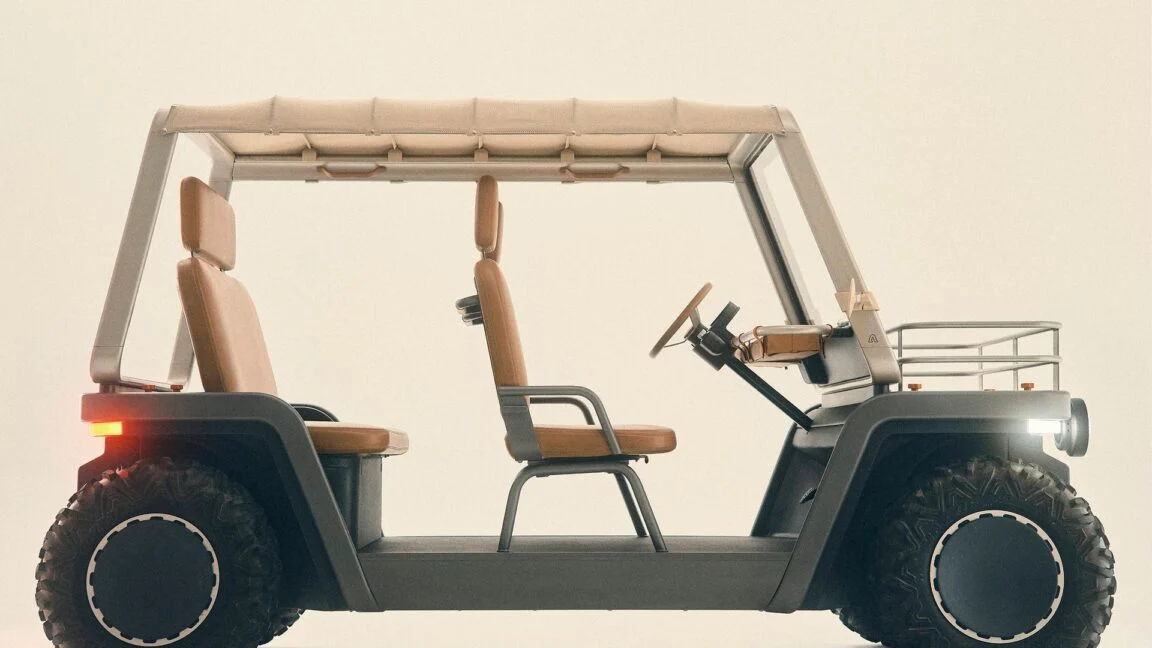
The global automotive industry is currently obsessed with range anxiety, charging infrastructure, and the race toward autonomous driving. Yet, in the shadow of $50,000-plus SUVs from heavyweights like Tesla and BYD, a quieter revolution is taking root. It is not about replacing the family workhorse; it is about reinventing the utility of the "second car." Enter the Amble One—a minimalist, modular, and undeniably chic electric vehicle that looks as if it were plucked from a lunar research base and dropped into a high-end European resort.
By targeting the premium hospitality sector first and the urban consumer second, Amble is attempting to bypass the graveyard of failed micromobility startups. With over 10 million euros in signed revenue and a roadmap stretching toward 2029, the company is betting that the future of personal transport isn’t just smaller—it’s more intentional.
The Genesis of the Amble One: Design Meets Utility
At its core, the Amble One is an exercise in purposeful engineering. Unlike the current trend of over-bloated electric crossovers, the Amble One prioritizes modularity. The vehicle is designed to be configurable from the moment it leaves the factory floor. For those needing cargo space, the rear seats fold flat to accommodate luggage or gear. For those in harsher climates, a forthcoming canvas weatherproofing option promises to bridge the gap between open-air freedom and cabin protection. Urban dwellers, meanwhile, can opt for a lockable front box, replacing the standard basket to ensure security in high-traffic environments.
While the current model eschews hard doors in favor of an airy, open-cabin aesthetic, the company is already looking toward the future. The "Amble Two," currently in the design phase, is slated for a 2029 release. This successor represents the company’s pivot toward more conventional car territory, featuring a lower roofline, a hardtop, and removable doors. It is a strategic evolution designed to capture a broader consumer base that wants the simplicity of an EV without sacrificing the structural comforts of a traditional vehicle.
A Strategic Timeline: From Resorts to Roads
The path to the driveway is paved with deliberate, incremental steps. Amble’s growth strategy deviates sharply from the "growth at all costs" mentality that decimated the micromobility sector in the early 2020s.
- 2025–2026 (The Foundation Phase): Amble secures its supply chain and finalizes production capabilities, focusing on the high-end hospitality market. By proving the vehicle’s durability in demanding environments—ranging from the dusty trails of Utah to the coastal sands of Portugal—the brand establishes a reputation for premium reliability.
- Mid-2027 (The Hospitality Launch): The first official deliveries of the Amble One commence. The client list is a "who’s who" of luxury travel, including Amangiri in Utah, the exclusive Mustique Island, Six Senses Les Bordes in the Loire Valley, and Uva’s Na Praia in Comporta. These high-visibility deployments serve as a rolling showroom.
- 2028 (The Consumer Rollout): Following the successful hospitality proof-of-concept, Amble opens its consumer channel. Preorders for the US and European markets are currently active, with a starting price point of $25,000.
- 2029 (The Amble Two): The introduction of the second-generation platform, targeting a more mainstream, urban-focused demographic that requires the protection and aesthetics of a traditional second car.
The Economic Argument: Why $50,000 is Too Much
The fundamental thesis of Amble, as articulated by the company’s leadership, is that the modern family is over-extended in its vehicle purchases. "Most families do not need twice that $50,000 BYD or Tesla," says company leadership.
The argument is compelling: A household’s primary vehicle—often a large, expensive EV or hybrid—is tasked with the "heavy lifting": road trips, grocery runs, and school commutes. However, the secondary vehicle, which often sits idle for 90% of the day, is frequently a redundant, equally expensive machine. Amble posits that the second car should be "designed for purpose, designed for shorter trips—and that can be much simpler, way more fun, way more open, and also more affordable."
By lowering the barrier to entry to $25,000, Amble aims to undercut the price of the average new internal combustion engine (ICE) vehicle, making the transition to electric for a household’s second car a logical financial decision rather than a luxury upgrade.
Industry Context: The Micro-EV Movement
Amble is not operating in a vacuum. The rise of "supermini" EVs—cars that are intentionally slow, small, and range-limited—is a global phenomenon. The Citroën Ami is the gold standard of this segment, boasting a 28-mph top speed and a 46-mile range. While modest by highway standards, these figures are perfectly adequate for dense city centers.
The appetite for these vehicles is growing. Stellantis, the parent company of Citroën, recently announced a significant expansion of production capacity for its supermini electric line at its Morocco plant. This move signals that legacy automakers view these small-form-factor vehicles not as novelties, but as essential components of a decarbonized transport future.
"This is the beginning of a turning point," the leadership notes. The market is shifting from "more is better" to "enough is enough."
Official Perspectives: Building a Premium Identity
A recurring failure in the micromobility space has been the attempt to compete with giants like Toyota or Ford on their own terms. Amble is consciously avoiding this trap.
"A lot of companies in micromobility start in the urban market and want to compete with everyone, and we all know that this did not work out so far," says the Amble team. "We’re taking a different approach: build our brand as a premium brand, and then step by step go more into this urban market."
By starting in the hospitality sector, Amble ensures its vehicles are seen by the affluent and the aspirational. A guest at an exclusive resort in the Loire Valley isn’t just using a car; they are experiencing a lifestyle. When they return home, that positive brand association is what Amble hopes will drive individual consumer sales.
Implications for the Future of Urban Transit
The implications of the Amble One’s success extend far beyond the niche of "luxury buggy." If a premium, $25,000 vehicle can successfully displace the second ICE car, it could lead to:
- Reduced Urban Congestion: Smaller vehicles occupy less space, both on the road and in parking structures.
- Lower Infrastructure Strain: Charging a 46-to-100-mile range vehicle requires significantly less energy and infrastructure investment than maintaining a fleet of long-range, high-performance EVs.
- Cultural Shift: The most significant hurdle to micromobility is social stigma. By positioning the Amble One as a "lunar-inspired" design object, the company is attempting to make smallness look cool rather than cheap.
Conclusion: A New Way to Commute
Can a niche, boutique EV truly convince the average suburban family to ditch their traditional second car? It is a tall order. The automotive industry is notoriously difficult to disrupt, and brand loyalty remains a formidable barrier.
However, the Amble One represents a rare convergence of design, timing, and strategic restraint. It is not trying to be a Tesla killer. It is not trying to be a highway cruiser. It is simply trying to be the most enjoyable, efficient, and aesthetic way to traverse the short distances that make up the bulk of our daily lives. As the world grapples with the transition away from fossil fuels, the "Amble" approach—slower, smaller, and more stylish—might just be the change we need.
Whether this proves to be a passing trend or the start of a fundamental shift in how we own and use vehicles, one thing is certain: the Amble One is a refreshing departure from the status quo. It is, at the very least, a sign that the industry is finally beginning to listen to the needs of the consumer, rather than just the capabilities of the battery.

 Reynand Wu
 Sagoh
Sagoh
 Raul Delapena Setiawan


 Ali Ikhwan