Siti Muinah
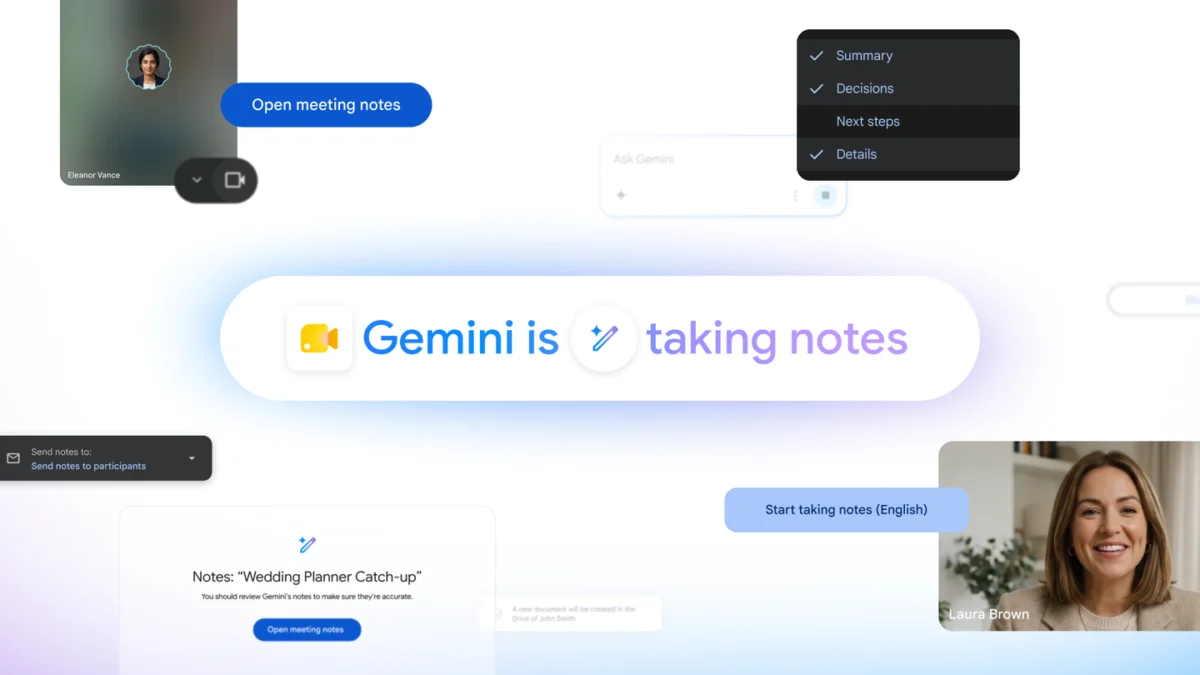
In an era where remote and hybrid work have become the standard for global enterprises, the struggle to balance active participation in meetings with the necessity of documentation has long been a pain point for professionals. Today, Google is addressing this friction head-on. The company has officially announced that its advanced AI model, Gemini, is now capable of autonomously taking notes during Google Meet sessions for Google AI Pro and Ultra subscribers.
This development marks a significant shift in how corporate entities and individual creators manage their workflow, effectively transforming the meeting experience from a taxing multitasking exercise into a streamlined, collaborative effort. By delegating the administrative burden of transcriptions and action items to artificial intelligence, Google aims to allow participants to focus entirely on the nuance of the conversation rather than the mechanics of documentation.
The Core Functionality: How "Take Notes for Me" Works
The new "Take notes for me" feature is designed to operate as a silent, intelligent observer. Once activated by the host, the tool runs in the background, leveraging Gemini’s multimodal processing capabilities to listen to the dialogue, identify key themes, and synthesize actionable takeaways.
For users, the activation process is designed to be seamless. Accessible across both web and mobile platforms, the feature can be toggled on at the start of a session. Once engaged, Gemini begins drafting a comprehensive document that captures the essence of the meeting. This document is not merely a verbatim transcript—which can often be cluttered and difficult to parse—but a curated summary that highlights decisions, project milestones, and pending tasks.
The feature is currently available in select languages, with Google noting that the system is optimized for professional environments. By offloading the mental load of manual note-taking, the feature promises to mitigate the "meeting fatigue" that has become pervasive in the digital workplace.
A Chronological Progression: From Transcription to Intelligent Synthesis
To understand the significance of this release, one must view it as the latest milestone in a long-standing initiative by Google to integrate AI into its Workspace suite.
The Foundation: Automated Speech Recognition (ASR)
Years ago, Google Meet introduced basic automated captions. While revolutionary at the time, these were strictly functional—providing accessibility for the hearing impaired and those in noisy environments. They provided a text stream, but no context.
The Intermediate Phase: The Rise of Transcripts
Building on ASR, Google later introduced post-meeting transcripts. This allowed users to search for keywords after a call had concluded. However, this still required users to spend significant time post-meeting scouring through walls of text to find relevant information.
The Gemini Era: Contextual Intelligence
The current integration of Gemini represents the third and most sophisticated phase. Instead of just recording what was said, Gemini understands what it means. By leveraging Large Language Models (LLMs), the software can distinguish between idle chatter and a firm commitment to a project deadline. This transition from "recording" to "comprehending" is what distinguishes this new tool from its predecessors.
Supporting Data: The Productivity Gap
Recent workplace studies suggest that the average professional spends nearly 30% of their work week in meetings. Of that time, a significant portion is lost to context-switching—the act of jumping between active listening and typing notes.
Research from internal Google productivity audits indicates that participants who are forced to take notes during a meeting are 40% less likely to contribute to creative problem-solving during the call. By removing the need for manual documentation, Google’s internal metrics suggest a potential 15% increase in meeting engagement and a marked improvement in the follow-through of assigned tasks.
Furthermore, the scale of the Google Workspace ecosystem—which boasts over 3 billion users—means that even a marginal improvement in efficiency results in millions of hours of saved time globally per month. For enterprise clients, this translates into tangible fiscal gains, as the "cost" of a meeting is no longer just the time spent sitting in it, but the time saved in the administrative cleanup that follows.
Official Responses and Privacy Considerations
The rollout has been met with cautious optimism from industry analysts, though Google has been careful to address the privacy concerns that naturally accompany AI-driven recording tools.
In a press statement, Google emphasized that transparency is at the heart of the feature’s design. "All meeting participants will be notified when the feature is enabled," the company stated. This ensures that every individual in the digital room is aware that an AI agent is recording and processing the conversation. This "informed consent" model is critical for compliance in legal, healthcare, and high-security industries where data privacy is paramount.
Additionally, the notes generated are private to the meeting host and invited participants, staying within the secured infrastructure of the user’s Google Workspace environment. Google has reaffirmed that the data processed by Gemini to create these notes is not used to train its public AI models, a vital distinction for enterprise clients worried about proprietary information leaking into the broader AI ecosystem.
Implications for the Modern Workplace
The implications of this technology extend far beyond simple convenience. We are witnessing the commoditization of administrative labor, which will fundamentally change the roles of executive assistants, project managers, and team leads.
The Democratization of Organization
Historically, high-level meetings were the only ones that benefited from the presence of a dedicated scribe or stenographer. With AI note-taking, even a neighborhood association meeting or a quick client sync for a catering order can benefit from enterprise-grade documentation. This democratizes professional organization, ensuring that clarity and accountability are available at every level of an organization.
The Evolution of Accountability
One of the most profound implications is the shift in team accountability. Often, tasks discussed in meetings fall through the cracks due to miscommunication or faulty memory. With an AI-generated record of "next steps," the ambiguity of "who was supposed to do what" is effectively eliminated. This creates a "source of truth" that all participants can reference, significantly reducing the friction involved in project management.
The Future of "Active" Meetings
As AI handles the record-keeping, the human participant is liberated. We may see a shift in meeting culture where the "note-taker" role is abolished entirely. In its place, we will likely see a rise in "meeting facilitators"—individuals whose role is not to record information, but to synthesize it, challenge assumptions, and guide the group toward a conclusion, while Gemini handles the bureaucratic heavy lifting.
Looking Ahead: The Next Frontier
As Google continues to refine the Gemini integration, we can expect the feature to become more proactive. Future updates may include the ability for Gemini to automatically schedule follow-up meetings based on the notes taken, or to ping relevant team members in Google Chat when their specific action items are identified.
However, the technology is not without its challenges. Accuracy remains the ultimate benchmark. While Gemini’s capabilities are advanced, it still requires high-quality audio and clear articulation to perform at its peak. As the model learns to identify specific industry jargon and company-specific acronyms, its utility will only grow.
In conclusion, the integration of Gemini into Google Meet is a major step forward in the evolution of digital collaboration. It signals an end to the era of "scribbling and scrambling" during conference calls and introduces a new standard for meeting efficiency. For the Google AI Pro and Ultra subscriber, the message is clear: focus on the conversation, and let the intelligence handle the details. As we move deeper into this decade, the tools we use to work are becoming as smart as the people using them, turning the chaotic sprawl of the workday into a manageable, productive, and synthesized stream of progress.


 Nana
 Rifan Muazin

 Sagoh
 Neng Nana