
 Rifan Muazin
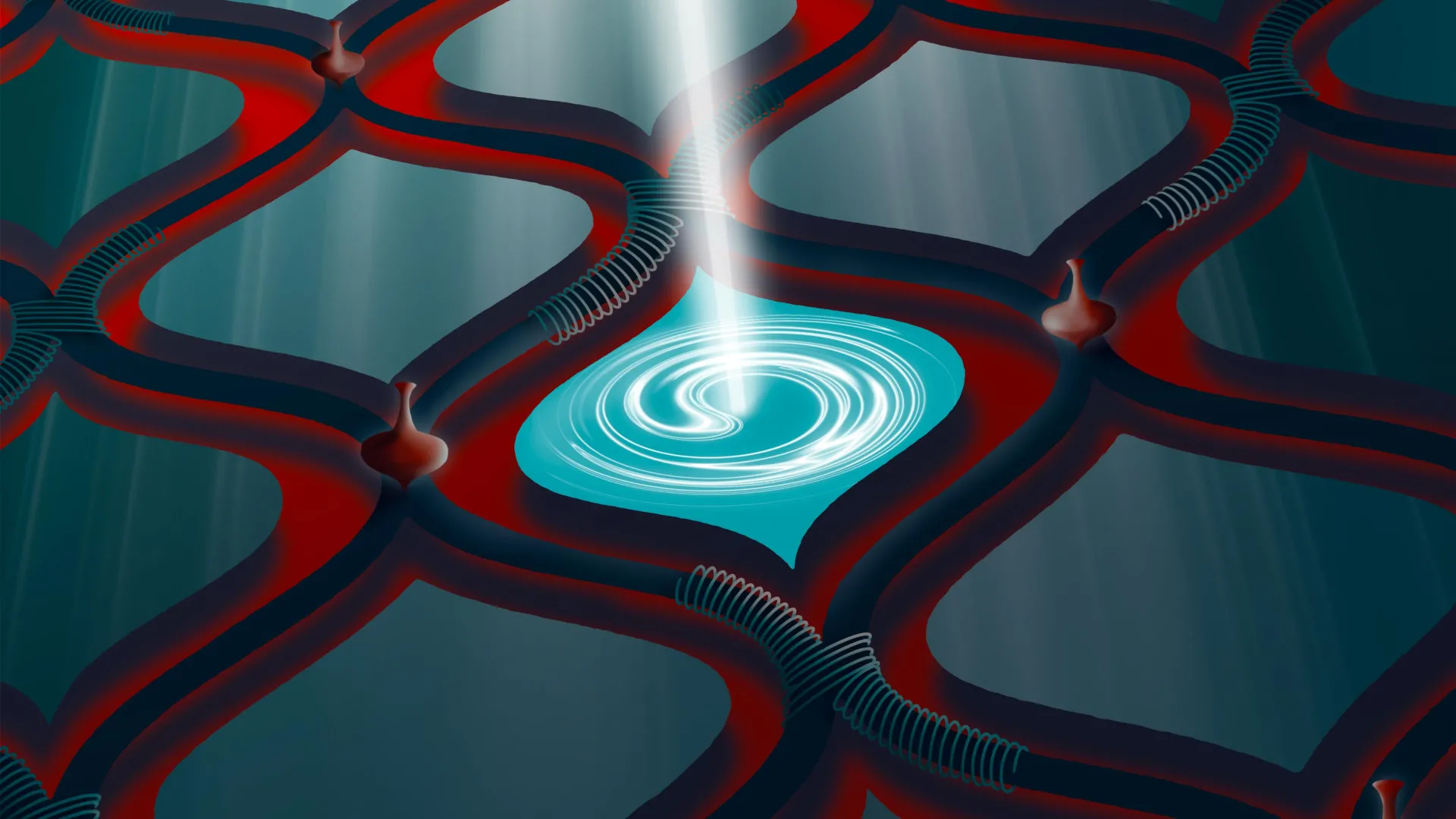
In the realm of classical physics, our intuition serves us well: to be pushed, you must be touched. To be influenced by a magnetic field, a charged particle must pass through it. However, at the subatomic scale, the universe operates under a different, more elusive set of rules. In a landmark achievement recently published in Nature Physics, researchers at the University of Oxford have successfully recreated the "Aharonov-Bohm effect"—a counterintuitive quantum phenomenon—using a hybrid quantum computer. By simulating a particle that is brought to a complete standstill by a magnetic influence it never actually touches, the team has opened a new window into the fundamental interactions that govern the building blocks of matter.
The Ghostly Influence: Understanding the Aharonov-Bohm Effect
The Aharonov-Bohm effect, first proposed in 1959 by theoretical physicists Yakir Aharonov and David Bohm, remains one of the most profound departures from classical mechanics. It posits that a charged particle can be influenced by a magnetic field even when the particle is confined to a region where the magnetic field is mathematically zero.
In our everyday experience, if you walk around a magnet, your path remains unaffected by the magnetic flux contained within that magnet. But in the quantum world, particles behave as waves. These waves possess a "quantum phase"—a characteristic that dictates how different paths taken by the same particle interfere with one another. When a charged particle travels around a region containing magnetic flux, the magnetic vector potential alters the particle’s quantum phase. Even if the particle never enters the region of the magnetic field, this phase shift changes the way its possible paths interfere, leading to observable changes in its behavior.
For decades, this was a theoretical curiosity, later verified by experiments with electrons. Now, the Oxford team, led by Dr. Sebastian Saner and Dr. Oana Bazavan, has moved beyond simple observation, integrating this effect into a dynamic, simulated environment known as a lattice gauge theory.
A Chronology of Discovery: From Prediction to Simulation
The project, which began in 2022, sought to bridge the gap between abstract quantum theory and the physical limitations of current computing.
- 1959: Yakir Aharonov and David Bohm publish their seminal paper, predicting that magnetic potentials could exert physical effects on particles without the presence of a traditional magnetic force.
- Late 20th Century: The effect is experimentally confirmed using electron interference patterns, cementing its place in the canon of quantum mechanics.
- 2022: Dr. Sebastian Saner and Dr. Oana Bazavan, in collaboration with Dr. Alejandro Bermudez from the Instituto de Física Teórica in Madrid, initiate the Oxford project to simulate lattice gauge theories using hybrid quantum systems.
- 2024: The team successfully demonstrates the "freezing" of a particle via the Aharonov-Bohm effect within a dynamical lattice, with their findings published in Nature Physics.
The experimental journey was fraught with complexity. To simulate these systems, the researchers needed a platform that could represent both "matter" and the "fields" through which that matter moves. They turned to a hybrid system utilizing trapped ions—atoms stripped of electrons and held in place by electromagnetic fields.
The Architecture of the Experiment: Qubits and Oscillators
To simulate the complex interactions of a lattice gauge theory, the team developed a bifurcated system. In these theoretical models, space is represented as a grid: matter resides at the nodes (points), while the fields are represented by the connections between those nodes.
The Oxford researchers used two distinct quantum components to mirror this structure:
- Qubits: Encoded in the internal states of the trapped ions, these represented the gauge fields.
- Quantum Oscillators: Created by the physical vibrations of the trapped ions, these represented the matter particles.
By linking these components into a closed loop, the researchers created a "unit cell" of a lattice gauge theory. Two oscillators stood in for the matter at two distinct locations, while two qubits mediated the field between them.
Entanglement: The Turning Point
The most significant hurdle was the magnetic flux. Initially, the team intended to treat the flux as a static background condition—an external constant. However, the hardware did not support such a rigid configuration. This limitation proved to be a stroke of luck.
By encoding the flux directly into the qubits, the researchers created a "dynamical gauge field." Instead of the particle moving through a stagnant, unchanging magnetic environment, the particle and the field became entangled. As the particle moved, the field reacted, and vice versa. "For us, the exciting step was to encode the magnetic flux in a gauge field that was itself dynamical," Dr. Saner noted. "Rather than having matter evolve in a fixed background, the matter and gauge field become part of the same quantum dynamics."
Supporting Data: The Frozen Particle
The effectiveness of the simulation was measured through the phenomenon of "quantum tunneling." Under normal conditions, a particle in this quantum loop would "tunnel" or move between the two locations with ease.
When the researchers ran the simulation without the simulated magnetic flux, the particle moved freely between the two nodes. However, upon introducing the entangled magnetic flux, the dynamics changed instantaneously. The flux caused the quantum phases of the two possible paths around the loop to shift. Because these paths were now out of sync, they underwent "destructive interference"—the wave-like probability of the particle being in any location effectively canceled itself out.
The result was a total cessation of movement. The particle, which had been tunneling freely moments before, became "frozen" in its original position. This was a direct, observed consequence of the Aharonov-Bohm effect, proving that the simulated field was exerting a profound influence on the matter, despite the lack of a classical magnetic force acting upon it.
Official Perspectives and Academic Context
The Oxford study did not exist in a vacuum. It was published in tandem with research from the University of Maryland, led by Professor Norbert Linke. While the Oxford team focused on the Aharonov-Bohm effect within a lattice, the Maryland group used a similar hybrid approach to simulate the "Yukawa potential"—a crucial mathematical interaction used to describe the strong nuclear force.
These twin studies underscore a growing consensus in the physics community: hybrid quantum computing is the most viable path toward solving problems that are computationally "intractable" for classical supercomputers.
"The mathematics involved in these lattice gauge theories becomes extraordinarily demanding as you add more particles or more complex field interactions," explains one project participant. "Conventional computers are essentially trying to crunch numbers that are too large for the universe to handle. Quantum computers, by contrast, are ‘native’ to these problems. We aren’t calculating the physics; we are building the physics."
Implications for Future Physics
The implications of this experiment extend far beyond the successful demonstration of a 65-year-old theory.
1. Solving High-Energy Physics
Lattice gauge theories are the bedrock of the Standard Model, the framework that describes how subatomic particles interact via forces like electromagnetism and the strong nuclear force. Current methods of simulating these interactions are limited by the "sign problem," where quantum calculations oscillate in ways that crash classical algorithms. Quantum simulation bypasses this entirely.
2. The Era of Dynamical Fields
The Oxford experiment represents a shift from "static simulation" to "dynamical interaction." By allowing the fields to evolve alongside the matter, scientists can now study how fundamental forces actually emerge and interact in real-time. This could eventually lead to a better understanding of high-energy environments, such as the interior of neutron stars or the conditions of the early universe.
3. A New Paradigm for Computing
The success of this hybrid system—marrying ion-trap qubits with vibrational oscillators—demonstrates that the future of quantum computing may not rely on a single type of hardware. By modularizing quantum components to mirror the structure of the physical world, researchers are finding that they can construct increasingly complex "digital twins" of nature.
As the scientific community moves forward, the "frozen particle" experiment serves as a reminder that the universe is far more connected than our classical senses allow us to perceive. The ability to simulate these ghostly interactions in a laboratory setting brings us one step closer to decoding the fundamental architecture of reality itself. Through the lens of the quantum simulator, the invisible has become, for the first time, a tangible subject of study.


 Neng Nana

 Evan Lee Salim

 Raul Delapena Setiawan

 Reynand Wu

 Sagoh


 Azzam Bilal Chamdy

 Ali Ikhwan
