
 Nila Kartika Wati

In the high-stakes world of software development, GitHub serves as the primary engine room for global innovation. However, maintaining the platform’s uptime is an ongoing battle against complexity, scale, and the inevitable entropy of distributed systems. In a transparent update covering progress through August and September, GitHub has pulled back the curtain on its infrastructure transformation, detailing a series of aggressive optimizations alongside a candid look at the incidents that challenged its reliability during the same period.
For the engineering teams at GitHub, the mantra remains absolute: "Availability first, then capacity, then features." This philosophy drives their ongoing migration to Azure and their persistent efforts to decouple monolithic database dependencies.
The Strategic Landscape: Infrastructure Modernization
The past two months have been defined by a concerted push to modernize GitHub’s backend architecture. As of early October, the company reached a significant milestone: 120 of 160 production services have been successfully deployed to the Central US Azure region. Furthermore, 13 of 51 primary MySQL databases have been migrated, a critical step in reducing the platform’s historical reliance on older, shared-database infrastructure.
The migration is not merely about relocation; it is about performance distribution. Currently, Azure handles 65.4% of read traffic for GitHub’s core application, 48.3% of Git read traffic, and 80.2% of stream-processing traffic. These metrics underscore a fundamental shift in how the platform processes data, moving away from legacy constraints toward a more elastic, cloud-native environment.
However, the path to modernization is rarely linear. GitHub hit a speed bump on September 11, when it was forced to pause deployments and traffic ramps in the Central US region due to uneven capacity across availability zones. While permanent ramps resumed on September 18, the delay meant the company missed its aggressive September 30 target for full service deployment. Despite these setbacks, the objective remains clear: unlocking full available capacity by the end of October.
Database Optimization and System "Cleanup"
Beyond the regional migration, GitHub has focused heavily on "debt reduction" within its databases. One of the most significant technical achievements of the period was the migration of 24 authentication-core tables off GitHub’s oldest shared database. This move effectively offloaded approximately one million queries per second from those replicas, providing much-needed breathing room for the system.

The team also conducted a massive "housecleaning" of the database cluster supporting issues and pull requests. By removing 980 million unnecessary rows of edit history, they reclaimed an estimated 1.8 terabytes of storage. This effort was not just aesthetic; it yielded tangible performance gains, including a 77% reduction in weekly deadlocks from their June peak. By implementing continuous cleanup protocols, GitHub hopes to prevent the unbounded growth that historically plagued these databases.
Resilience Engineering: Preparing for the Unpredictable
A core component of GitHub’s strategy involves building systems that fail gracefully. "Half of sampled pull request traffic can now continue with limited functionality when a shared dependency fails," the report notes, highlighting a successful move toward partial degradation rather than total outage.
Furthermore, the introduction of automated database traffic routing has allowed for dynamic scaling. During a spike in pull request activity on September 23, one service group automatically expanded from 14 to 19 instances, absorbing the load without manual intervention. Additionally, new production overload controls now empower engineers to protect high-priority API and web workflows by shedding lower-priority traffic before a system reaches the point of saturation.
Incident Chronology: Analyzing September’s Disruptions
Despite these optimizations, the platform faced two significant service interruptions in September that tested the limits of these new safeguards.
September 13: The Database Saturation Event
At 09:16 UTC, GitHub experienced an incident that lasted one hour and 28 minutes, characterized by degraded performance at the "front door."
The Cause: A background data-cleanup job, intended to improve system hygiene, triggered the failure. While the job featured a safeguard designed to throttle writes if replicas fell behind, the mechanism failed to account for the incoming load on the primary database server. Consequently, the job continued to execute until the primary server reached its maximum connection limit.
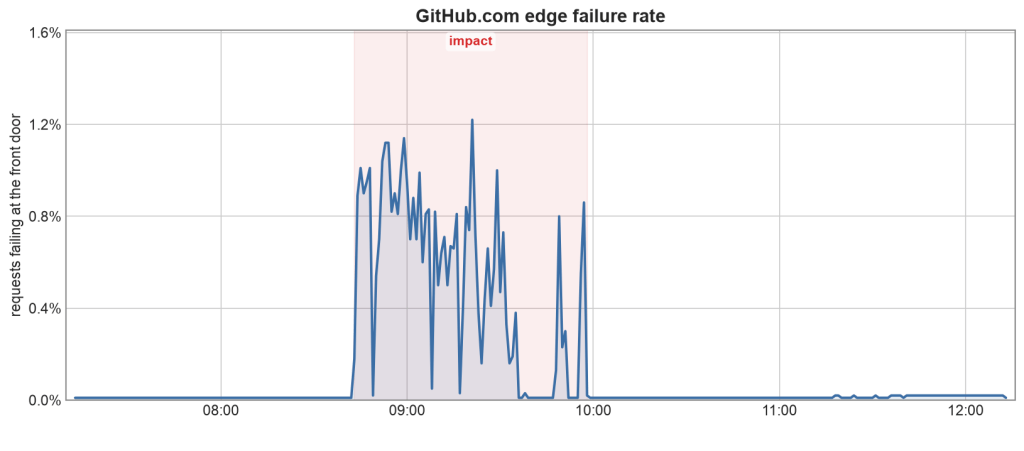
The Cascading Failure: Two critical architectural flaws exacerbated the incident. First, the lack of a "fail-fast" timeout on database calls meant that request handlers remained locked, waiting for the saturated database rather than timing out and providing an error message. Second, a retry loop surrounding token creation inadvertently kept resending failed writes, effectively preventing the database from ever catching up or recovering.
September 28: The Copilot Code Review Failure
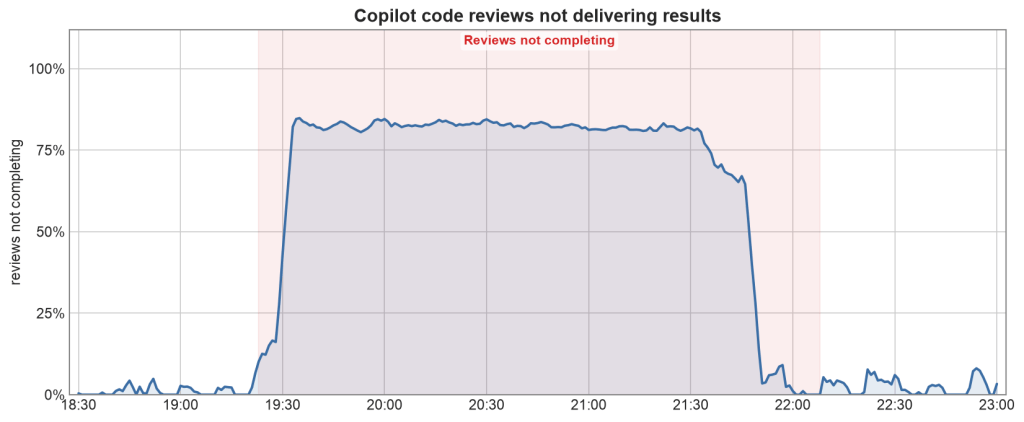
On September 28, at 21:16 UTC, users encountered a 52-minute disruption where Copilot code reviews failed to deliver results.
The Cause: A service change introduced a regression in how review data was handled. Copilot code reviews generate two versions of results: a limited version (without comments) and a full version (including comments). The service was intended to post from the full version, but a configuration error resulted in only the limited version being generated for a subset of users.
The Detection Gap: The system mistakenly flagged these incomplete jobs as "successful," leading to a delay in detection. The incident was only identified once reviews remained in an incomplete state for over 30 minutes, finally triggering an alert for human intervention.
Supporting Data and Performance Metrics
The data collected during these incidents provides a roadmap for future engineering efforts. GitHub’s internal telemetry shows that when infrastructure is properly cached, the results are transformative. For instance, a new infrastructure cache for GitHub Actions reduced Redis bandwidth by 84%, slashed median response times for inventory requests by 96%, and cut queued requests by 95%.
These figures demonstrate that while infrastructure migrations carry inherent risks, the eventual gains in latency and reliability provide a compelling case for the continued investment in cloud-native scaling.
Official Stance and Future Implications
GitHub’s leadership has been transparent about the fact that these incidents—including the August 6 and 17 outages—are a sobering reminder that technical debt is not resolved by deployment alone. The "capacity pause" in September was a deliberate choice to prioritize system health over speed, reflecting a mature approach to site reliability engineering (SRE).
The message from the engineering team is one of cautious optimism. By prioritizing availability above all else, GitHub is deliberately slowing its feature rollout to ensure that the foundation is rock-solid. As they continue to move workloads to Azure and refine their overload protection systems, the goal is to reach a state where the platform can absorb surges in user activity—whether through natural organic growth or unexpected spikes—without manual oversight.
Conclusion: The Path Forward
The path to a resilient, high-scale platform is never finished. As GitHub continues its transition, users can expect a focus on "failure containment"—the ability for specific features to remain operational even when their underlying dependencies are struggling.
The lessons of September—specifically the need for better timeout management, smarter retry logic, and more robust monitoring for asynchronous tasks—are being integrated into the company’s development lifecycle. For the millions of developers who rely on GitHub daily, the promise is simple: the platform is getting faster and more reliable, but the journey to that state involves constant iteration, occasional failure, and a transparent commitment to improvement.
As GitHub continues its migration, the tech community will be watching closely, not just for new features, but for the continued stability of the most important repository in the world. The shift in priority from "features at all costs" to "stability as a feature" is perhaps the most significant change occurring within the company today.


 Jia Lissa


 Raul Delapena Setiawan

 Reynand Wu

 Sagoh


 Azzam Bilal Chamdy

 Ali Ikhwan
