
 Evan Lee Salim
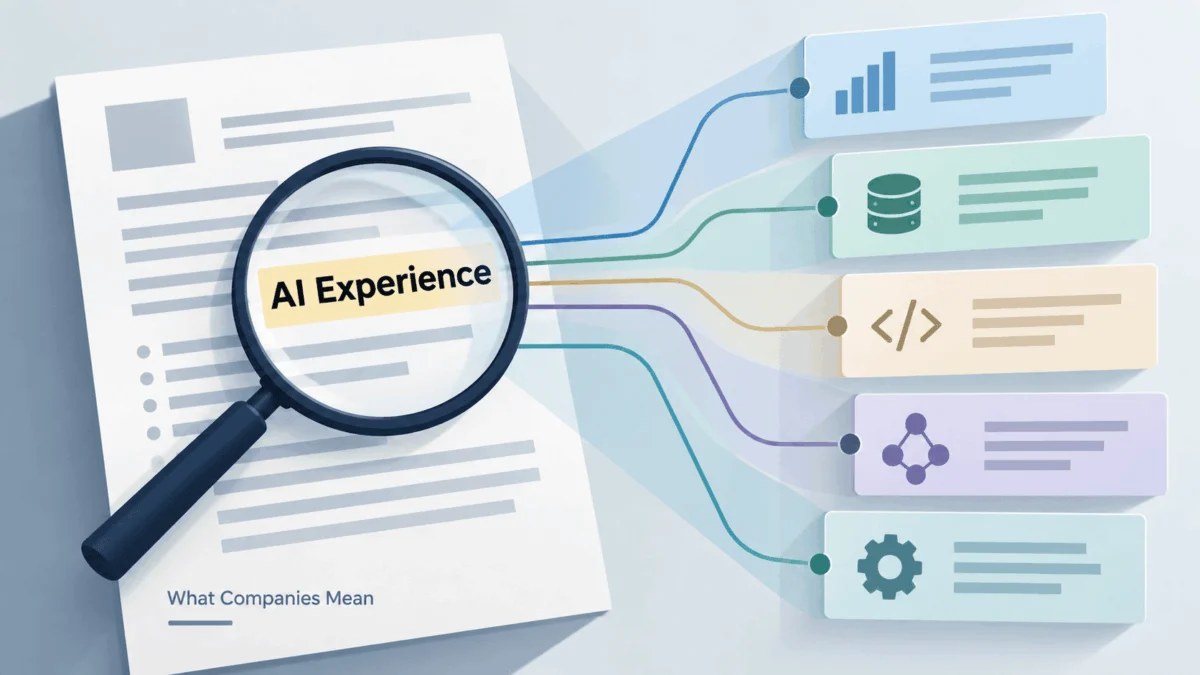
In the modern job market, a curious phenomenon has taken hold of recruitment: the omnipresence of the term "AI experience." Whether a candidate is applying for a role in quantitative finance, retail logistics, or healthcare technology, they are increasingly confronted with this vague, catch-all requirement.
But what does it actually mean? For the uninitiated, the term can be intimidating—a gatekeeping phrase that suggests a need for deep neural network architecture expertise. However, for those with a background in statistics, data analysis, or research, "AI experience" is often less of a technical barrier and more of a communication challenge.
The Anatomy of a Marketing Buzzword
At its core, "AI experience" is a marketing term, not a technical one. In professional engineering or data science, we rely on precise language: "experience with Scikit-Learn," "proficiency in Bayesian inference," or "expertise in natural language processing." These phrases describe tangible capabilities. In contrast, "AI experience" lacks a shared industry definition.
This ambiguity is rarely an oversight. It is a strategic signal used by hiring managers to convey a sense of modernity and to filter for candidates who are actively engaging with the rapid evolution of the industry. Because hiring teams often struggle to define exactly what their internal AI needs are, they default to this broad umbrella term. For the candidate, this requires a shift in mindset: the job posting is not a rigid list of technical prerequisites, but a dataset that must be analyzed and interpreted.
The Four Categories of "AI Experience"
To navigate this ambiguity, professionals must categorize the "AI" expectations of a role. Most job descriptions fall into one of four distinct archetypes:
1. The Tool-User
In this category, "AI experience" simply means comfort with generative AI tools (like LLMs) for productivity. The employer wants someone who knows how to use prompt engineering, automated summarization, or AI-assisted coding to speed up routine tasks. If you can integrate AI into your daily workflow, you satisfy this requirement.
2. The Informed Consumer
This is the most common category for mid-level analysts. These companies don’t need you to build models from scratch, but they do need you to understand how AI outputs should be validated. They are looking for someone who can spot hallucinations, identify bias in model responses, and communicate the limitations of AI-driven insights to non-technical stakeholders.
3. The Model Practitioner
Here, the requirement is technical. This is the realm of traditional machine learning. These roles require the ability to implement, train, and maintain predictive models. If a posting lists specific libraries or mentions "deployment," this is the category you are in.
4. The Domain-Specific Integrator
This represents the cutting edge, where AI is applied to a niche industry problem—such as predictive maintenance in manufacturing or algorithmic trading in finance. Here, your "AI experience" is less about the algorithms and more about your ability to bridge the gap between AI capabilities and specific, high-stakes business objectives.
Translating Your Statistical Legacy
One of the most persistent myths in the job market is that statisticians and data scientists must overhaul their resumes to become "AI practitioners." In reality, statistical training is the bedrock upon which all modern AI is built.
The gap between a traditional statistician and an AI practitioner is almost entirely a matter of vocabulary and tooling, not underlying reasoning. For example, when you have "built predictive regression models to forecast quarterly demand," you are already performing supervised machine learning.
To bridge this gap, you must translate your existing expertise:
- Instead of "Data Analysis," use "Pattern Recognition and Feature Engineering."
- Instead of "Model Validation," use "Performance Evaluation and Bias Mitigation."
- Instead of "Reporting," use "Communication of Probabilistic Outcomes."
By framing your experience around the outcomes and the reasoning processes you employed, you demonstrate that you possess the analytical rigor that companies are actually desperate for, even if they lack the terminology to describe it.
Analyzing the Job Posting as a Dataset
When you approach a job posting, treat it with the same healthy skepticism you would apply to a noisy, incomplete dataset. Recognize that the "requirements" section is aspirational; it is a wish list of the "ideal" candidate, and very few applicants will hit every single metric.
To effectively parse the true needs of the hiring team, focus on these three indicators:
- The Contextual Weight: If "AI experience" is listed as the first of fifteen requirements, it is a priority. If it is buried at the bottom, it is likely a secondary consideration.
- The Verb Choice: Look for the action verbs associated with AI. Are they asking you to "build" (Category 3), "integrate" (Category 1), or "evaluate" (Category 2)?
- The Modifier: Words matter. "Preferred" indicates a nice-to-have, whereas "Required" without further explanation points toward a more foundational, or perhaps a more generic, organizational need.
The Seniority Signal
The expectations for "AI experience" change drastically based on the level of the role. Understanding this will allow you to tailor your interview performance to the specific level of seniority required.
| Seniority | Core Expectation | Practical Application |
|---|---|---|
| Junior | Adaptability | A willingness to learn new AI tools and a lack of fear regarding AI-generated outputs. |
| Mid-Level | Collaboration | The ability to work alongside engineering teams to evaluate model effectiveness. |
| Senior | Strategic Judgment | The capacity to determine when AI is the wrong tool and to manage the risks of deployment. |
Clearing Up Persistent Misconceptions
The journey to a role in the AI space is often hindered by three common misconceptions that keep qualified candidates from applying.
1. The "Kitchen Sink" Resume
Many candidates believe they must list every single AI tool they have touched. This is a mistake. Hiring managers are looking for evidence of judgment—the ability to choose the right tool for a problem—not a list of software you have experimented with. Focus on the problems you solved and the reasoning behind your tool choices.
2. The "From Scratch" Fallacy
You do not need to have built a machine learning model from scratch to be qualified for most "AI experience" roles. What employers are truly seeking is a deep understanding of data quality, model assumptions, and the interpretation of results. These are fundamental statistical skills. If you can explain why a model might fail, you are more valuable than someone who can simply code a model but cannot explain its risks.
3. The Certification Trap
While online certifications can be helpful for networking or self-learning, they are rarely the deciding factor in an interview. Most hiring managers at the analyst level are far more interested in your ability to reason through an AI problem in real-time. Can you explain the limitations of a system? Can you identify where data might be biased? Those insights will win over a resume filled with badges any day.
Implications for the Future
The evolution of the labor market toward AI integration is not a passing trend; it is a structural shift. As AI tools become more democratized, the competitive advantage for data professionals will not be the ability to code in a specific language, but the ability to act as a bridge between technical capability and business strategy.
For the statistician or researcher, this is an era of immense opportunity. The "AI experience" requirement is not a wall; it is an invitation to prove that you possess the critical thinking skills necessary to navigate an automated world. By reading between the lines of job postings and reframing your existing expertise, you can position yourself not just as a worker, but as an essential architect of your organization’s AI-driven future.
In conclusion, stop viewing the term "AI experience" as a rigid technical specification. Start viewing it as a conversation starter. When you enter the interview room, you aren’t just there to show them you have used a tool; you are there to show them that you understand the data, the process, and the outcomes—the very things that AI, for all its power, still struggles to master without human guidance.

 Neng Nana


 Raul Delapena Setiawan

 Reynand Wu

 Sagoh


 Azzam Bilal Chamdy

 Ali Ikhwan
