
 Nana Muazin
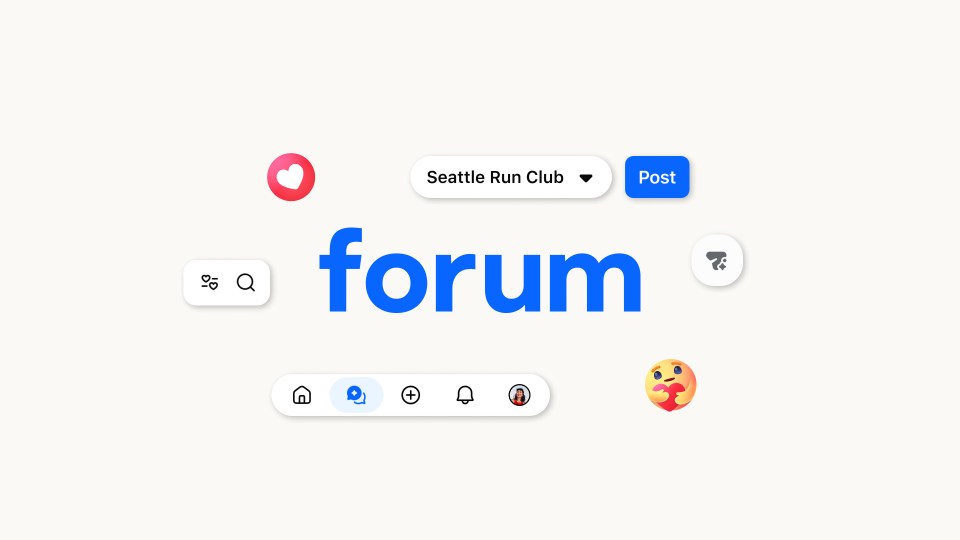
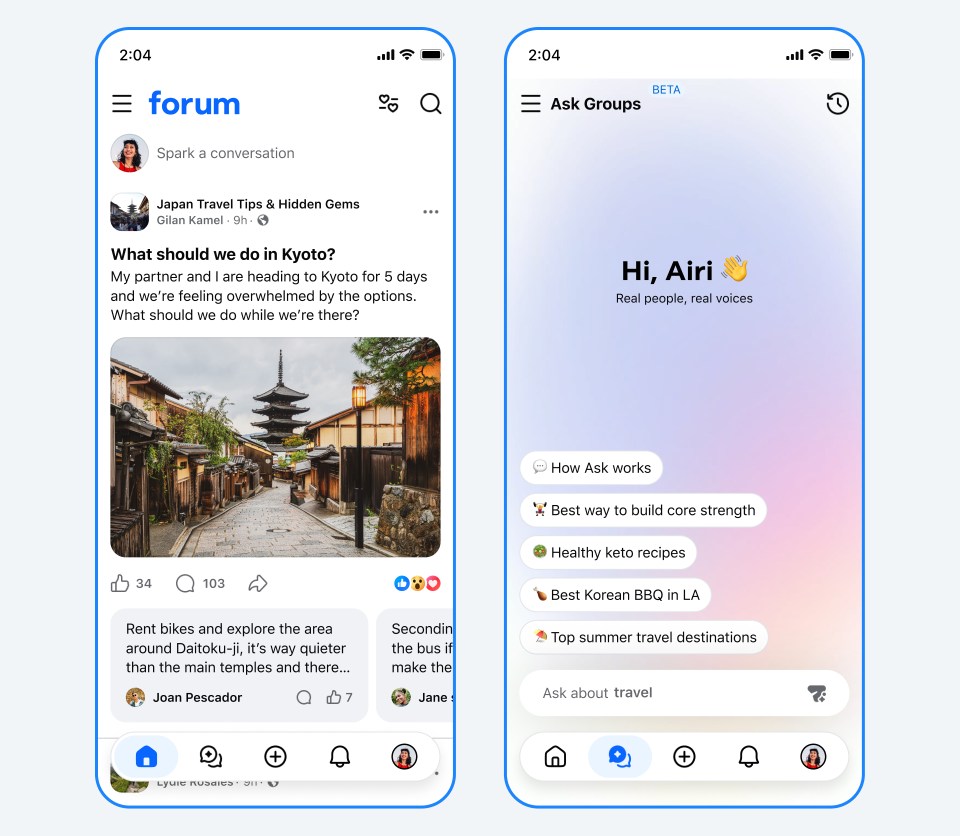
In the rapidly evolving landscape of software development, the role of Artificial Intelligence has largely been relegated to a digital "pair programmer"—a tool designed to shave seconds off the task of typing boilerplate code. However, a small, specialized team at Meta recently challenged this paradigm. By building "Forum," a standalone Groups application, from the ground up, the team transformed the AI’s role from a passive assistant into an active, autonomous participant in the engineering lifecycle.
The experiment, which prioritized "production-ready outcomes" over sheer code volume, marks a significant shift in how tech giants approach AI integration. Rather than treating AI as a mere typing accelerator, Meta’s engineers treated the agent as a teammate capable of planning, implementing, testing, and verifying software. This transition from "human-in-the-loop" to "human-on-the-loop" represents a fundamental evolution in software engineering methodology.
The Shift: From Human-In-The-Loop to Human-On-The-Loop
For most developers, the current AI experience is "human-in-the-loop." The engineer remains the primary driver, using AI to autocomplete functions, suggest minor refactors, or answer syntax-related questions. While useful, this approach is inherently bottlenecked by the human operator’s pace.
Meta’s Forum team moved toward a "human-on-the-loop" architecture. In this model, the agent manages the entire iteration—planning the architecture, writing the code, building the artifact, running tests, correcting errors, and repeating the cycle. The human engineer transitions into a supervisory role: setting high-level goals, monitoring the agent’s progress, intervening if the process drifts, and ultimately providing the final sign-off.
The brilliance of this approach lies in the decoupling of tasks. By removing the engineer from the immediate, granular cycle of development, the team enabled overlapping workstreams. Engineers shifted their focus from syntax and execution to strategy, judgment, and maintaining the quality bar.
The Chronology of an Agentic Workflow
The development of Forum was not a linear path but a series of iterative improvements in agentic capability.
Phase 1: Foundational Architecture
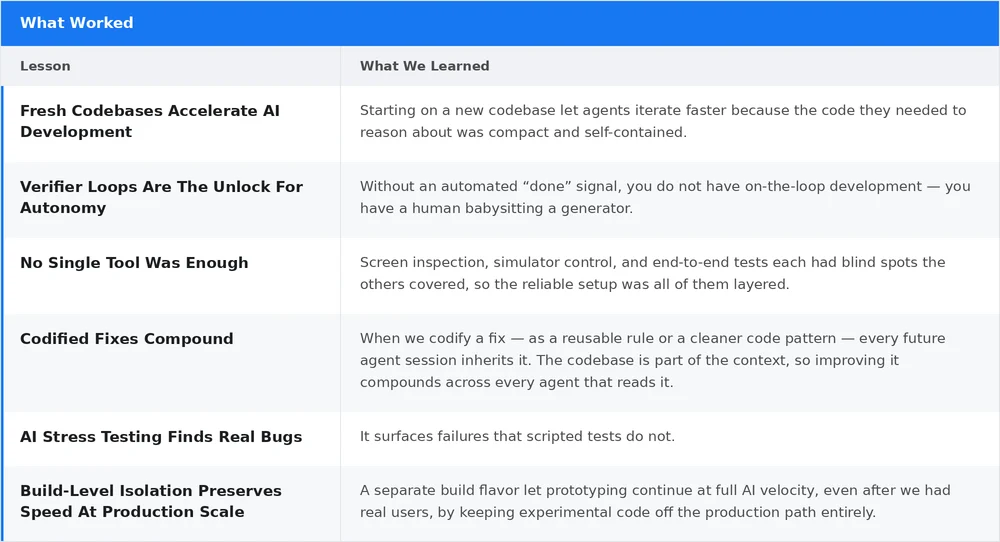
The project began by prioritizing architectural legibility. Recognizing that AI agents learn patterns from existing code, the team chose to modularize the architecture. Where modularization wasn’t possible, they rebuilt components from scratch. This "architectural cleanliness" ensured that when an agent learned a specific pattern, that improvement propagated throughout the codebase, preventing the accumulation of "technical debt" often generated by AI agents working on legacy, messy code.
Phase 2: Providing Tools, Not Descriptions
A primary failure mode identified early in the project was the agent losing spatial awareness of the application. If asked to modify the group home screen, the agent might inadvertently edit the home feed or guess incorrect screen coordinates. The solution was to stop describing the application to the agent and start providing it with direct tools. By allowing the agent to query the live view hierarchy from the simulator, list actual screen elements, and programmatically map paths to UI targets, the team saw a drastic reduction in misdirected edits.
Phase 3: The Sandbox Approach
As Forum matured, the team needed a way to prototype without jeopardizing the production environment. They implemented a "separate build flavor"—a sandbox app that shared the same codebase and design system as the production app but functioned as an isolated environment. This allowed for aggressive AI-driven prototyping, where code was only merged into the production build after rigorous human review and automated verification.
The Necessity of Verification: Building a Trust-Based Loop
The greatest risk of AI-generated code is the "plausibility trap"—code that looks correct to a human eye but fails under stress. To solve this, Meta set the "finish line" at verification, not compilation.
Automated Verification as a Force Multiplier
The Forum team integrated automated pass/fail signals directly into the agent’s loop. This included unit tests, build status checks, and visual regression testing. Before an engineer ever saw a pull request, the agent had already performed its own self-checks. This transformed the review process: instead of sifting through a sea of potentially broken code, engineers reviewed a smaller, high-confidence set of changes accompanied by pre-populated test plans and recorded verification sessions.
Simulated User Testing
To ensure the app remained resilient, the team deployed "navigation agents." These bots interact with the live app just as a human user would—scrolling, clicking, and browsing. These agents act as continuous, automated QA testers, reporting regressions in real-time.
Agentic Production Operations
Even after deployment, the agents remained active. When users submitted feedback, the agents analyzed the data to identify potential regressions. By investigating the root cause and forwarding a structured report to the engineers, the agents significantly reduced the "Mean Time to Resolution" for production issues.
Supporting Data: The Impact on Quality
The results of the Forum experiment were not merely anecdotal; they were reflected in the performance profile of the application. By catching systemic issues—such as memory bottlenecks—during the development phase, the team achieved a higher level of app stability than typically expected for a new release.
- Memory Growth: Automated stress testing allowed agents to identify and resolve memory leaks before the app reached the hands of users.
- Reduced Rework: Because agents verified their own work against unit tests and visual specs, the volume of discarded or rewritten code dropped significantly.
- Context-Driven Success: By providing agents with the same onboarding documentation, design specs, and code-base context as a new human hire, the team saw a marked jump in the quality of the agents’ investigative outputs.
Official Perspective: Engineering Philosophy
In a statement regarding the project, the Forum team emphasized that their success was not a product of "better prompting," but of "better context." The team argues that the future of engineering lies in creating an environment where agents are treated as first-class citizens of the codebase.

"We invested in rigorous upstream decomposition and machine-readable context," the team noted. "Ambiguity that an engineer might resolve through intuition results in agent failure. By tightening the engineering loop with precise, machine-readable specifications, we made the workflow better for both the human and the machine."
Implications for the Industry
The Forum project serves as a blueprint for the future of software development. Its implications are threefold:
- The Death of "Faster Typing": The industry is moving away from AI as a mere coding assistant toward AI as an autonomous orchestrator. Companies that continue to use AI only for code completion are likely to be outpaced by those that integrate AI into the entire verification and planning loop.
- Architectural Rigor is Mandatory: As the Forum team discovered, agents are only as good as the code they inhabit. If the architecture is complex and messy, the agent will reproduce that mess. High-quality AI development requires a disciplined, modular codebase.
- Human-on-the-loop is the New Standard: The human role is not disappearing; it is changing. The future developer is less of a "coder" and more of an "engineering manager" for AI agents. Success will be measured by the ability to curate the quality bar, oversee agentic workflows, and provide the contextual guidance necessary for agents to make the right architectural decisions.
By successfully delivering a high-quality app through this agent-centric methodology, Meta has proven that the bottleneck in software development is no longer the speed at which code can be typed, but the speed at which it can be verified and managed. As AI continues to mature, the "Forum model" is poised to become the standard operating procedure for engineering teams globally.


 Jia Lissa

 Nila Kartika Wati

 Raul Delapena Setiawan

 Reynand Wu

 Sagoh


 Azzam Bilal Chamdy

 Ali Ikhwan
