
 Pevita Pearce
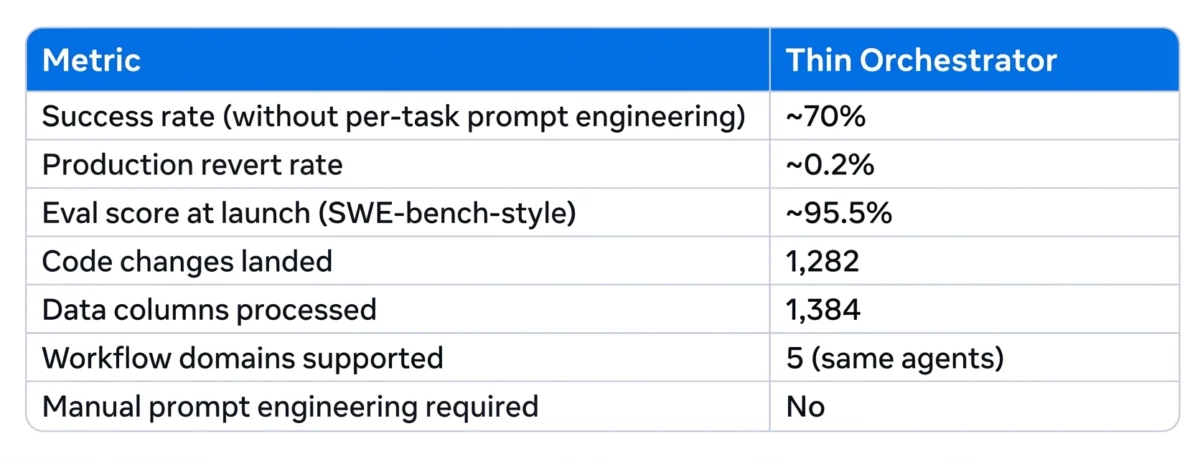
In the rapidly evolving landscape of artificial intelligence, the conventional wisdom for building autonomous systems has been to pursue the "God Agent"—a singular, omniscient model capable of ingesting vast swaths of context to handle complex, end-to-end workflows. However, Meta’s engineering team has recently debunked this approach, proving that when it comes to enterprise-grade AI, the secret to success is not more intelligence, but less.
By deploying a 1,300-line "thin orchestrator," Meta has successfully routed over 20 distinct workflows to 14 specialized AI agents. The orchestrator itself performs zero domain-specific tasks. This radical simplicity has enabled Meta to automate the complex, multi-layered process of onboarding data columns across its massive recommendation systems, turning a multi-day manual effort into a sub-hour automated process.
Main Facts: The Shift from Monoliths to Modular Specialists
The core of Meta’s breakthrough lies in the realization that "more context" is often the enemy of performance. In complex environments—such as Meta’s configuration-as-code pipelines—data onboarding involves three separate code repositories, three programming languages, and a six-stage synchronization process.
Initially, Meta’s engineers built a central, monolithic agent loaded with every schema, rule, and dependency. While it performed adequately in controlled demonstrations, it failed spectacularly in production. The agent suffered from "contextual cross-contamination," where it would conflate field naming conventions or apply logic from one subsystem to an entirely different one.
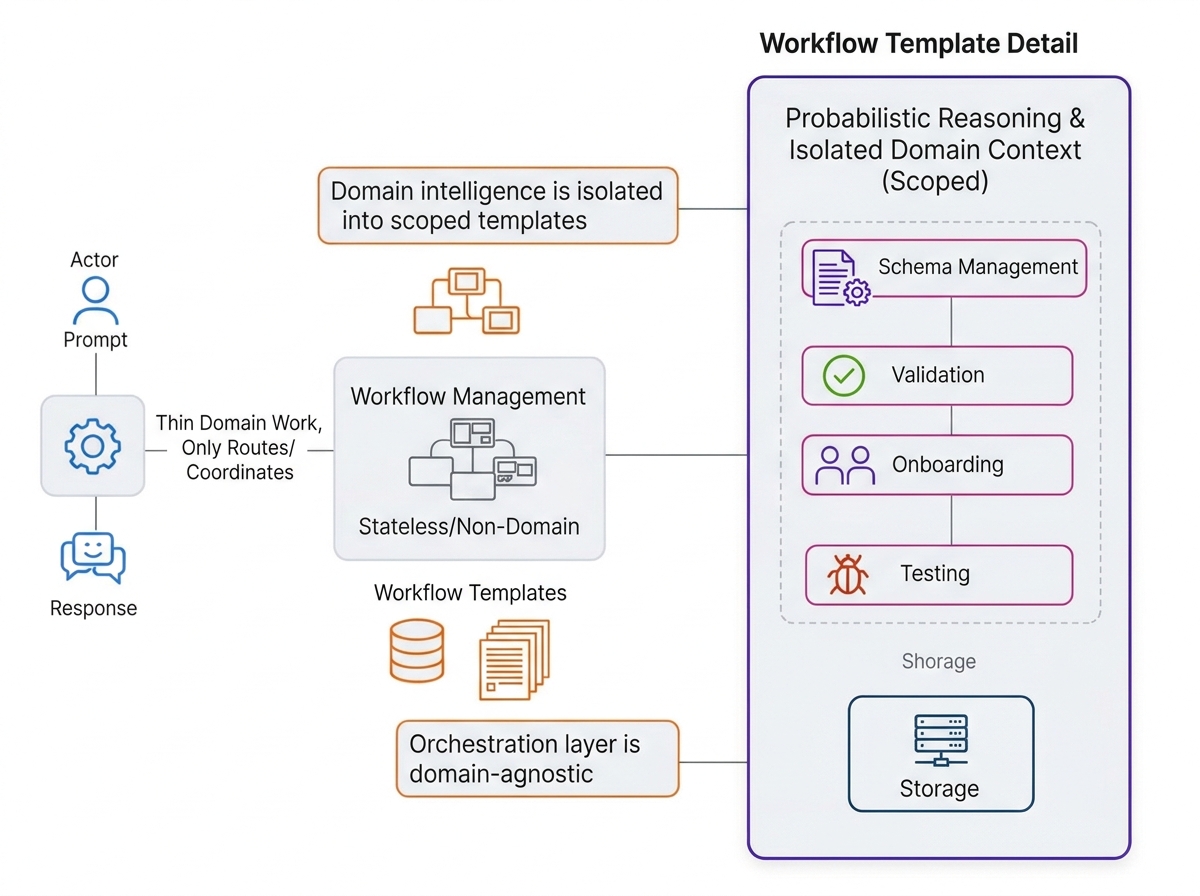
The "Thin Orchestrator" pattern addresses this by splitting the system into two distinct layers:
- The Orchestrator: A deterministic, lightweight traffic controller that owns sequencing, state management, and reliability checks.
- Specialist Workers: Isolated, domain-specific agents that handle the "heavy lifting" of logic, code generation, and data processing.
By decoupling the what from the how, Meta has ensured that the orchestrator only manages the flow of the task, while the specialist agents handle the reasoning.
Chronology of the Development: From Hallucination to Precision
The journey toward this architecture was characterized by a cycle of trial, error, and architectural pivot.

Phase 1: The Monolithic Attempt
Initially, the team loaded a single LLM with the entirety of the domain knowledge. The hypothesis was that providing the agent with every piece of available documentation would yield the most accurate result. In reality, the agent became overwhelmed. As the context window grew, the performance degraded—a phenomenon corroborated by research from the Mount Sinai Windreich Department of Artificial Intelligence, which suggests that isolated tasks in multi-agent systems significantly outperform single-agent models by preventing context interference.
Phase 2: The "Prompt Engineering" Trap
The team then tested a version that relied on heavy manual prompt engineering. While this increased success rates to 70–80%, it was not sustainable. Each new task required an engineer to craft a bespoke system prompt, effectively turning the AI developers into glorified prompt writers. The team recognized this as an architectural failure rather than a language model limitation.
Phase 3: The Thin Orchestrator Deployment
Recognizing the need for a structural change, the team built the thin orchestrator. They implemented a fixed seven-step protocol for every request. Steps 1 through 5 (input validation, workflow selection, state initialization) and Step 7 (final verification) are entirely deterministic. Only Step 6, which involves reasoning, is delegated to an isolated subagent. This design ensures that the system is predictable, auditable, and, crucially, scalable.
Supporting Data: The Efficiency Gains
The performance metrics following the implementation are striking. Before the thin orchestrator, onboarding a new data column took three to four days of manual labor. Even with previous configuration-driven systems, the process took roughly a full day. Today, the thin orchestrator completes the process in under an hour.
- Token Efficiency: By isolating tasks, the system avoids redundant context, reducing token usage by up to 65-fold compared to massive, context-heavy single agents.
- Accuracy at Scale: Research indicates that orchestrated multi-agent systems maintain a 65.3% accuracy rate across 80-task batches, whereas single-agent models plummet to 16.6% under the same load.
- Zero-Code Scaling: When Meta needed to support a completely new use case—pipeline migration—the team did not write a single line of new agent code. They simply authored a new workflow template, demonstrating that the system is essentially a composable engine rather than a static product.
Official Responses and Engineering Philosophy
The team behind the project—including Mani Bhushan, Rahul Maliakkal, Jae Ha, Chakrapani Kumar, Vivek Tiwari, and Amanda Yin—emphasizes that this architectural shift is not merely a technical tweak but a fundamental shift in how developers should think about AI.
"The strongest argument for a thin orchestrator is the failure mode of the alternative," says the engineering team. "When a heavyweight orchestrator hallucinates, the error propagates downstream, causing cascading failures. In our model, the orchestrator follows a fixed protocol, and the specialist agents work in isolated, domain-scoped contexts where hallucination risk is minimized and failures are easily contained."
The team asserts that the most important component of their system is the one that does the least amount of work. By forcing the orchestrator to stay "thin," they have created a system that is as reliable as the deterministic code that wraps it.
Implications for the Future of AI Development
The implications of Meta’s findings for the broader tech industry are profound.
1. Architectural Boundaries vs. Computational Boundaries
The industry has long conflated "intelligence" with "reasoning capability." Meta’s approach proves that for enterprise systems, computational boundaries must be aligned with architectural boundaries. By limiting the scope of each agent, developers can use smaller, faster models for specific tasks, reducing costs and latency.
2. The Move Toward Composable AI
Meta’s success suggests a shift toward "Composable AI." Instead of building one massive model to solve a problem, companies should build a "library" of specialized agents that can be orchestrated in various sequences. This allows for rapid iteration—when a new business requirement emerges, the team simply re-sequences existing agents rather than training or prompting a new, massive system.
3. Continuous Improvement Loops
Looking ahead, the team is exploring automated feedback loops. By monitoring production usage, the system can identify specific failure patterns and suggest targeted updates to subagent knowledge files. This creates a "closed-loop" system where the AI continuously refines itself under the watchful eye of human reviewers.
Conclusion: A Counterintuitive Lesson
The "thin orchestrator" pattern serves as a sobering reminder for AI developers: complexity is often a liability. In an era where the focus is frequently on the size of the context window or the parameters of the model, Meta has demonstrated that the most effective path forward is the one that embraces modularity, isolation, and strict, deterministic oversight.
By relegating the LLM to a specialist role and keeping the "manager" (the orchestrator) focused on rigid protocols, Meta has achieved a level of production-grade reliability that was previously thought impossible for AI-driven pipelines. For any team looking to move from experimental demos to production-grade AI, the lesson is clear: Keep your orchestrator thin, your specialists deep, and your protocols fixed. In the world of complex engineering, sometimes doing the least amount of work at the top is exactly how you achieve the most at the bottom.


 Jia Lissa

 Nila Kartika Wati

 Raul Delapena Setiawan

 Reynand Wu

 Sagoh


 Azzam Bilal Chamdy

 Ali Ikhwan
