
 Raul Delapena Setiawan
By Olivia Tauber
October 22, 2026
For over a decade, audiences watched Robert Downey Jr. command holographic interfaces and manipulate complex data streams with little more than a flick of his wrist. As Tony Stark, the face of the Marvel Cinematic Universe, Downey popularized the concept of "techno-optimism," projecting a future where augmented reality (AR) wasn’t just a gimmick, but the primary language of human productivity.
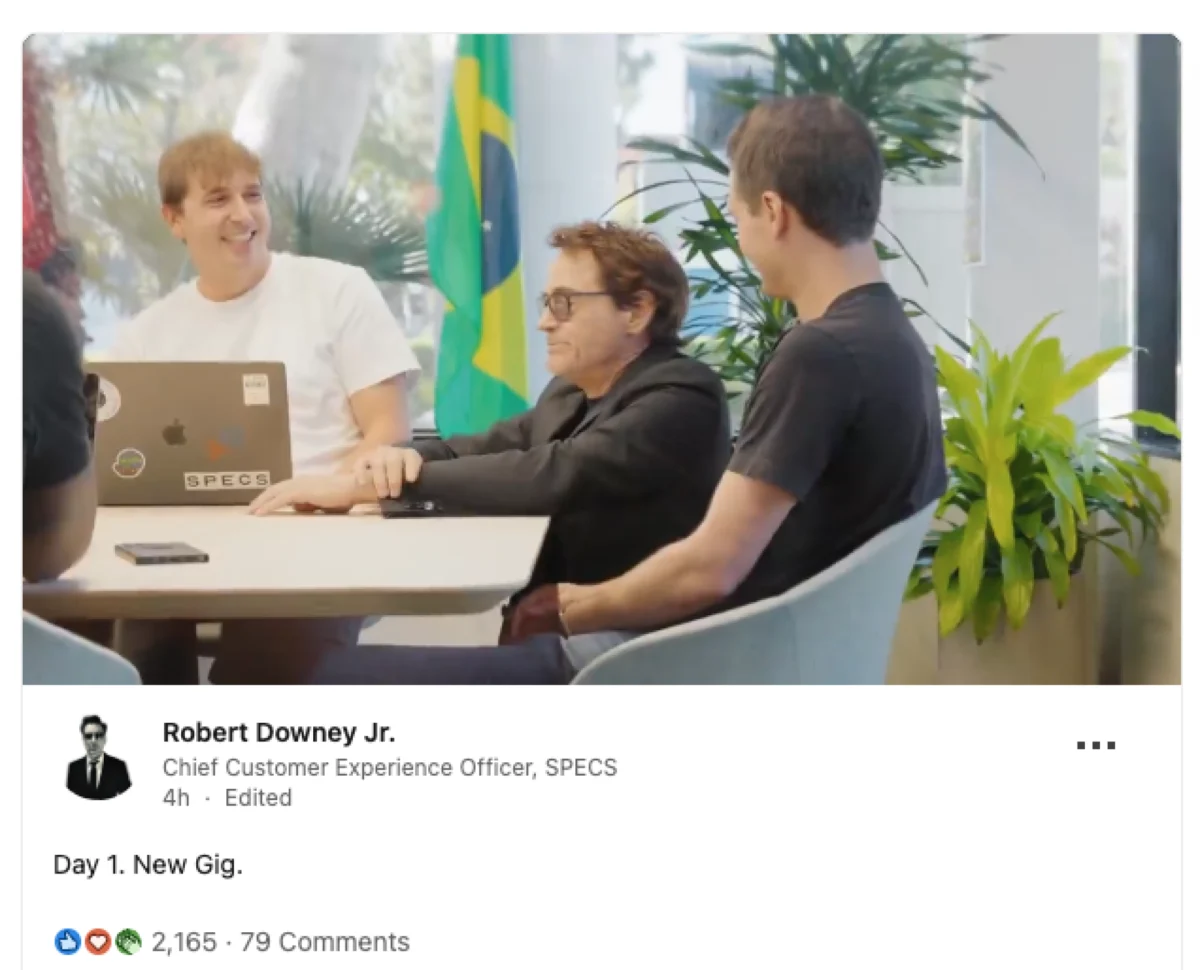
On October 20, 2026, the line between fiction and reality blurred once again. Robert Downey Jr. officially announced his appointment as the Honorary Chief Customer Experience Officer for "Specs," Snap’s ambitious foray into the augmented reality hardware market. In a move that feels tailor-made for a script, the actor is pivoting from the silver screen to the boardroom of a tech giant, tasked with bridging the gap between high-end hardware and mass-market appeal.
"Life imitates art—imitates life!" Downey remarked in a press statement, acknowledging the meta-narrative of his new role. For Snap, which has faced significant headwinds in the wearable tech sector, the move is a high-stakes gamble to secure a cultural icon who embodies the very promise they are trying to sell to the world.
The Strategic Partnership: A New Chapter for Snap
The partnership between Downey and Snap is far from a standard celebrity endorsement. According to official disclosures, the collaboration is comprehensive, spanning original content creation, custom AR development, and hardware innovation. Downey’s remit as Chief Customer Experience Officer involves deep dives into how AR can transform disparate industries, ranging from healthcare and advanced manufacturing to creative arts and education.
The collaboration kicked off with a high-profile marketing campaign that debuted during the opening game of the 2026 World Series. A 30-second spot featured Downey navigating a seamless blend of digital and physical worlds, highlighting the glasses’ utility in everyday scenarios—from professional workflows to leisurely golf outings. The content strategy is clear: Snap wants to move the conversation away from the "AI assistant" tropes that have defined recent competitors and toward a vision of a persistent, productive, and immersive digital overlay.

For Downey, the decision to join the team was not based on brand alignment alone, but on a genuine, albeit surprising, conversion experience. "Trying is believing," Downey noted in his announcement. "Having tested practically every wearable tech that’s come to market in the last 20 years, and been largely unimpressed, I was absolutely sold on SPECS within 40 seconds."
Chronology: From Tony Stark to Santa Monica
The road to this partnership has been paved with years of public engagement regarding the intersection of humanity and artificial intelligence.
- 2018: Downey executive produced and hosted the YouTube series The Age of AI, a deep dive into how emerging technologies would reshape global infrastructure.
- 2021: He began his transition into the role of a serious tech investor, participating in the $65 million Series C funding round for the AI-driven customer service firm Forethought.
- 2024: Downey made headlines for his vocal stance on AI ethics and the protection of his digital likeness, famously stating on the On With Kara Swisher podcast that his law firm would remain active in protecting his image, even after his death.
- 2025: His Broadway debut in McNeal saw him further interrogating the morality of AI, incorporating generative technology into the stage production itself.
- June 2026: Snap officially unveiled its new Specs, a standalone computer worn as glasses, setting a premium price point of $2,195.
- October 20, 2026: Downey makes the partnership "LinkedIn official," signaling his intent to take a hands-on role in the development and marketing of the hardware.
This timeline reveals a man who is not merely a celebrity face for a product, but someone who has spent nearly a decade cultivating a personal brand centered on the responsible, yet aggressive, advancement of technology.
Specs: The Hardware Behind the Hype
To understand the significance of this hire, one must understand the product. Unlike the "smart glasses" that have flooded the market with cameras and rudimentary AI features, Snap’s Specs are designed as a standalone computer. They utilize transparent lenses to layer digital content onto the physical world, controlled by advanced hand-tracking and voice recognition.
Industry analysts, including Mashable’s own hardware experts, have noted that the experience of using Specs feels more akin to the Apple Vision Pro than to standard smart frames. They offer a large, immersive workspace that travels with the user. However, they also present a physical challenge: while they are impressively compact for a full-functioning computer, they remain somewhat "chunky" compared to traditional eyewear.
Snap CEO Evan Spiegel has been transparent about the company’s long-term timeline. During an August 2026 earnings call, he addressed the $2,195 price tag, framing it as a "high consideration purchase" primarily intended for early adopters and developers. Spiegel acknowledged that true mass-market penetration is likely a goal for the end of the decade, making the "Downey Factor" essential for maintaining momentum in the interim.

Market Implications and the Competition
Snap is entering a crowded and contentious field. Meta, through its long-standing partnership with EssilorLuxottica, dominated the first half of 2026, accounting for over 81% of all AI-glasses shipments. Meta’s Ray-Ban glasses have succeeded largely by being indistinguishable from regular eyewear, a design philosophy that stands in stark contrast to the more "tech-forward" aesthetic of Snap’s Specs.
However, the market is facing a growing regulatory and social backlash. Concerns regarding the privacy implications of "always-on" recording devices have reached the European Data Protection Board (EDPB), which has recently issued strict guidelines regarding smart glasses. In response, competitors like Meta have had to implement "bricking" features to ensure that tampering with a camera leads to a dead device, a move intended to placate privacy advocates.
Snap must now navigate this minefield. By bringing in Downey—a figure associated with the "good" side of technology—the company is attempting to frame its product as a tool for empowerment rather than a surveillance device. They are actively distancing themselves from the "AI glasses" label, aiming instead to sell the concept of an "augmented companion."
Official Responses and the "Stark" Legacy
The response from the tech industry has been a mix of amusement and strategic recognition. Snap CEO Evan Spiegel publicly welcomed Downey in the comments of his LinkedIn post, noting, "Excited to collaborate together." Meanwhile, the internet, true to form, has been flooded with references to the Marvel Cinematic Universe. Some commenters have jokingly warned Downey to steer clear of "Obadiah Stane"-style corporate sabotage, a testament to how deeply the actor’s previous role is ingrained in the public consciousness.
For the average consumer, the question remains: Can a pair of glasses, even those endorsed by Iron Man, justify a $2,195 price tag?
The early evidence suggests that the value proposition lies in the utility. Whether it is a golfer perfecting their swing through real-time AR feedback or a remote worker using a virtual monitor while on the road, the use cases are beginning to materialize. As Downey suggested, "Families can share experiences instead of hunching over devices."

Conclusion: A Visionary’s Next Act
The hiring of Robert Downey Jr. is a masterstroke in narrative positioning. By aligning its hardware with the man who defined the modern vision of what a "tech billionaire" could achieve, Snap is buying more than just a brand ambassador—they are buying the credibility that only a cultural icon can provide.
The road ahead is fraught with technical, legal, and economic hurdles. The market for $2,000 eyewear is small, and the scrutiny on wearable cameras is at an all-time high. Yet, as we move toward 2027, one thing is certain: if any individual has the cultural cachet to make the "chunky" glasses of 2026 the standard-issue accessory of the 2030s, it is the man who turned a comic book invention into a global standard for the future.
Whether the reality of Specs can live up to the promise of the silver screen remains to be seen, but for the first time in a long time, the tech world is looking at a piece of hardware and seeing something that feels like the future.


 Reynand Wu

 Sagoh



 Azzam Bilal Chamdy

 Ali Ikhwan
