
 Raul Delapena Setiawan
In the rapidly evolving landscape of artificial intelligence, a quiet revolution is occurring—not in the creation of larger, more power-hungry models, but in the intelligent compression of knowledge. As AI giants race to train models with trillions of parameters, the industry is grappling with a significant bottleneck: how to move these high-performance models from massive server farms to the palm of a user’s hand. The answer lies in Model Distillation, a technique that mimics the age-old tradition of the master-apprentice relationship to create lean, efficient, and highly capable artificial intelligence.
The Evolution of Knowledge Transfer
Knowledge transfer is a cornerstone of human progress. From the oral traditions of ancient Mesopotamia, where history and law were passed down through storytelling, to the formal academic lineages of the Greek philosophers—Socrates teaching Plato, and Plato teaching Aristotle—the transmission of intelligence is how civilization advances.
In the 21st century, this lineage has taken a digital form. During the "AI Winter" of the late 20th century, when neural networks were largely dismissed, a dedicated group of researchers kept the flame alive. Figures like Geoffrey Hinton, often called the "father of modern AI," fostered a generation of innovators including Yann LeCun and Ilya Sutskever. This human lineage has now evolved into a machine-to-machine paradigm known as Model Distillation, allowing smaller neural networks to inherit the "wisdom" of their gargantuan predecessors.
What is Model Distillation?
Model Distillation, or Knowledge Distillation, is a compression technique that enables a compact, computationally efficient model—the "student"—to learn from a complex, high-performing model—the "teacher."
The primary objective is to capture the functional behavior of the teacher model in a student model that requires a fraction of the hardware resources. By doing so, developers can deploy sophisticated AI capabilities on edge devices, such as smartphones, IoT sensors, and laptops, without sacrificing significant accuracy.
The Problem: The Computational Wall
The current state of AI is defined by "frontier models." These models are characterized by trillions of parameters, requiring massive data centers, specialized GPU clusters, and enormous energy consumption. For most businesses and developers, running these models in production is financially prohibitive and technically unsustainable. Without methods to condense this intelligence, the benefits of advanced AI remain locked behind massive infrastructure requirements. Distillation provides a vital bridge between high-performance research and practical, scalable deployment.
Techniques of Knowledge Transfer
Distillation is not a one-size-fits-all process. Depending on the nature of the model and the specific constraints of the deployment environment, researchers utilize several distinct techniques to transfer knowledge.
1. Response-Based Distillation
Introduced by Geoffrey Hinton in his seminal 2015 paper, Distilling the Knowledge in a Neural Network, this is the most common form of distillation. It focuses on the "soft labels" generated by the teacher model.
While "hard labels" provide a binary answer (e.g., "This image is a dog"), "soft labels" provide probability distributions (e.g., "This image is 85% a dog, 10% a cat, and 5% a horse"). This probability distribution contains "dark knowledge"—information about the relationships between classes that the smaller student model can use to generalize its learning far more effectively than if it were trained on hard labels alone.
2. Feature-Based Distillation
Where response-based distillation looks only at the output, feature-based distillation looks at the "work." By forcing the student to match the internal activations (hidden layers) of the teacher, the student learns the teacher’s thought process. Using Mean Squared Error (MSE), the student is penalized if its internal logic deviates from the teacher’s path, effectively forcing the student to replicate the teacher’s internal feature representations.
3. Attention Distillation
Particularly relevant for Transformer-based models (the backbone of modern LLMs), this technique involves the student mimicking the "attention maps" of the teacher. By observing exactly where the teacher focuses its computational attention when processing a sentence or image, the student learns to prioritize the same critical features, significantly improving its performance on complex tasks.
Implementation: A Practical Approach in PyTorch
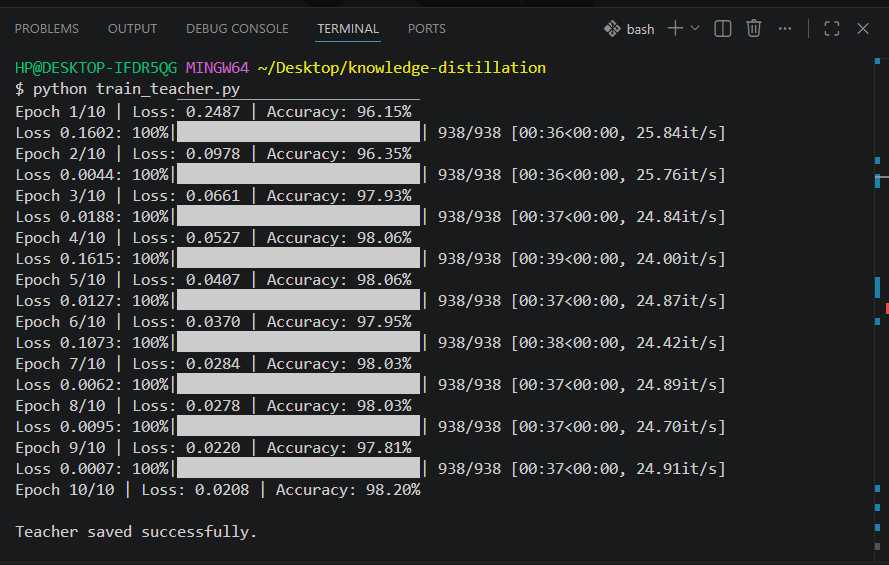
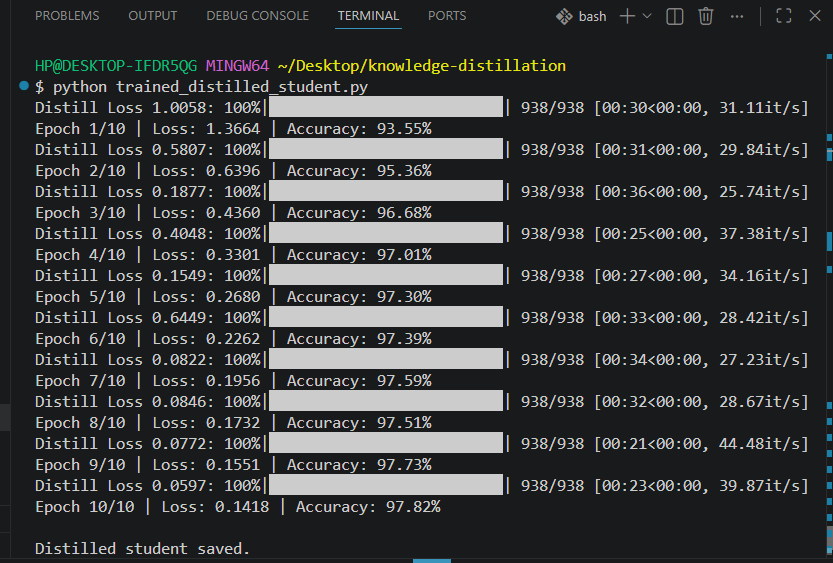
To understand distillation, one must look at the code. In a typical implementation using PyTorch, the workflow involves three primary phases:
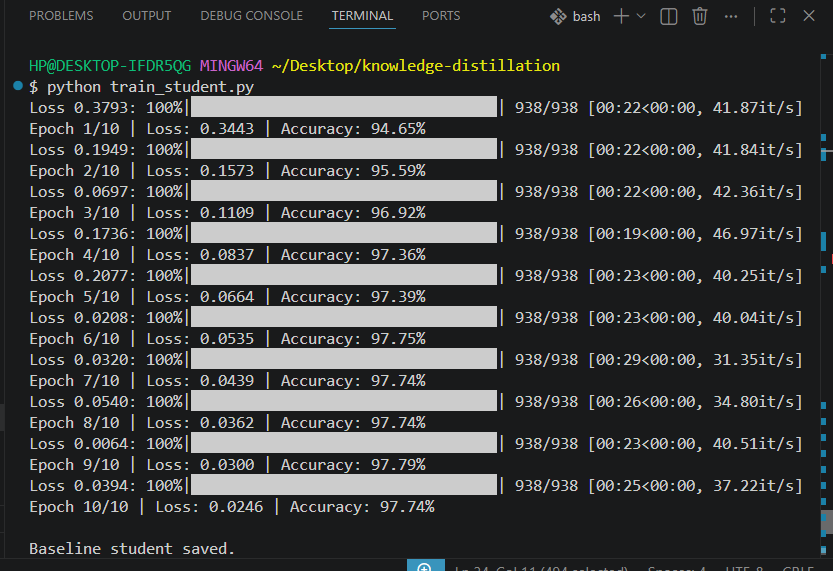
- The Teacher Phase: Train a large, high-capacity model on a dataset (such as MNIST) until it reaches peak performance.
- The Student Phase: Initialize a significantly smaller model architecture.
- The Distillation Phase: Train the student using a custom loss function that combines two components:
- Hard Loss: The standard cross-entropy loss against the ground-truth labels.
- Soft Loss (KL Divergence): The difference between the teacher’s probability distribution and the student’s probability distribution, scaled by a "temperature" parameter.
By balancing these two losses with a hyperparameter (alpha), the student effectively learns to be accurate while remaining compact.
Comparative Analysis: Distillation vs. Other Methods
While distillation is powerful, it is one of several tools in an engineer’s toolkit. It is often confused with or used alongside other optimization techniques:
- Quantization: This targets the "container" rather than the "content." By reducing the bit-width of numerical weights (e.g., moving from 32-bit floating-point numbers to 8-bit integers), quantization shrinks the model size by up to 75% without necessarily changing the architecture. Think of it as printing a textbook in a smaller font to save paper.
- Pruning: This involves removing "dead weight"—parameters that contribute little to the model’s final output. By systematically zeroing out or deleting these connections, the model becomes faster and more sparse. If distillation is summarizing a book, pruning is removing the unnecessary chapters.
- Low-Rank Factorization: This uses linear algebra to decompose large matrices into smaller ones, simplifying the mathematical operations required for inference.
Implications for the Future of AI
The implications of successful distillation are profound. As AI models become increasingly embedded in our daily lives, the ability to run these models locally is essential for both privacy and latency.
When a model runs on a user’s local device rather than in the cloud, data does not need to be sent to a server, addressing significant security and privacy concerns. Furthermore, local execution removes the latency associated with network round-trips, enabling real-time AI interactions that are currently impossible with cloud-dependent models.
Conclusion
Knowledge distillation is more than a mere optimization trick; it is a fundamental pillar of sustainable artificial intelligence. As we continue to push the boundaries of model complexity, the ability to synthesize, compress, and transmit that intelligence into smaller, accessible forms will define the next generation of technological progress.
Just as the scholars of antiquity relied on the masters who came before them, the future of efficient AI relies on our ability to distill the immense complexity of current models into the lean, agile, and powerful tools of tomorrow. By mastering these techniques, developers are not just saving compute cycles—they are democratizing the power of high-level intelligence for everyone, everywhere.
References
- Hinton, G., Vinyals, O., & Dean, J. (2015). Distilling the Knowledge in a Neural Network. arXiv:1503.02531.
- UK Government, AI Insights: Model Distillation, gov.uk.
- PyTorch Documentation, Model Optimization and Quantization Guides.
- LeCun, Y., et al. (1998). Gradient-based learning applied to document recognition. Proceedings of the IEEE.


 Jia Lissa

 Nila Kartika Wati


 Reynand Wu

 Sagoh


 Azzam Bilal Chamdy

 Ali Ikhwan
