
 Muslim
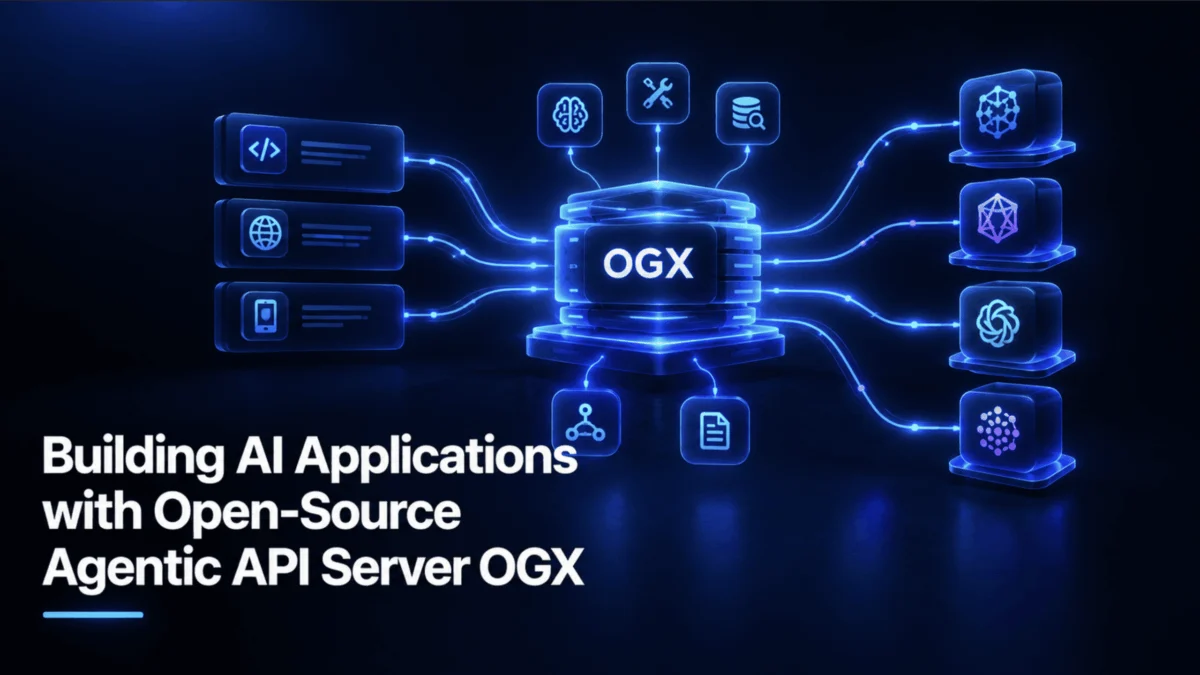
In the rapidly evolving landscape of generative AI, the distinction between a fleeting experiment and a production-ready application often comes down to the architecture beneath the hood. For developers navigating the fragmented ecosystem of agentic frameworks and local inference servers, a significant shift has arrived. The project formerly known as Meta’s "Llama Stack" has undergone a strategic rebranding and mission expansion: welcome to OGX.
This transformation is more than a mere change of nomenclature. It represents a pivot toward a model-agnostic, multi-SDK, and production-grade philosophy. For those currently researching agentic API servers, OpenAI-compatible interfaces, or the complexities of local AI application development, this rebranding is a critical milestone. Understanding OGX is the key to bypassing the confusion that often plagues the fast-moving world of open-source AI.
The Evolution: From Llama Stack to OGX
To understand where we are, we must look at the chronology of this transition. Meta’s Llama Stack was initially introduced to provide a standardized way to interact with their Llama family of models. However, the community’s requirements quickly outgrew a single-vendor scope. Developers demanded the ability to swap models—moving from Llama to Mistral, Qwen, or proprietary alternatives—without tearing down their entire infrastructure.
OGX emerged as the evolution of that ambition. By severing the explicit branding tie to a single model provider, the project has positioned itself as a universal interface for the modern AI stack. As noted on the official GitHub repository, the shift to OGX is a deliberate move to support "any model" and "any infrastructure." With over 8,400 GitHub stars and 1,400 forks, the project has solidified its standing as an established, community-driven pillar in the open-source landscape.
Core Pillars: What Makes OGX Unique?
At its heart, OGX functions as a drop-in replacement for the OpenAI API, but with a critical difference: you maintain complete sovereignty over the infrastructure. Whether you are running a lightweight instance on a local laptop, scaling a cluster in a datacenter, or deploying via cloud providers, the API surface remains consistent.
1. The Pluggable Provider Architecture
The primary value proposition of OGX is its provider-agnostic design. During the development phase, you might connect your application to Ollama for cost-free, local inference. As your application matures and moves toward production, you can seamlessly migrate to vLLM or a managed cloud service provider. Because OGX sits as a middleware layer, your application code remains untouched. This decoupling of the business logic from the underlying model provider is the "holy grail" for enterprise-grade AI development.
2. Beyond Chat: The Responses API
While many servers focus strictly on basic chat completions, OGX introduces the "Responses API." This feature set is designed for complex, agentic workflows. It handles server-side orchestration, multi-turn tool calling, and deep integration with Model Context Protocol (MCP) servers. Furthermore, it includes native support for Retrieval-Augmented Generation (RAG) through built-in file search. By supporting the OpenAI, Anthropic, and Google GenAI SDKs, OGX ensures that developers aren’t locked into a specific vendor’s client library.
Practical Implementation: Building "DocBrain"
To demonstrate the power of OGX, let us consider the construction of "DocBrain"—an agentic application designed for document intelligence.
Prerequisites and Setup
Modern AI development requires a modern toolkit. We recommend using uv, the high-performance Python package manager. Unlike one-off, throwaway installation commands, uv provides a robust foundation for maintainable projects.
Installation Sequence:
# Ensure Ollama is running and the model is ready
ollama pull llama3.2:3b

# Project initialization
uv init docbrain
cd docbrain
uv add ogx openai
By utilizing uv init, developers establish a professional project structure that scales from a five-minute prototype to a production-ready service. The inclusion of the standard openai Python client is a strategic choice; because OGX mirrors the OpenAI API schema, DocBrain requires zero proprietary client code to function.
Validating the Infrastructure
Once the server is initialized via uv run ogx go, it operates on localhost:8321. Because OGX prioritizes security, it uses HTTPS by default. Developers can verify the health of the connection with a simple cURL command:
curl -k -s https://localhost:8321/v1/models
This request confirms that the server is active, the provider (Ollama) is correctly linked, and the model registry is populated.
Implementing Retrieval-Augmented Generation (RAG)
In traditional RAG implementations, developers often spend excessive time managing the lifecycle of a vector database—chunking text, calculating embeddings, and handling database connectivity. OGX abstracts this entire layer.
By using client.files.create with purpose="assistants", the developer uploads a document, and client.vector_stores.create automatically indexes that document. When a query is passed to the responses.create method, the file_search tool handles the retrieval process behind the scenes. The model doesn’t just receive raw text; it receives context that has been programmatically retrieved and grounded, leading to significantly higher accuracy and reduced hallucinations.
Agentic Capabilities: The Custom Tool Paradigm
True agency is defined by an application’s ability to take action, not just provide summaries. In our DocBrain project, we define a custom Python tool, save_action_item, which allows the model to interact with the local file system.
The Logic of Persistence
We structure our action items using JSON Lines (.jsonl). This is a deliberate design choice for robustness. Appending a single line to a file is an atomic operation that is less prone to corruption than attempting to read, parse, and rewrite a large JSON object—especially in an asynchronous, agentic environment.
Defining the Schema
The ACTION_ITEM_TOOL_SCHEMA acts as the interface between the model’s reasoning and our Python code. By providing a strict, descriptive schema, we guide the LLM to understand when it is appropriate to trigger an action. The inclusion of a priority enum ensures that the data remains clean and useful for downstream processes.
Implications for the AI Ecosystem
The transition from Llama Stack to OGX reflects a broader maturation of the AI industry. We are moving away from the "model-centric" era, where the specific weights of an LLM were the only variable that mattered, toward an "infrastructure-centric" era.
1. Future-Proofing Applications
The ability to switch providers (e.g., from a 3B-parameter model on a laptop to a 70B-parameter model on an H100 GPU cluster) without rewriting the application code is a massive competitive advantage. It allows teams to iterate quickly without fear of vendor lock-in.
2. Standardization of Agentic Workflows
OGX is helping define the standard for how agents interact with their environments. By integrating file search, tool calling, and memory management into a unified API, it reduces the "glue code" burden that typically consumes 70% of a developer’s time when building agents.
3. Democratization of Enterprise Tech
Features that were previously restricted to proprietary, enterprise-only platforms—such as server-side RAG and robust tool orchestration—are now accessible to any developer with a local machine and a basic understanding of Python. This lowers the barrier to entry for small businesses and independent developers who need production-grade tools but cannot afford the overhead of managed, high-cost AI platforms.
Conclusion
OGX represents the bridge between the experimental, "notebook-based" world of generative AI and the rigorous, stable world of software engineering. By embracing a provider-agnostic, open-source approach, it provides a stable foundation for the next generation of intelligent applications.
As we look toward the future, the winners in the AI space will not necessarily be those who have the best model, but those who have the best architecture to manage those models. Whether you are building a document assistant like DocBrain or a more complex autonomous agent, OGX offers the tools to ensure your application remains flexible, scalable, and genuinely useful.
The message for developers is clear: stop worrying about the API wrapper and start building the platform. With OGX, you are building on a foundation designed to evolve alongside the industry, ensuring that your work today is still relevant and functional in the production environments of tomorrow.

 Neng Nana

 Evan Lee Salim

 Raul Delapena Setiawan

 Reynand Wu

 Sagoh


 Azzam Bilal Chamdy

 Ali Ikhwan
