
 Dwi Wanna
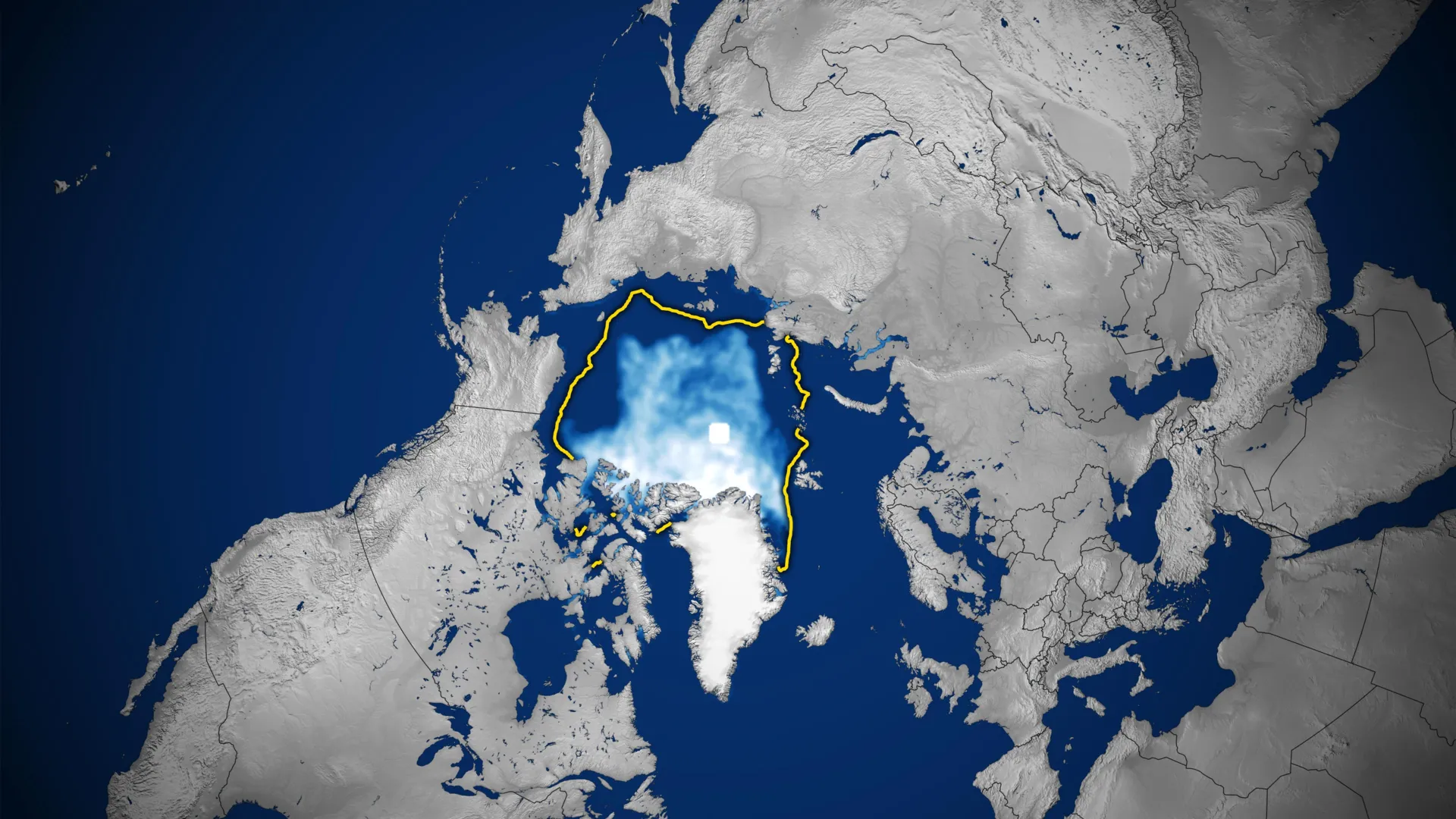
For nearly fifty years, the Arctic has served as the planet’s early warning system—a vast, frozen laboratory where the impacts of a warming world are written in shifting sheets of ice. New data synthesized by NASA and the National Snow and Ice Data Center (NSIDC) confirm that this once-resilient environment is undergoing a profound and troubling metamorphosis. The Arctic Ocean, characterized for millennia by its reliable seasonal expansion and contraction, is losing its structural integrity, transitioning from a domain of thick, ancient ice to one dominated by fragile, seasonal slush.
The Architecture of Decline: Main Facts
The Arctic’s seasonal rhythm is dictated by the sun. Throughout the long, dark polar winter, sea ice accumulates, reaching its maximum extent in March. As the sun returns and temperatures climb, the ice pack retreats, hitting its annual minimum in September. While this cycle has persisted for thousands of years, the era of satellite observation—beginning in late 1978—has exposed a structural decline that is both relentless and systemic.
In 2026, the Arctic reached its annual minimum on September 12, covering just 4.6 million square kilometers (1.78 million square miles). This figure, while not the absolute record low, ties the minimums observed in 2008, 2010, and 2025, placing it among the 10 lowest levels since records began. More importantly, the data reveals that the Arctic is not just shrinking in area; it is thinning in depth. The "old guard" of Arctic ice—multiyear ice that survives multiple melt seasons—is rapidly disappearing, replaced by thinner, first-year ice that is highly susceptible to the intensifying heat of the summer sun.
A Chronology of a Changing Pole
The narrative of the Arctic is best understood through the timeline of the satellite era.
- 1978–1999: The Establishing Baseline. With the launch of the Nimbus-7 spacecraft, scientists gained the ability to monitor the entire Arctic basin regardless of cloud cover. During these two decades, the seasonal cycle remained relatively consistent, though the first tremors of warming were beginning to register.
- 2000–2012: The Era of Acceleration. The turn of the millennium marked a dramatic shift. The rate of ice loss accelerated, resulting in a series of record-breaking lows. The defining moment of this period occurred in September 2012, when the Arctic reached the smallest summer extent ever recorded, a catastrophic low that signaled to the scientific community that the Arctic was entering a new, precarious state.
- 2013–2024: Fluctuations and "Stabilization." Interestingly, the post-2012 era has seen a period of relative plateauing in summer ice loss. Scientists have identified this as a "stalling" rather than a recovery. Factors such as increased cloud cover have provided a temporary thermal blanket, shielding the ice from direct solar radiation. However, this has not reversed the underlying warming trend.
- 2025–2026: The New Normal. Recent data indicates that even winter ice is failing to recover. In March 2026, the annual maximum tied the 2025 record for the lowest winter peak ever observed. This suggests that the "recharging" phase of the ice cycle is now as compromised as the melting phase.
Supporting Data: The Science of Measurement
Monitoring the Arctic is an exercise in technical precision. Scientists utilize passive microwave sensors, which detect the microwave energy naturally emitted by the Earth’s surface. Because sea ice emits higher levels of this energy than liquid water, researchers can generate highly accurate maps of the ice edge.
Crucially, microwave sensors can "see" through clouds. In a region frequently shrouded in fog and storms, this technology is vital. Since the early days of the Nimbus-7 mission, the observation network has expanded to include instruments from the Defense Meteorological Satellite Program (DMSP), NASA’s Aqua satellite, and most recently, the Japan Aerospace Exploration Agency’s GCOM-W satellite.
Despite this technological sophistication, gaps remain. The "pole hole"—a circular region at the geographic North Pole—remains outside the sensor view of many satellites. To maintain continuity in their datasets, researchers must make informed assumptions based on surrounding conditions, treating this hole as ice-covered. While these assumptions are standard, they highlight the inherent difficulty of mapping the most remote reaches of our planet.
Official Perspectives and Scientific Consensus
The scientific community is largely in agreement: natural climate variability, such as the Arctic Oscillation—a pressure pattern that dictates wind and temperature flows—plays a significant role in year-to-year changes. However, experts emphasize that these natural patterns cannot explain the persistent, long-term downward trend.
"We are seeing a convergence of natural variability and human-induced warming," says one lead researcher associated with the NSIDC. The consensus is that while a cold year might occasionally yield a higher-than-average ice extent, the trend line is unmistakably negative. The reduction in sea ice is not merely a statistical anomaly; it is a fundamental shift in the Arctic’s energy balance. As white ice—which reflects sunlight back into space—is replaced by dark, open ocean, the region absorbs more heat, creating a feedback loop that accelerates further melting.
Implications: A Future Without Ice?
The implications of a melting Arctic extend far beyond the polar circle. The most alarming projection currently circulating in the scientific literature is that the Arctic Ocean could become essentially "ice-free" during the summer at least once before the middle of the 21st century.
An ice-free Arctic would represent one of the most profound environmental shifts in human history. The loss of multiyear, resilient ice fundamentally alters the habitat for species that rely on the ice for hunting, breeding, and migration. For indigenous communities who have lived in harmony with the seasonal ice cycle for generations, the rapid change threatens the survival of traditional lifestyles and food security.
Furthermore, the loss of the Arctic ice cap has global climate consequences. As the Arctic warms, it alters the temperature gradient between the pole and the equator, potentially shifting the jet stream and affecting weather patterns across the Northern Hemisphere. This could result in more frequent extreme weather events, from heatwaves in Europe to unseasonable cold snaps in North America.
Conclusion: The Finality of the Shift
The transition from a frozen, permanent northern cap to a seasonal, ephemeral slush is not a distant threat—it is a present-day reality. For nearly fifty years, satellites have provided us with a front-row seat to this transformation. What began as a scientific curiosity has become a clarion call for the global community.
As we look toward the 2030s and beyond, the data serves as a stark reminder that the Earth’s climate system is interconnected. The ice in the Arctic does not disappear in a vacuum; it vanishes in response to a changing atmospheric composition and a warming ocean. The loss of the oldest, thickest ice is a permanent change—a loss of the "old guard" that kept our planet’s climate in balance for centuries. While the rate of loss may fluctuate due to cloud cover or wind patterns, the trajectory is clear: the Arctic is thinning, retreating, and fundamentally changing before our very eyes.


 Raul Delapena Setiawan

 Laily UPN

 Reynand Wu

 Sagoh


 Azzam Bilal Chamdy

 Ali Ikhwan
