
 Nana Wu
For many engineering organizations, the allure of building an internal AI knowledge system is seductive. The initial hurdle—setting up a vector database, integrating a few key APIs, and pointing a Retrieval-Augmented Generation (RAG) pipeline at internal documentation—often feels like a weekend project. To the uninitiated, it is a straightforward engineering task.
However, reality sets in roughly six months later. What was intended to be a secondary project often balloons into a full-time, resource-heavy mandate for the platform team. This phenomenon is not the result of underestimated database complexity; it is the result of conflating a "vector store" with a "governed knowledge pipeline." While the former is a technical component, the latter is a complex, continuous-maintenance organism that must navigate issues of trust, compliance, and institutional scale.
The Five-Stage Anatomy of a Production Pipeline
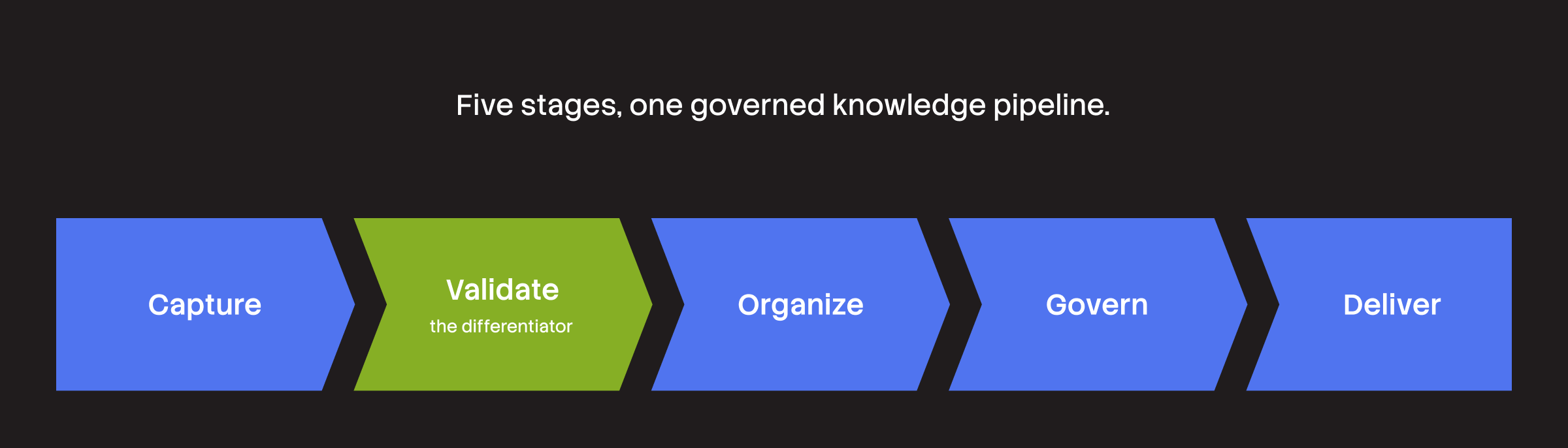
To survive the lifecycle of an enterprise-grade AI deployment, engineering teams must move beyond the "prototype" mindset. A sustainable knowledge pipeline is comprised of five distinct, interconnected stages: Capture, Validate, Organize, Govern, and Deliver.
1. Capture: The Illusion of "Set and Forget"
The initial phase involves connecting to various data silos—Slack, Jira, Confluence, GitHub, and internal wikis. While writing a connector is technically simple, maintaining it as vendor APIs evolve is a Sisyphean task. Each tool update risks breaking the connection, requiring manual intervention, permission re-authentication, and constant adjustments. Furthermore, raw ingestion leads to redundancy; without intelligent deduplication, the AI agent becomes confused by multiple, conflicting versions of the same document.
2. Validate: The Core Differentiator
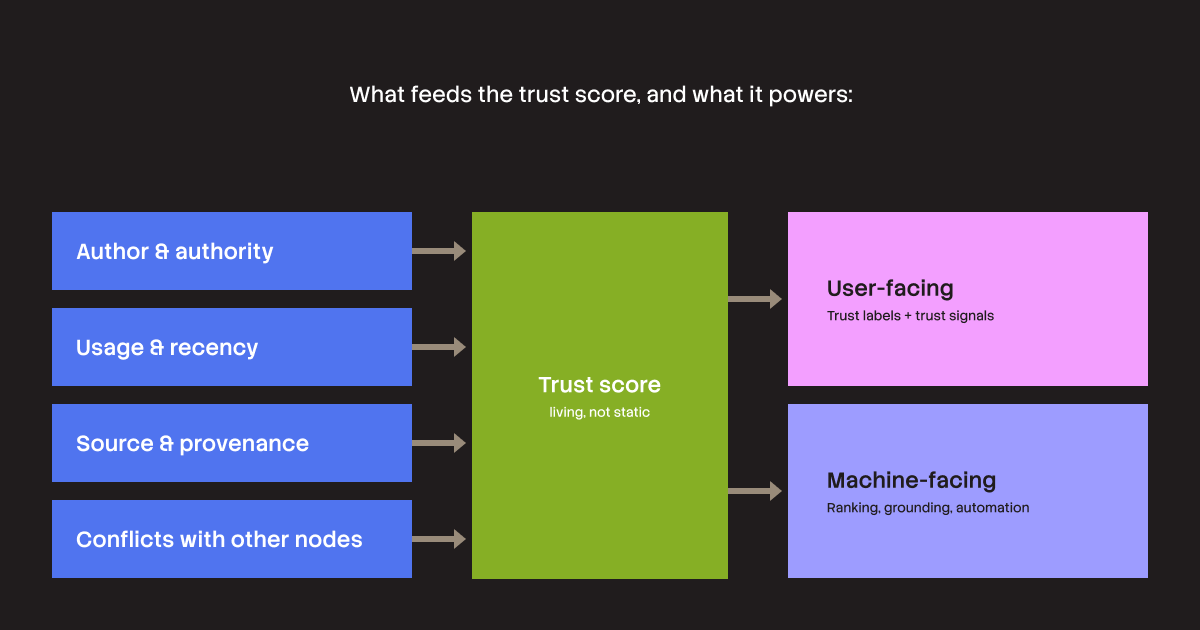
The greatest failure in enterprise AI is treating all ingested content as equally trustworthy. In a raw pipeline, a stale, deprecated design document is weighted with the same authority as a newly approved architectural standard. A production-grade system requires a validation layer that assigns a "trust score" to every piece of knowledge, evaluating factors like authorship, usage frequency, and recency.
3. Organize: Contextual Hierarchy
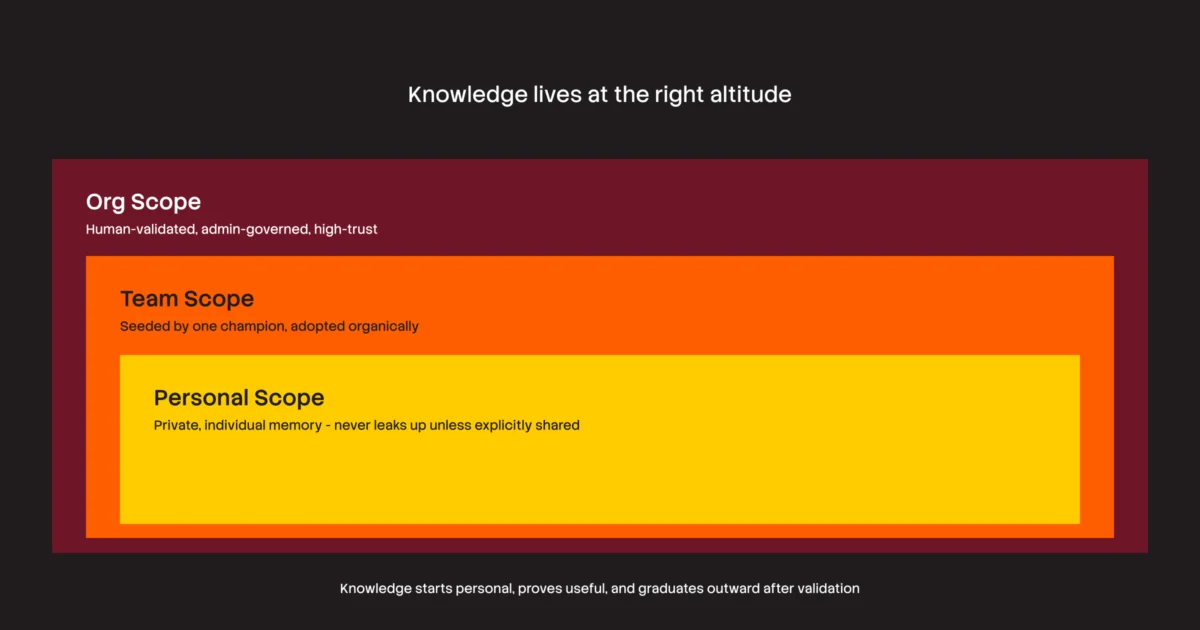
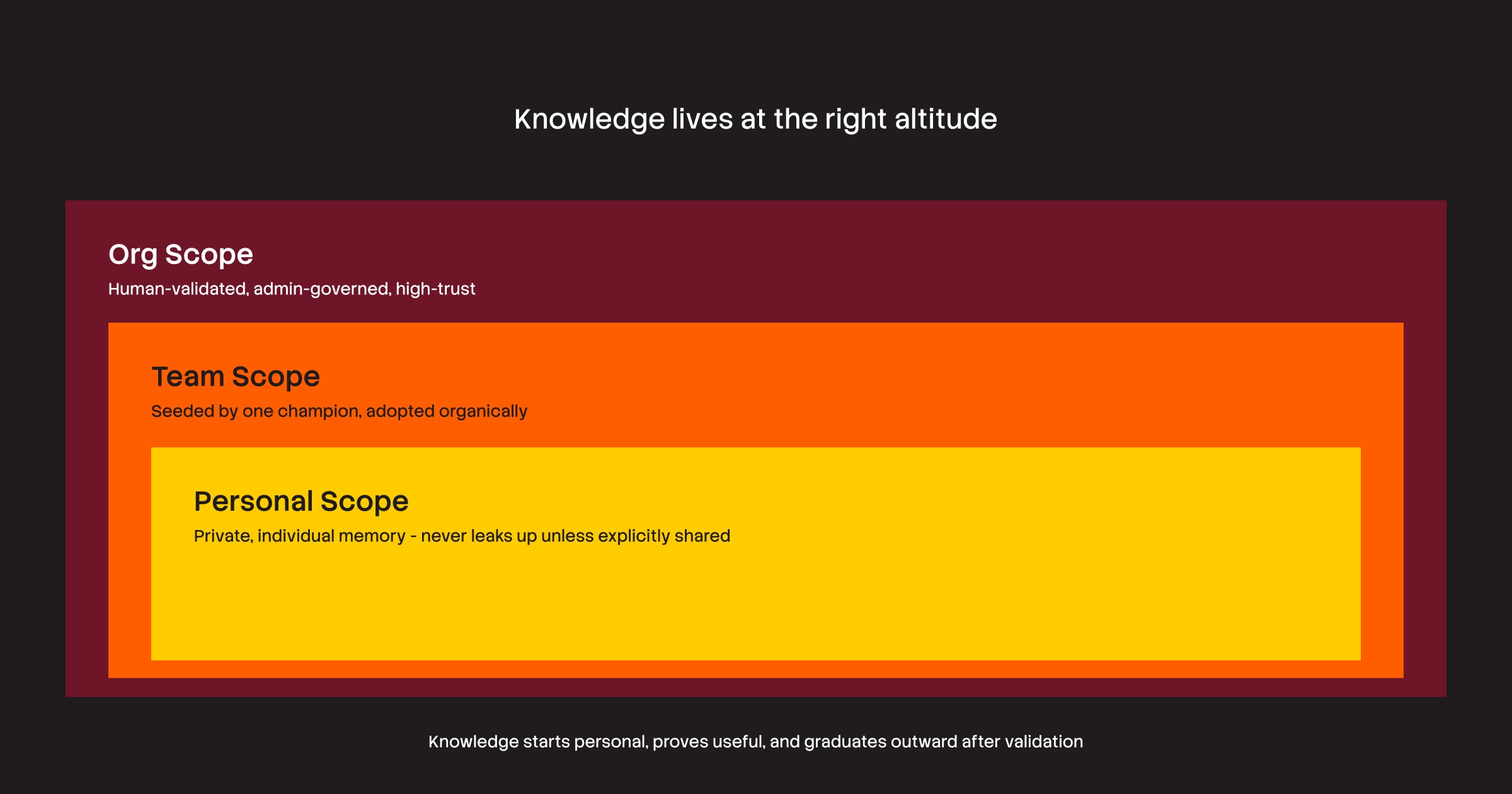
Manual filing is the death of knowledge management. Effective systems utilize "scopes"—automated, hierarchical boundaries that categorize knowledge as Personal, Team-based, or Organization-wide. This ensures that knowledge naturally flows to the right audience without requiring users to manually tag or categorize every entry.
4. Govern: Compliance and Security
Security teams do not care about vector embeddings; they care about audit trails, bulk permission management, and data sovereignty. A robust pipeline must integrate with existing Identity Providers (IDPs) and provide granular visibility into who accessed what, satisfying the requirements of compliance audits that are inevitable in a scaling enterprise.
5. Deliver: The End-User Experience
The final stage is the interface between the user and the knowledge base. This can be explicit—where a user queries the system—or proactive, where the system identifies potential bottlenecks based on historical data. By utilizing the Model Context Protocol (MCP), organizations can ensure their agents are querying a standardized, validated state of the truth rather than a stale snapshot.
Chronology of a Failed Build: Why Projects Stall
The lifecycle of an "in-house" AI project usually follows a predictable trajectory.
Months 0–2: The Honeymoon Phase.
Engineers successfully stand up a vector database. They run a proof-of-concept (PoC) with a few team members. The RAG pipeline returns impressive answers, and the leadership team is optimistic.
Months 3–4: The Maintenance Debt Accumulates.
The first major update to a third-party tool occurs. The pipeline breaks. The team spends weeks manually fixing connections. Simultaneously, users start reporting "hallucinations" because the AI is retrieving obsolete data that was never purged from the vector store.
Months 5–6: The Governance Crisis.
A security review highlights a lack of audit logs and improper permission inheritance. The legal team demands proof that private, sensitive data is not leaking into public-facing AI responses. The platform team realizes that their "weekend project" is now a full-time, high-stakes compliance nightmare.
Month 6+: The Pivot.
The team either concedes that they are in the "business of knowledge management" rather than their core product, or they seek a platform-native solution to offload the overhead of the pipeline.
Supporting Data: The Cost of Miscalculation
The costs associated with maintaining a bespoke pipeline are not static; they compound. Consider the following breakdown of what is required versus what is assumed:
| Stage | The "Easy" Assumption | The Reality of Maintenance |
|---|---|---|
| Capture | Plug and play connectors | Constant API updates and permission re-syncing |
| Deliver | Connecting LLMs to data | Ensuring cross-agent parity in answers |
| Govern | Basic role-based access | Full audit history and compliance reporting |
| Organize | Manual folder structures | Dynamic, auto-populated knowledge scoping |
| Validate | Simple user upvotes | Multi-signal trust scoring and SME intervention |
The "human interruption" metric is the most critical KPI in this ecosystem. If an employee must manually correct an AI’s answer, the pipeline has failed. The goal should always be to drive the number of manual human interventions toward zero through automated validation and trust-decay mechanisms.
Official Perspectives: The Build vs. Buy Dilemma
Industry experts and engineering leaders are increasingly vocal about the distinction between technical capability and organizational focus.
"If knowledge infrastructure is your competitive advantage—if you are building a search engine or a proprietary data analytics platform—then by all means, own the pipeline," says a lead infrastructure architect at a major software firm. "But for the vast majority of product companies, every hour spent tuning a vector database is an hour stolen from the product roadmap. You aren’t just building a feature; you are becoming an IT infrastructure provider."
The consensus is shifting toward standardized, composable protocols. The Model Context Protocol (MCP) is leading this transition, allowing teams to move away from bespoke, "spaghetti" integrations toward a unified way of querying enterprise truth.
Implications for the Future of Enterprise AI
The implication of this shift is clear: Enterprise AI is moving from the era of "Data Ingestion" to the era of "Knowledge Governance."
Trust is the New Currency
As agents take on more consequential tasks—such as informing product strategy or answering complex support queries—the provenance of information becomes as important as the answer itself. Companies that fail to implement a formal trust-score model will find that their AI agents become liabilities rather than assets. When an AI provides a faulty answer, the ability to trace it back to a specific document, approved by a specific expert, is no longer optional—it is the difference between a successful implementation and a total loss of trust.
Automation of the Knowledge Lifecycle
The most successful organizations are those that automate the lifecycle of knowledge itself. This includes:
- Automatic Decay: Recognizing that knowledge has a "shelf life" and prompting owners for revalidation.
- Scope Inheritance: Ensuring that permissions are not just applied to files, but inherited through the organizational structure of the company.
- Living Nodes: Treating knowledge not as a static block of text, but as a "knowledge node" that carries metadata regarding its owner, its source, and its level of authority.
The Strategic Pivot
For leadership teams, the decision to build or buy hinges on the question of focus. Engineering teams are expensive and finite. By choosing to offload the burden of connector maintenance, validation logic, and compliance-grade governance to a platform-native solution, companies can reclaim their engineering cycles. They can focus on building the agents that deliver value to customers, rather than the plumbing that keeps those agents from hallucinating.
Ultimately, the most sophisticated AI stack in the world is useless if it is built on a foundation of stale, unverified, and ungoverned data. As the enterprise AI landscape matures, the focus will inevitably shift from "how fast can we get this running" to "how can we ensure this remains trustworthy for the next decade." The companies that realize this sooner will be the ones that win the long-term race for institutional efficiency.
For more information on modernizing your internal AI knowledge architecture, explore resources on Stack Internal, designed to automate the full pipeline from capture to delivery.


 Jia Lissa

 Nila Kartika Wati

 Raul Delapena Setiawan

 Reynand Wu

 Sagoh


 Azzam Bilal Chamdy

 Ali Ikhwan
