
 Jia Lissa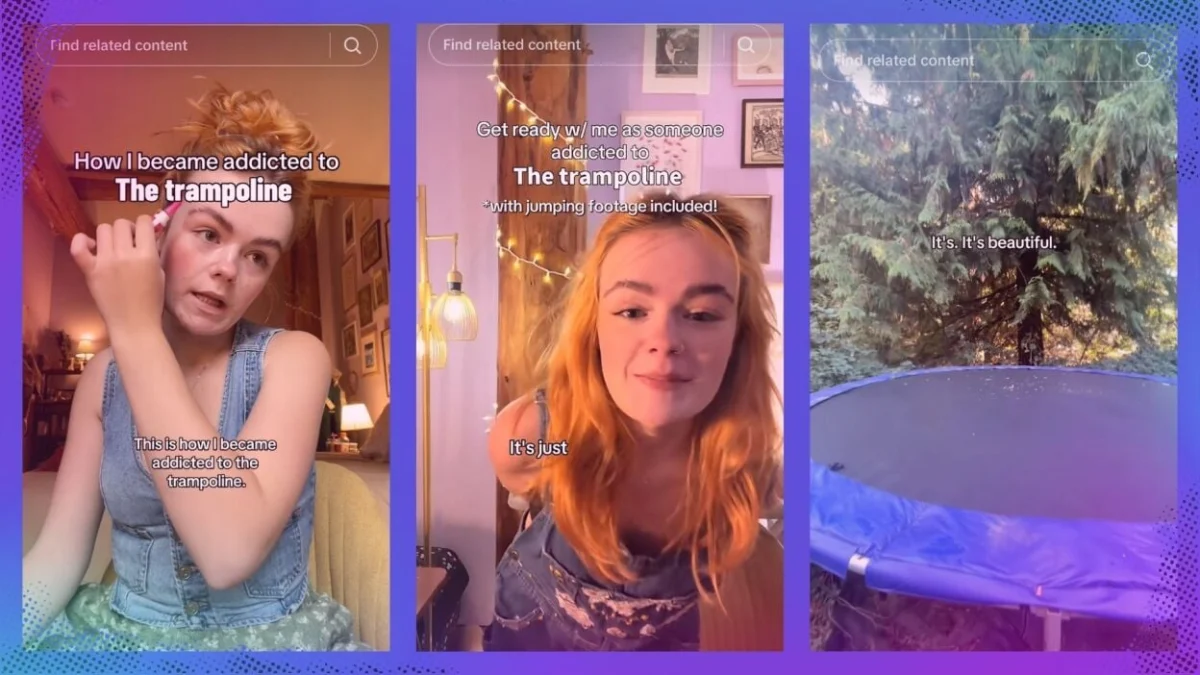
By Crystal Bell
In an era defined by the "hustle culture" of 5:00 a.m. cold plunges, meticulously tracked macro-nutrients, and the relentless pressure to monetize every waking hobby, the internet has become a crowded theater of performative self-improvement. Yet, amidst the noise of productivity hacks and "that girl" morning routines, a quiet, rhythmic anomaly has emerged from the depths of social media.
TikTok creator @whatifimjustagirl has captivated millions with a habit that is as perplexing as it is strangely profound: she spends nearly every night, usually between the hours of midnight and 3:00 a.m., jumping on a backyard trampoline. For seven years, this nocturnal ritual has remained a constant in her life—a solitary, gravity-defying escape from the pressures of the waking world.
The Ritual: A Midnight Escape from Reality
The routine is remarkably simple, lacking the trappings of a "wellness trend." There are no branded energy drinks, no specialized athletic sponsors, and no complex training regimens to follow. It is, quite literally, just a woman and her trampoline under the cover of darkness.
Clad in a rotation of comfortable attire—often leggings and a flannel for the chill of the midnight air—she dons a pair of headphones and steps into the backyard. For up to two hours, she bounces. To the casual observer, it might look like a surreal scene out of a late-night indie film. To her, it is a non-negotiable anchor.
"I look forward to it every single day," she shared in a recent video that has since garnered millions of views and sparked a wave of discourse across digital platforms. This isn’t a fitness challenge; she isn’t counting calories or tracking heart rate variability. She is simply existing in a state of rhythmic motion, finding peace in the solitude of the night.
A Chronology of Seven Years
While the viral fame is new, the habit is not. Seven years of consistent nightly activity marks a significant commitment—a span of time that encompasses life transitions, career shifts, and the rapid evolution of the internet itself.
- Year 1-3: The Private Habit: In the initial years, the trampoline was a strictly personal sanctuary. It served as a decompression tool, a way to process the stressors of the day without the watchful eye of an online audience.
- Year 4-6: The Integration: As she became more comfortable with the practice, it evolved into a form of moving meditation. It was during these middle years that she began to realize the profound impact the activity had on her mental equilibrium.
- Year 7: The Viral Spotlight: In 2026, the creator began documenting her late-night sessions on TikTok. The transparency of her content—showing the reality of being awake while the rest of the world sleeps—struck a chord with a generation of viewers struggling with burnout and existential fatigue.
The Mental Health Discourse and Public Scrutiny
With viral fame comes unsolicited armchair psychology. As her videos gained traction, the comment sections were flooded with questions—some curious, others diagnostic. A significant portion of the audience began speculating about her neurodivergence, specifically suggesting that her repetitive, high-energy behavior was a manifestation of autism.

The creator addressed these claims with characteristic candor. "I’m a girl who’s addicted to the trampoline," she noted in a follow-up video, taking a firm stance against the tendency of social media to pathologize unconventional joy.
She clarified that she does live with OCD (Obsessive-Compulsive Disorder), which she acknowledges plays a role in her attachment to the structure of the ritual. However, she was quick to draw a line: "Yes, is my obsession with the trampoline a little extreme? Yes. Does my OCD play a factor in that? Yes, but that’s not why I jump. I don’t think there needs to be a diagnosis for it."
Her refusal to frame her happiness through a clinical lens serves as a powerful commentary on how we view modern behavior. In a digital age where we are constantly encouraged to label our quirks and monetize our interests, her insistence that she is "just a girl on a trampoline" is an act of quiet rebellion.
The Science of Repetitive Motion
While the creator rejects the need for a clinical diagnosis, behavioral scientists might find her routine fascinating. The act of jumping on a trampoline—or "rebounding"—has long been associated with the stimulation of the lymphatic system and the release of endorphins.
However, the psychological benefits of such a routine go beyond the physical. Rhythmic, repetitive movement is a known mechanism for self-regulation. When the body engages in a predictable, repetitive physical task, the brain is often able to enter a "flow state"—a mental condition where a person is fully immersed in an activity, characterized by a feeling of energized focus and full involvement.
For many people, this is achieved through long-distance running, swimming, or even knitting. For this creator, it happens to be the act of bouncing. By doing this in the dead of night, she also minimizes external stimuli, allowing for a sensory environment that is entirely under her control.
Implications: A Critique of Wellness Culture
The viral nature of this story highlights a growing trend in digital culture: the "anti-wellness" movement. People are becoming increasingly exhausted by the commodified versions of health that dominate Instagram and TikTok. We are tired of the $15 smoothies, the $400 sneakers, and the complex morning routines that require a PhD in time management to execute.
This creator’s routine resonates because it is fundamentally inaccessible in its simplicity. It requires a backyard, a trampoline, and the ability to forgo sleep—none of which are "hacks" that can be sold in an online course. She represents a departure from the "optimization" mindset. She isn’t trying to be more productive; she isn’t trying to "crush" her goals by 8:00 a.m. She is, in the most literal sense, just jumping.

The Barriers to Adoption
Of course, it is important to acknowledge the privilege inherent in this routine. As social media users have pointed out, not everyone has the luxury of a backyard or the silence required to jump at 2:00 a.m. without disturbing neighbors. Furthermore, the physical toll of repetitive jumping on joints is a reality that cannot be ignored by those who might be inspired to try this themselves.
Yet, the core lesson remains: the secret to happiness might not be found in the next big wellness trend, but in the rediscovery of play. Most adults view play as something that is "finished" in childhood. We treat leisure time as a reward for work, rather than a necessary component of human existence.
Finding Your Own "Trampoline"
The widespread fascination with this TikTokker is a mirror held up to society. We are looking for something that is ours, something that isn’t for the "algorithm," and something that isn’t for our bosses.
Whether it is reading, gardening, stargazing, or—in this case—bouncing on a trampoline in the dark, the importance of finding a "third space" for the mind is paramount. As the digital world continues to encroach upon our private lives, the need for these unmonetized, un-optimized moments of joy becomes more critical than ever.
Conclusion: The Quietude of the Night
As the world moves toward an increasingly connected and scrutinized future, stories like this one serve as a reminder of the power of simplicity. The creator, who prefers to let her actions speak louder than any influencer-style explanation, has inadvertently become a figurehead for a generation that is tired of the grind.
She hasn’t found a "secret" to happiness in the way a lifestyle guru might sell it. She hasn’t unlocked a life-changing hack. She has simply carved out a space in the world where she can be herself, free from the expectations of others, under the vast, quiet expanse of the night sky.
Perhaps that is the most radical thing one can do in 2026. In a world that demands we be "on" at all times, there is a profound, quiet strength in choosing to go outside at midnight, putting on your headphones, and simply jumping. No goals, no growth, no metrics—just the joy of the bounce.


 Nana
Nana
 Asep Darmawan
 Layla Zulfa

 Pevita Pearce
 Rifan Muazin

 Iffa Jayyana